Almost half of allergy sufferers are sensitized to mites, whereby the most important triggers of a mite allergy are the two house dust mites Dermatophagoides pteronyssinus and farinae. Most allergens of these two species show a high sequence homology of 80-85%, so that the IgE antibodies cross-react.
Allergies to tropical mites and storage mites show a lower homology, which does not lead to cross-reactivity. However, storage mites can also be found in house dust, which means that not only bakers and farmers are affected by these allergies.
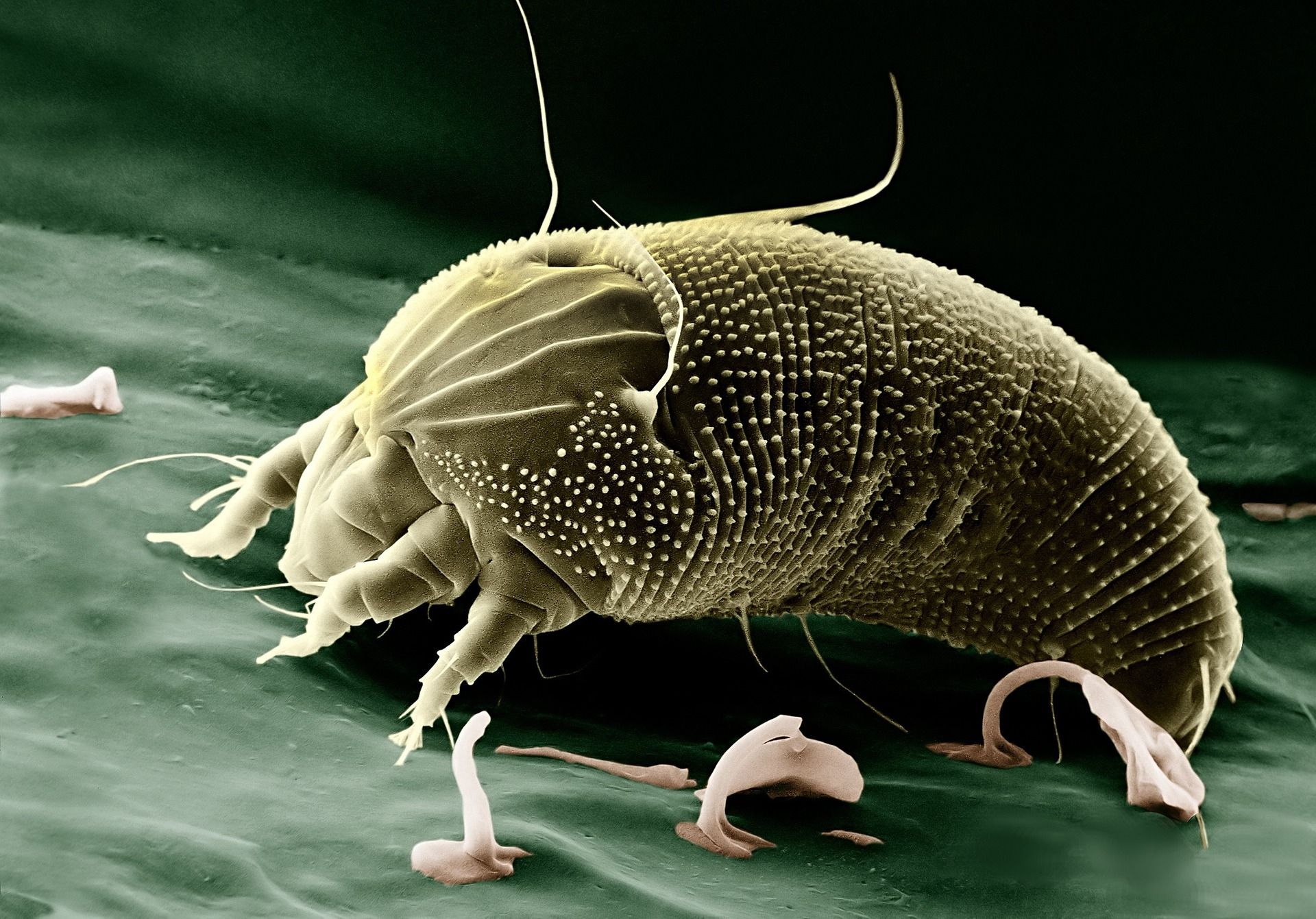
House dust mite allergies
Over 20 allergens have already been defined. Der p 1 and Der f 1 are the main allergens to which 80-90% of mite allergy sufferers react and which are found in high quantities in house dust. Another potent allergen is Der p 23, which is present as a monosensitization in about 5% of cases.
It is interesting to note that some of the allergens have enzymatic activity. For example, p 1 can open the barrier of the bronchial epithelium so that allergens can reach dendritic cells, which in turn activate other cells of the immune system. In contrast, p 2 activates Toll-like receptor 4, simulating the presence of lipopolysaccharide from gram-negative bacteria, which induces an unnecessary immune response. The p 10, to which 10% of mite allergy sufferers react, is the highly conserved muscle protein tropomyosin, which can lead to cross-allergy with invertebrates such as crustaceans, insects and molluscs. In the case of dominant Der p 10 sensitization, a food allergy to shrimps and other crustaceans should therefore also be considered.
Pantry mite allergy
Storage mites are tiny arachnids that, as the name suggests, can be found in supplies such as straw, flour or cheese. They mainly cause bronchial asthma, but can also lead to food allergies after eating affected foods. There is a high level of cross-reactivity within the storage mites, but not with house dust mites.
Clarification of mite allergies
Unfortunately, the extracts are not very standardized and do not contain all allergens in sufficient quantities, especially p23 is often underrepresented. If the result for d1 and d2 is negative, it is therefore advisable to also test Der p 23 . If storage mites could also be the cause, the diagnosis should be extended accordingly. As already described, in rare cases food allergies can also be triggered by storage mites.
| Mite species |
Total extract or recombinant allergen
|
Designation |
| House dust mix |
| House Dust Greer Labs |
Mix of D. pteronyssinus d1, D. farinae d2, cockroach i6 |
h1 |
| House Dust Hollister-Stier Labs |
Mix of D. pteronyssinus d1, D. farinae d2, cockroach i6 |
h2 |
| House dust mites |
| Dermatophagoides pteronyssinus |
Total extract |
d1 |
| rThe p 1 |
Cysteine protease |
d202 |
| rThe p 2 |
Lipid-binding protein |
d203 |
| rThe p 10 |
Tropomyosin |
d205 |
| rThe p 23 |
Chitin-binding protein |
d209 |
| Dermatophagoides farinae |
Total extract |
d2 |
| Dermatophagoides microceras |
Total extract |
d3 |
| Storage mites |
| Acarus siro |
Total extract |
d70 |
| Lepidoglyphus destructor |
Total extract |
d71 |
| Tyrophagus putrescentiae |
Total extract |
d72 |
| Glycophagus domesticus |
Total extract |
d73 |
| Euroglyphus maynei |
Total extract |
d74 |
| Blomia tropicalis |
Total extract |
d201 |