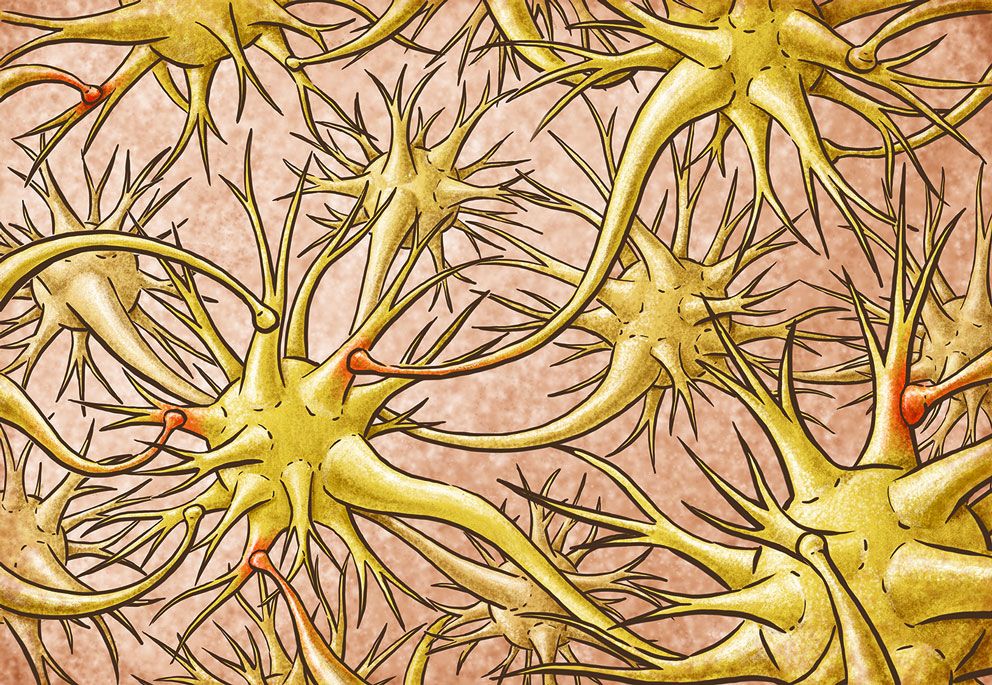
The human brain is an extremely complex structure. It is created long before birth, matures over many years and is never finished. That's why we never stop learning - from babyhood to old age.
Text: Helga Kessler, Illustration: Nadja Baltensweiler
As the old saying goes, you can’t teach an old dog new tricks. In other words: What we didn’t learn in our youth, we can no longer acquire in old age. On the other hand, it is said that “you are never too old to learn”. So what is true? Will we stop learning at some point? Or is it a question of will and practice? The answer is complicated, like everything that has to do with our thinking organ. There is no more complex structure than the human brain. And there is no other organ that changes so constantly.
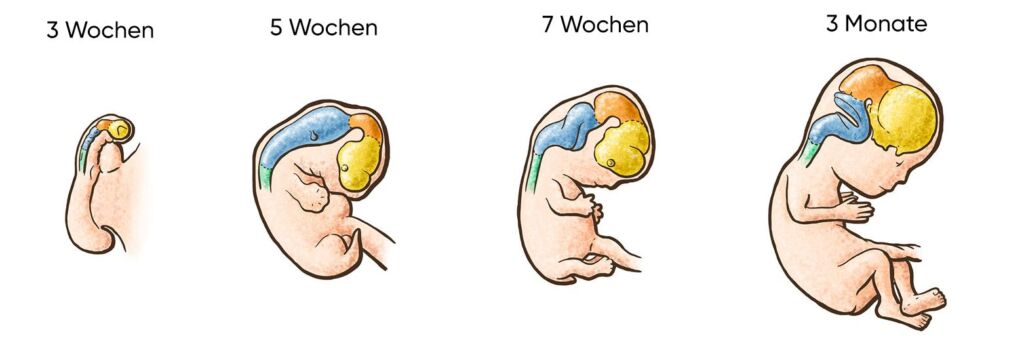
The process begins long before birth – and it only ends with death. The brain develops as early as the third week of pregnancy – at a time when most women do not yet know that they are pregnant. The future nervous system with the brain develops from a plate of cells on the embryo’s back. First a depression forms, which later closes to form the neural tube, the precursor of the spinal cord. At the front end of the cell plate, three protrusions form, the brain vesicles, from which the brain, eyes, olfactory organ and ears will develop in the future. The embryo has now implanted in the lining of the uterus. It is now about two millimeters in size.
Fetus: masses of new nerve cells
The two halves of the brain are already visible in the fourth week, after six weeks the neural tube is closed and the first brain structures, including the cerebellum and the cerebral cortex, have developed. In the ninth week, the embryo is now about two centimeters in size, tiny fingers and toes can already be seen, the spinal cord begins to control the first movements. The brain now looks like a curled-up lizard. From the tenth week, when the internal organs are formed, we speak of the fetus. The “gray matter” of the brain now grows particularly quickly: around 250,000 new nerve cells or neurons develop every minute, which network and distribute signals throughout the body.
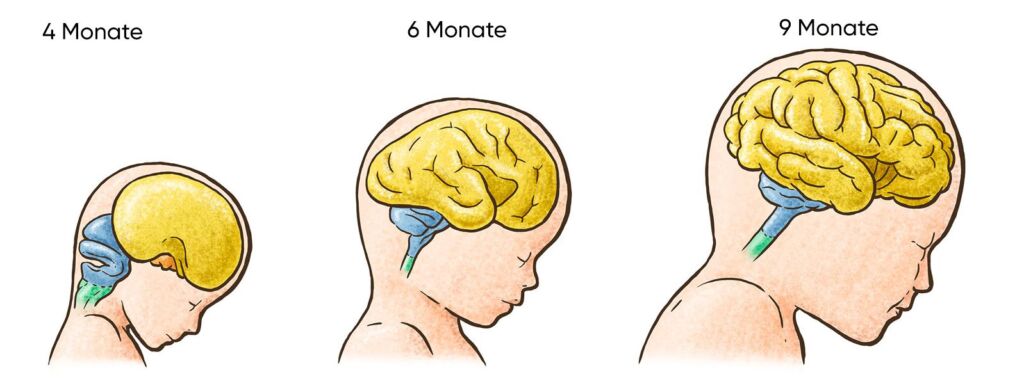
After three months, the fetus is about five centimeters tall and the head appears huge. Structures in the cerebellum, midbrain and hindbrain are already well developed, but the cerebral cortex is still largely smooth. However, because the posterior cerebral hemisphere in particular is now growing rapidly and space is limited, the cerebral cortex forms around the 24 weeks, the first furrows appear and the wrinkle structure typical of the human brain develops. This process, which continues after birth, enlarges the surface area many times over and creates space for higher functions such as thinking and acting, which develop later. From the 25th week the fetus can taste, from the 26. and see from the 32nd.
Baby: Random contacts
When the baby is born, its brain is equipped with an estimated 100 billion nerve cells. However, the baby’s brain is by no means fully developed. Quite the opposite: the brain and head are now visibly growing. The brain weighs 300 grams at birth, 750 grams at the end of the first year of life and 1,300 grams at the age of five. This is also due to the fact that the nerve fibers that form the “white matter” are now insulated with the myelin sheath and thus become thicker. The signals now flash through the brain even faster. At the same time, the nerve fibers make masses of contacts with each other, called synapses. By the age of three, the number of connections literally explodes to an unimaginable 200 trillion, although this happens rather haphazardly. Just as a baby randomly grabs objects and puts them in its mouth, the brain now networks – as if it wanted to try out what a new contact would bring.
Anything that turns out to be useless is soon dismantled. Overall, however, more new connections are created than already established ones disappear: This is why three-year-olds have twice as many synapses in their brains as adults. They can now absorb new information such as words or movement sequences particularly easily. Although they can already hear and see or feel well, their short-term memory is not yet fully developed. Young children can only store experiences – and remember them later – from around the age of three.
Puberty: The big tidy-up
During puberty, the ratio of newly formed and degraded synapses changes. The brain tidies up and deletes what it can’t use: Playing the flute or French, which is never spoken. In contrast, it amplifies the signal traces and synapses that it frequently uses. This is how learning works: the brain memorizes faster and better what receives full attention. If we watch a movie at the same time as reading a text, both contents are not stored completely. On the other hand, the more often we repeat something and the more senses we use, the more synapses are formed. If we not only read a new language, but also hear it, we master it more quickly.
A large part of the learning process takes place during sleep. This is because during sleep, the brain decides what is transferred from short-term memory in the brain region called the hippocampus to long-term memory and linked to existing information. Because brain development and sleep are closely linked, babies, children and adolescents need a lot of sleep.
During puberty and early adulthood, the brain rebuilds its neural network. This makes it more efficient and even faster thanks to additional myelin sheaths. The process is completed at around 25 years of age. The brain now has its later basic structure: an estimated 50 percent of it is hereditary, the remaining 50 percent is contributed by what we have experienced and learned. With advancing age, the density of synapses decreases only slowly. New synapses are constantly being formed as part of memory processes, while unused ones are lost. This remains the case until around the age of 80 – provided the brain remains active.
Adults: Learn and forget
Brain development continues in adults. Instead of building and tidying up, the focus is now on retaining what has been learned and learning new things. What is not needed is deleted at some point – and thus forgotten. “Use it or lose it”, they say. Use it or lose it. By using our brain, we are constantly changing it. The so-called plasticity of the brain remains intact into old age. It also ensures that people with brain injuries, for example after a stroke, can relearn lost skills such as controlling movements or speaking.
And as we know today, new neurons can also develop in old age. They do this in the area of the brain that is responsible for long-term memory: the hippocampus. In fact, our brain is as efficient as we want it to be. And it doesn’t stop learning on its own. Not even what was deleted in young adulthood is completely lost. Around 10 percent of the existing connections are retained and switched to standby. So if Hänschen has learned to speak French, Hans can reactivate or relearn it at the age of 80. He just has to want it.