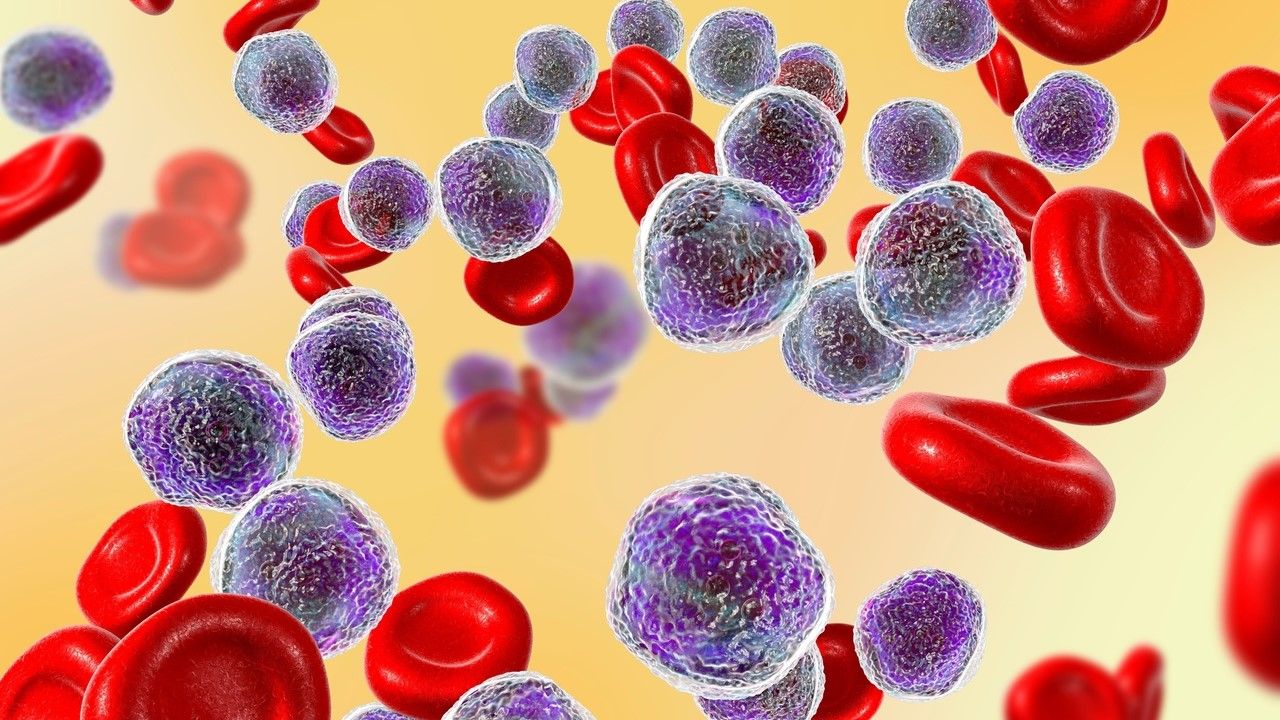
In the case of aggressive forms of leukemia, including relapses, a stem cell transplant may be the most suitable therapy. In any case, an exact diagnosis is recommended.
In acute leukemia , rapid action is vital for survival. Classical treatment is with chemotherapy, and for a few years now also with targeted or immunotherapies – these can be used in addition to or instead of the rather unselective and cell-damaging cytostatic drugs. However, in around half of the patients treated at the USZ, the specialists realize very early on that a more intensive therapy such as a blood stem cell transplant is necessary. A transplant may also be considered in the event of a recurrence.
“If we see certain genetic changes, we know that we don’t have a targeted molecule or antibody, or that the prognosis for survival is very poor,” says PD Dr. Antonia Müller. She is a senior physician at the Clinic for Medical Oncology and Haematology and specializes in stem cell transplants; her field of research is the graft-versus-host reaction. Because high-dose chemotherapy destroys the entire hematopoiesis and immune system prior to transplantation, older patients in particular, who are often affected by leukemia, are examined very carefully to determine how good or bad their state of health is. “We can only transplant if the people being treated are fit enough,” says Dr. Müller.
Mostly allogeneic, rarely autologous
After around seven days of high-dose chemotherapy, the patient is infused with cells from a donor in an allogeneic transplant. The cell mixture of blood stem cells and immune cells will take over hematopoiesis and immune defense in the future; even years after a transplant, the donor cells can attack reappearing leukemia cells. “An allogeneic transplant is like immunotherapy,” says Dr. Müller. Even aggressive forms of leukemia can be cured, but often an immune reaction against healthy tissue of the recipient can occur, the so-called graft-versus-host reaction. Immune activity after stem cell transplantation is therefore “a kind of balancing act” in which a desired immune attack against leukemia cells and tissue-damaging immunity of healthy organs are modulated by means of drug-based immunosuppression. “The lymphocytes of donors and recipients must match in ten to twelve characteristics, otherwise the immune reaction against healthy tissue is too strong,” says Dr. Müller. A less frequently chosen treatment option for leukemia is autologous stem cell transplantation after high-dose chemotherapy, in which the patient’s own blood stem cells are reinfused after treatment with cytostatic drugs. “The patient’s own stem cells only serve to speed up the recovery of blood formation – an immune reaction against leukemia cells does not occur.”
For a long time, chemotherapy was the only treatment for leukemia, but over the last five years, basic research has continuously produced new findings that have led to new and specific treatment options. In order to be able to choose the right treatment for the person suffering from the disease, an exact diagnosis is necessary. “We try to characterize the disease as well as possible based on cellular, genetic or other features and then treat it as specifically as possible,” says Dr Müller. Age is not an exclusion criterion for a stem cell transplant. It is often decided too early that therapy is not worthwhile. She advises a complete diagnosis in all cases. “Only then can you assess how to treat, whether intensively or less intensively.”