Other hearing implants
In addition to the cochlear implant, there are other hearing aids with implantable components. These hearing implants are suitable for special hearing disorders. We also look after patients who come to us at the ORL Clinic and the Cochlear Implant Center for such implants for clarification, surgery and check-ups. Your ORL specialist will refer you to us if necessary.
Bone conduction implants
With these implants, sound is transmitted directly into the inner ear by vibrations of the skull bone. They can be used primarily for hearing disorders in the outer and middle ear (sound conduction disorders), i.e. also for malformations of the external auditory canal and the middle ear, but also for unilateral deafness. There are systems from various manufacturers, for example the Baha and Osia from Cochlear or the Bonebridge from Med-El.
Active middle ear implants
These hearing systems are used when conventional hearing aids can no longer be worn, for example in cases of chronic inflammation of the external auditory canal. Prerequisites include an at least partially functioning inner ear and a functioning auditory nerve. Depending on the system, either the complete device or parts of the system are implanted. However, even with full implants, an external device is required to recharge an implanted battery. One example is the Vibrant Soundbridge from Med-El.
Brain stem implant
If the auditory nerve is so damaged that a cochlear implant (CI) is no longer an option, an auditory brainstem implant (ABI) can be implanted under certain circumstances. In neurofibromatosis type II, for example, tumors occur on both sides of the auditory nerve, and these patients are at risk of bilateral deafness due to tumor growth or surgical removal of these tumors. In this situation, a cochlear implant can no longer be used because the auditory nerve can no longer be stimulated.
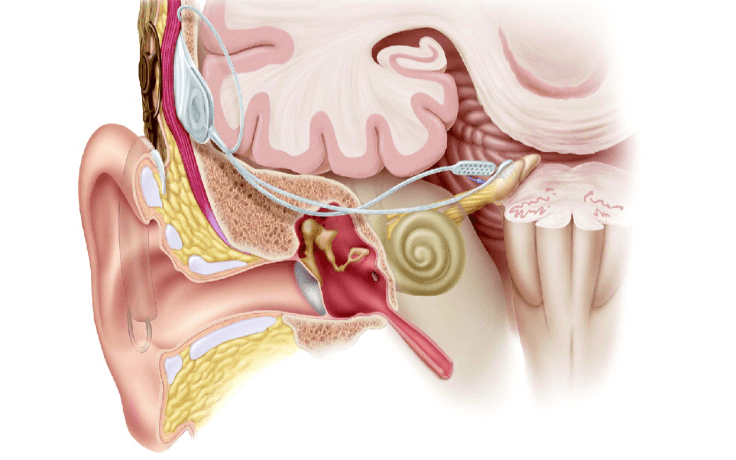
A brainstem implant works in a similar way to a cochlear implant, but the surface electrodes are placed directly on the brainstem (cochlear nucleus, see illustration). This makes it possible to electronically stimulate the auditory pathway directly at the entrance to the brain. This can trigger hearing perceptions in many patients. This allows environmental sounds to be heard again and supports lip reading.