Department of Neurology
Brain – structure, function, diseases
The brain is the central organ of the nervous system. It controls movements and sensory perceptions and enables thinking, memory, language and emotions. Many vital functions such as breathing and circulation are also regulated in the brain. A basic understanding of its functions helps to better classify diseases and recognize them at an early stage.
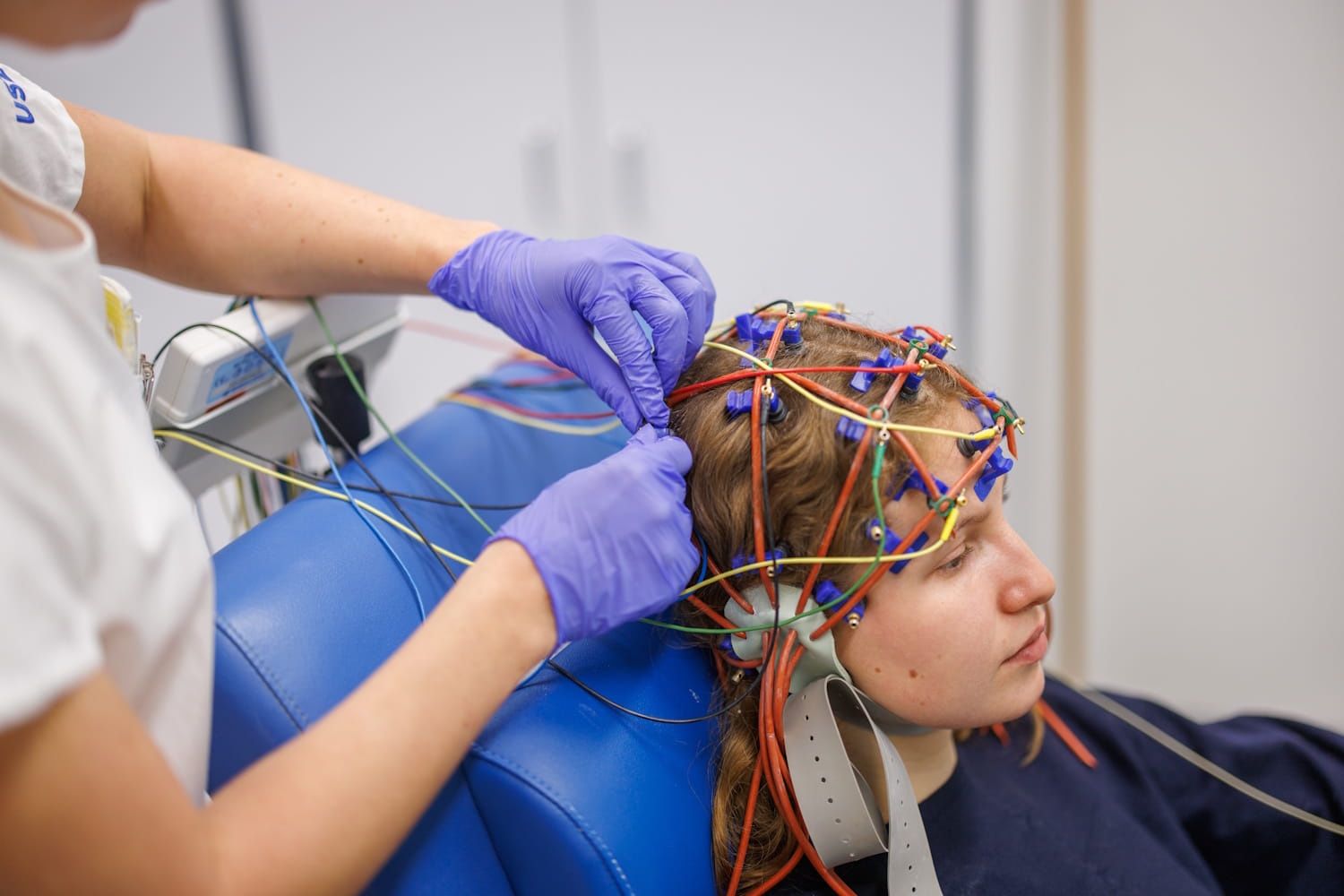
The brain processes information from the environment and our own body, controls movements and regulates basic bodily functions such as breathing and heartbeat. Thoughts, memories, feelings, language and consciousness arise in the brain. An important characteristic of the brain is its adaptability. Learning and experience can change connections between nerve cells. This process is known as neuroplasticity.
How the brain can be influencedThe brain is located in the skull and is protected there by several structures:
- Skull bones: protect the brain from mechanical impact.
- Meninges: three layers of tissue surround the brain and help to protect it.
- Cerebrospinal fluid (cerebrospinal fluid): acts as a buffer and supports the removal of metabolic products.
The brain is directly connected to the spinal cord. Together they form the central nervous system (CNS).
The brain consists of several areas with different tasks that work closely together. It continuously processes information from the body and the environment and adapts movements and bodily functions accordingly.
Parts of the brain: Structure of the brain
The brain is involved in almost all conscious and unconscious processes of the body. It controls movements, processes sensory impressions, enables thinking and remembering and influences emotions and behavior. The individual sections of the brain take on different functions.
Structure of the cerebrum
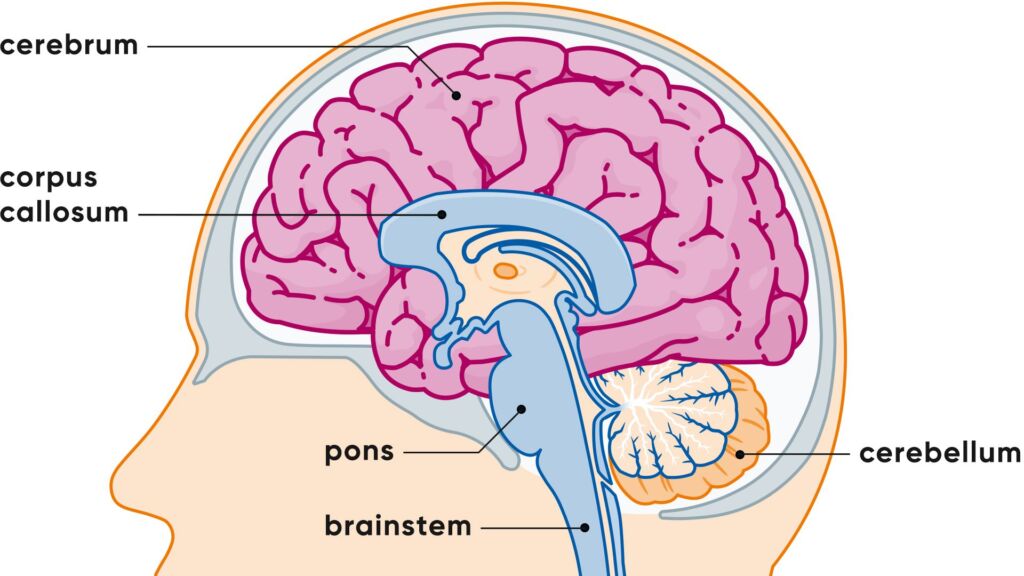
The cerebrum (telencephalon) is the largest part of the brain. This is where sensory impressions are processed, movements are planned and controlled, memories are stored and decisions are made. It is essentially involved in consciousness and personality.
The cerebrum consists of a left and a right hemisphere, which are connected to each other via the corpus callosum. Certain functions are distributed differently between the two hemispheres, with both sides working closely together.
Structure of the cerebellum
The cerebellum lies below the cerebrum in the back of the skull. It is important for the coordination of movements, balance and the fine-tuning of motor processes.
Structure of the brain stem
The brain stem connects the brain with the spinal cord. It controls basic, unconscious functions such as breathing, heartbeat, blood pressure and reflexes such as swallowing or coughing.
What is the brain made of?
The human brain weighs around 1.3 to 1.5 kilograms. It consists mainly of nerve cells (neurons) and glial cells, which fulfill different tasks.
- Nerve cells (neurons) process and transmit electrical signals and thus enable perception, movement, thinking and memory. Nerve cells are connected to each other via synapses and form complex networks.
- Glial cells support the nerve cells, supply them with nutrients, stabilize the tissue and are involved in protective and repair processes.
The brain also consists of gray and white matter:
- The gray matter mainly contains the cell bodies of nerve cells and is used to process information.
- The white matter consists mainly of nerve fibers that connect different regions of the brain.
Blood supply to the brain
The brain is continuously supplied with oxygen and nutrients. Two large arterial systems perform this task: the internal carotid artery and the vertebral artery. At the base of the brain they form the Circulus arteriosus Willisii, which enables an even distribution of blood. Even short interruptions in blood flow can lead to functional disorders, as nerve cells react sensitively to a lack of oxygen.
The brain processes sensory impressions, controls movements, regulates bodily functions and enables thinking, feeling and speech. These tasks are performed by different areas of the brain that work closely together.
Task and function of the cerebrum
The cerebrum consists of two hemispheres. Certain functions are distributed differently, such as language or spatial perception.
The cerebral cortex processes sensory impressions, controls movements and is involved in cognitive functions. Individual sections take on different tasks:
- Frontal lobe: Planning, language, impulse control
- Parietal lobe: Processing of touch, temperature and pain stimuli
- Temporal lobe: Hearing, speech, memory
- Occipital lobe: Processing of visual information
The cerebrum is the largest part of the human brain. It consists of a left and a right brain hemisphere. Each hemisphere has its own tasks.
Function of the cerebral hemispheres: The left hemisphere is responsible for language, logic and analytical thinking, while the right hemisphere is responsible for creativity and spatial imagination.
Function of the cerebral cortex: The outer layer of the brain is the cerebral cortex. This is where stimuli from the environment are processed, movements are planned and thought processes are controlled. The individual areas of the cerebral cortex perform different tasks depending on their location:
- Function of the frontal lobe: planning, language, emotions, impulse control
- Function of the parietal lobe: processing of touch, temperature and pain stimuli
- Function of the temporal lobe (temporal lobe): Hearing, speech, memory
- Function of the occipital lobe (occipital lobe): Vision
- Function of the prefrontal cortex: attention, planning and decision-making processes
- Function of the cerebellum: coordination of movements, control of balance, learning of motor processes
- Function of the brain stem: connection between the brain and spinal cord, control of vital functions such as breathing, heartbeat and blood pressure
- Function of the diencephalon (thalamus, hypothalamus and other structures): Transmission of sensory information, regulation of the sleep-wake rhythm, body temperature and hormone balance
Diseases of the brain can impair thinking, behavior, movement and bodily functions. The causes are varied and range from infections and circulatory disorders to degenerative or inflammatory diseases.
Inflammations and infections of the brain
Acute illnesses include inflammation of the brain (encephalitis) and meningitis. They are usually caused by viruses or bacteria and can manifest themselves as fever, headache, stiff neck or loss of consciousness. Rapid medical treatment is required. Autoimmune diseases can also affect the central nervous system, such as multiple sclerosis or autoimmune encephalitis.
Circulatory disorders of the brain
Circulatory disorders are a common cause of neurological deficits. Vascular occlusions or vasoconstrictions can lead to strokes. Suddenly occurring speech disorders, paralysis or visual disturbances require immediate medical clarification. Balance disorders or dizziness often occur in the area of the brain stem or cerebellum.
Metabolic diseases and functional disorders
Metabolic disorders can be congenital or acquired and affect the brain’s energy supply. The symptoms are often unspecific and range from fatigue to cognitive impairment.
Degenerative diseases: Dementia and Alzheimer’s disease
Alzheimer’s disease is the most common form of dementia. It usually begins gradually and leads to impaired memory, speech and orientation as it progresses. Other forms of dementia show different progressions, but also affect the structure and function of the brain. Early diagnosis facilitates planning and treatment.
First signs of dementia:
- Increasing forgetfulness in everyday life
- repeated questions or narration
- Orientation problems in familiar surroundings
- Difficulties with everyday activities
- Word-finding disorders
- impaired judgment
- Changes in mood or personality
Not all forgetfulness is dementia. If you are unsure, seek medical advice.
Neurological mental illnesses
Mental illnesses can be accompanied by changes in brain function. In psychoses, for example, delusions, hallucinations or thought disorders can occur. In old age, such conditions can also be triggered by physical illnesses.
Rare neurological diseases
One example of a rare brain disease is Huntington’s disease. This is a genetic neurodegenerative disease that can lead to involuntary movements as well as mental and cognitive changes. Rare metabolic or autoimmune diseases can also affect the brain and should be considered if neurological symptoms are unclear.
Brain tumor
A brain tumor is a neoplasm in the brain that can be benign or malignant. The prognosis depends on the type, location and growth of the tumor.
Typical symptoms of a brain tumor are persistent headaches, nausea, visual disturbances, seizures, speech disorders or changes in behavior and personality. As these complaints can also have other causes, a neurological examination is necessary for clarification. If such symptoms occur again or increase over days or weeks, a medical examination should be carried out, especially if several symptoms exist at the same time. Initially unspecific complaints can also be the reason for a further examination. The diagnosis is usually made using magnetic resonance imaging (MRI). In certain cases, a tissue sample is also required to determine the exact type of tumor. The treatment depends on the type and location of the tumor. Depending on the situation, surgery, radiotherapy, chemotherapy or a combination of these procedures may be used. The prognosis varies and depends largely on the type of tumor.
Radiotherapy of a brain tumor can inhibit tumor growth and alleviate symptoms, but is usually part of a holistic treatment plan. Individual, interdisciplinary care by neurosurgery, oncology and radiotherapy is important.
A healthy lifestyle helps to maintain brain function:
- Mental activity through learning and new tasks
- Regular physical exercise
- balanced diet
- Adequate sleep
- Stress reduction
- Social contacts
- Treatment of risk factors such as high blood pressure, diabetes or smoking
Responsible departments
- Website USZ
- Matthew MacDonald (2009). Your brain. O’Reilly Publishing. Cologne.
- Bear, Mark F. et al. (2018). Neurosciences. A basic textbook for biology, medicine and psychology. 4th edition. Springer Spektrum.
- AWMF (2021). S2k guideline on gliomas (retrieved 09.04.2025)
- Institute for Quality and Efficiency in Health Care (2021). How does the brain work? (Retrieved 09.04.2025)
- Health Knowledge Foundation (2021). How does the brain work? (Retrieved 09.04.2025)
- German Cancer Society (2017). Primary tumors of the brain and spinal cord (Retrieved 09.04.2025)
- Thieme Duale Reihe (2017). Physiology. 3rd edition. Stuttgart.