Research Group Marian Galovic: Epilepsy, seizures and brain health
Marian Galovic's research group (Galovic Lab) is a clinical and translational research group within the Department of Neurology, led by Prof. Dr. med. Marian Galovic, PhD, head of the Division of Epileptology and EEG.
The group studies how to predict, prevent and better treat epilepsy and its effects on the brain. It combines clinical epileptology with quantitative methods, including brain imaging, large-scale health data and prognostic modelling, to address questions relevant to clinical care across epilepsy, stroke and brain health.
Key Research Areas
A proportion of patients develop epilepsy after a stroke or other brain injury – a process called epileptogenesis. The group develops and validates prognostic models in large multicentre cohorts to identify patients at risk, and conducts prospective studies examining whether epilepsy can be predicted and, potentially, prevented.
Working within international imaging consortia, the group uses longitudinal brain imaging to study how epilepsy and status epilepticus affect brain structure over time, and whether treatment can limit these changes.
Seizures that begin later in life can be associated with cognitive change. Using large health datasets, the group investigates the relationships between seizures, their treatment, cognitive ageing, and dementia in older adults.
Representative projects of the Galovic Lab
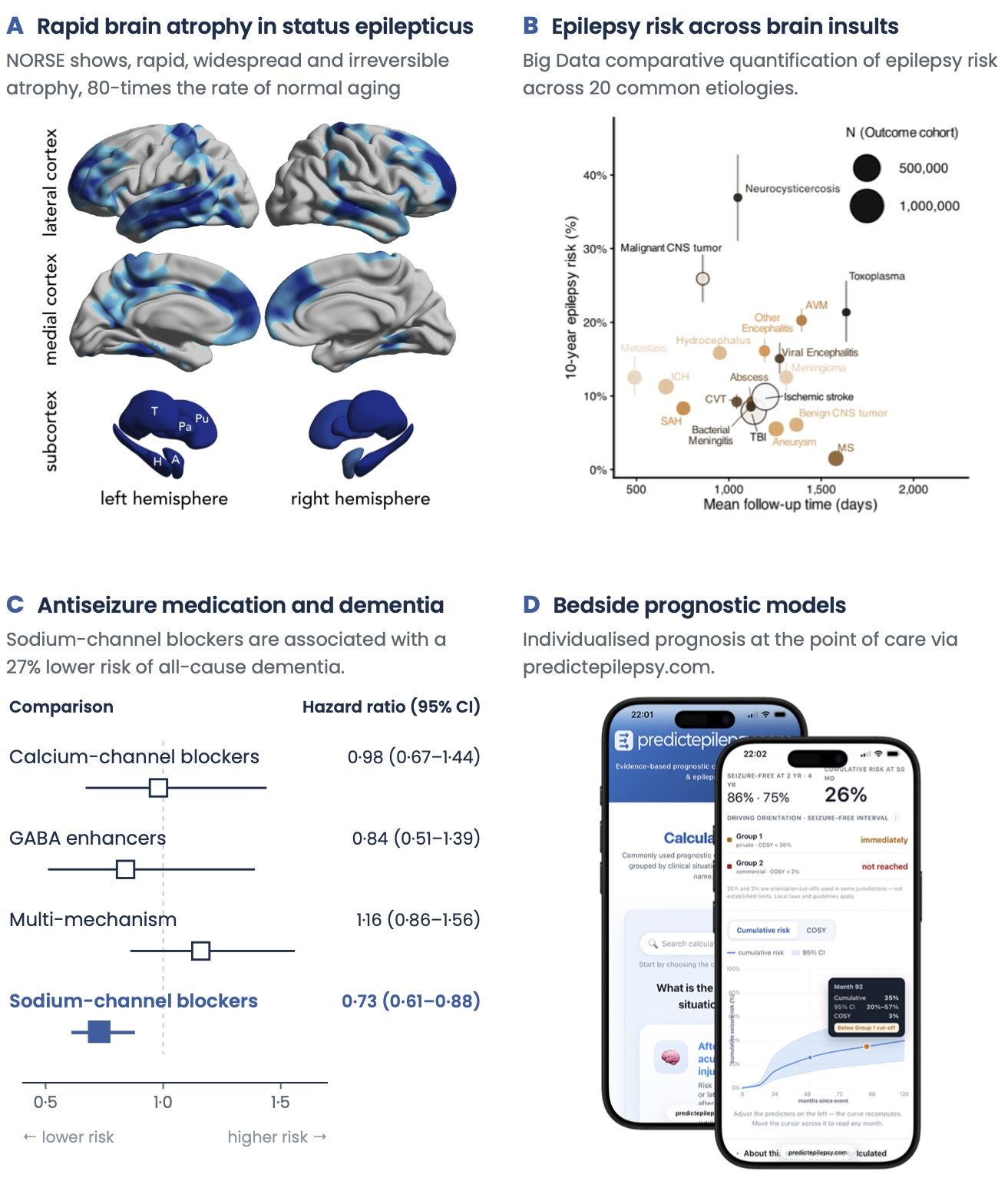
(A) Status epilepticus is associated with particularly rapid brain atrophy and brain ageing.
(B) Quantification of the risk of epilepsy following 20 common brain disorders.
(C) Treatment with sodium-channel blockers is associated with a 27 % lower risk of dementia.
(D) Our own and external prognostic models are available on predictepilepsy.com, on the web and on the smartphone.
Representative Projects from the Galovic Lab, more information here.
Selected research contributions
- The group developed and validated the SeLECT score, a tool for estimating the risk of epilepsy after an ischaemic stroke (The Lancet Neurology, 2018), and has since extended it with the SeLECT 2.0 (JAMA Neurology, 2023) and SeLECT-EEG (Annals of Neurology, 2025) models.
- In longitudinal imaging studies, focal epilepsy was associated with accelerated brain atrophy, and successful epilepsy surgery with reduced progression of this change (JAMA Neurology, 2019; Brain. 2020; Brain Communications, 2025). Status epilepticus, particularly new-onset refractory status epilepticus, were associated with exceptionally high rates of brain atrophy and brain ageing.
- In big data studies, antiseizure medications, and sodium channel blockers in particular, were associated with an approximately 27% lower risk of dementia and with lower amyloid and tau burden. Hearing-aid use was associated with an approximately 23% lower dementia risk in people with epilepsy and hearing loss.
- The group developed the WAMS models to guide the withdrawal of antiseizure medications after epilepsy surgery and to define its optimal timing (Brain, 2023; Neurology, 2026).
Research infrastructure and networks
The group builds and coordinates several research resources, a number of which are open to external collaborators:
- SeLECT Consortium (www.select-consortium.com), an international research network on seizures after stroke, comprising more than 20 cohorts across four continents.
- PRe-SeLECT (https://mgalovic.github.io/PReSeLECT_web), a prospective, multicentre study of seizures after stroke.
- IMPOSE, a multicentre imaging study of brain injury during status epilepticus.
- ENIGMA-Epilepsy (https://enigma.ini.usc.edu/ongoing/enigma-epilepsy), within which the group coordinates the longitudinal-imaging analysis.
- PredictEpilepsy (http://predictepilepsy.com), a platform providing validated prediction models as clinical tools.
Publications
The group’s research is supported by the Swiss National Science Foundation, the Swiss League Against Epilepsy, the Swiss Heart Foundation, the Koetser Foundation for Brain Research, the USZ Innovationspool, the Theodor and Ida Herzog-Egli Foundation, and the Philas Foundation.
Collaboration and academic opportunities
The group collaborates with clinical and academic partners internationally and welcomes enquiries about joint projects and participation in its consortia. Research projects are regularly available for MD, PhD and master’s students. Enquiries are welcome by email.



Full team: the Galovic Lab team