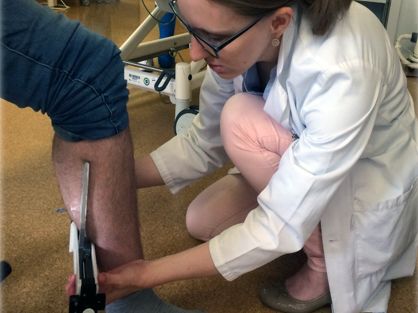
Thanks to a sophisticated ultrasound method, excessive muscle loss in older adults can now be detected more quickly. The University Hospital of Zurich has been offering this test since the fall of 2017.
The prevalence of sarcopenia increases with age. Up to 50 percent of people over the age of 80 are affected by this. To ensure early detection of the disease, a team of radiology researchers at the USZ tested and applied the ultrasound technology developed by ETH Zurich. They wanted to know whether this would allow for a more accurate measurement of muscle mass. Sarcopenia could be detected with an accuracy rate of 93.6 percent.
How does sonography work? A standard, portable ultrasound device is combined with a simple Plexiglas reflector for the recordings. At the heart of the new method is software that can calculate the speed of sound waves in three dimensions based on the ultrasound data. Using such ultrasound measurements of the calf muscles, the research team found that the sound waves traveled significantly more slowly in older adults with less muscle mass than in young people.
What is the main advantage of an ultrasound exam? The measurement takes two minutes. “In addition, the treatment is inexpensive and widely available,” says Prof. Dr. med. Marga Rominger of the Institute for Diagnostic and Interventional Radiology. “Furthermore, patients don’t have to go into a tube, as they do with a CT or MRI. And there is no radiation exposure, as there is with an X-ray.” “Ultrasound is used ‘in older adults, following periods of immobility—such as after bone fractures—or after rehabilitation training,'” Prof. Dr. Rominger continued.
What is sarcopenia?
As we age, muscle mass and muscle strength decrease. If muscle mass decreases more rapidly than is normal for a person’s age, this is referred to as sarcopenia (from the Greek: “little flesh”). Muscles are important not only for movement but also for protein and carbohydrate metabolism.
Sarcopenia is considered a precursor to frailty. Frailty often leads to hip fractures and a loss of independence. Research into measures for the prevention and treatment of sarcopenia is therefore a high priority in modern gerontology, with the goal of promoting “healthy aging” and preventing “frailty.”