Ebola is one of the so-called viral hemorrhagic fevers; “hemorrhagic” means “associated with bleeding.” Ebola disease is often severe. Early treatment and careful care improve the chances of survival. This includes, in particular, replenishing fluid and electrolyte losses and treating complications. Effective antibody therapies are also available for illnesses caused by the Zaire Ebola virus; however, there are currently no approved specific therapies for other Ebola viruses. Nevertheless, the disease can be fatal even with treatment. With a few isolated exceptions, all cases of infection to date have occurred in Africa; experts consider the risk of contracting Ebola within Europe to be extremely low.
When should Ebola be considered?
Only if both of the following are true:
- You have been in an Ebola-affected region of the Democratic Republic of the Congo within the last 21 days.
- You have a fever or other symptoms such as severe headaches, extreme weakness, a sore throat, vomiting, diarrhea, abdominal or muscle pain, shortness of breath, or unexplained bleeding.
If that happens, call a medical service immediately and mention that you are traveling. Do not go to a doctor’s office or hospital without an appointment.
Unless you have been in an affected region, it is extremely unlikely that Ebola is the cause of your symptoms. This also applies if you have a fever, cough, or body aches.
Overview: What Is Ebola?
Ebola is one of the so-called zoonotic diseases. These are infectious diseases that can be transmitted from animals to humans. Well-known examples, besides Ebola, include avian flu and rabies. The Ebola virus, first discovered in 1976, is believed to have originated in a population of bats in Central Africa (the Ebola River in that region gave the disease its name). Other wild animals, such as monkeys, can also play a role in the transmission of the Ebola virus. Once the Ebola virus has infected a human, human-to-human transmission is also possible. An Ebola outbreak—the one with the fastest-growing spread worldwide—was reported in 2026 from the Democratic Republic of the Congo. By that time, there had been roughly more than 30,000 cases of Ebola in Central and West Africa; approximately 12,000 people had died from the disease.
There are various types of Ebola viruses. Four of them are pathogenic to humans (meaning they can cause disease in humans). Ebola viruses are classified as Risk Group 4 in the EU—the highest risk group for biological agents. This classification takes into account, among other factors, the severity of the disease, the risk of transmission, and the options for prevention and treatment.
However, Ebola is not a global epidemic: So far, there have only been localized outbreaks in a few African countries. Similarly, an Ebola patient treated in Switzerland in October 2026 did not contract the Ebola virus in Europe, but rather during a previous stay in Africa.
Even though the COVID-19 pandemic a few years ago showed that viruses know no national borders, there have been no reported cases of locally acquired Ebola infections in Europe to date.
Causes: How Does Ebola Develop?
Bats or flying foxes are believed to serve as a reservoir for Ebola viruses. Even transmission of the virus from a single animal—for example, while preparing or consuming its meat—can be enough to trigger an Ebola outbreak. If someone becomes infected and develops Ebola, they become a source of infection for others: these people can come into contact with the infected person’s bodily fluids and become infected as a result.
There are four types of Ebola viruses in the genus Orthoebolavirus that can cause Ebola infection in humans. Each has been named after the region where it first appeared:
- Zaire Ebola viruses ( abbreviated as EBOV). These viruses have caused the majority of Ebola infections and deaths in the past; the case fatality rate among untreated patients has historically ranged from 60 to 90 percent. EBOV is currently the only Ebola virus species for which there are approved vaccines and antibody therapies. Since the Zaire Ebola virus is the most widespread variant among all Ebola virus species, it is often referred to simply as the “Ebola virus,” despite the existence of other virus strains.
- Sudan Ebola viruses ( SUDV). The fatality rate for Ebola infections caused by these viruses has so far been somewhat lower than that of EBOV, at about 40 to 60 percent. However, they also cause severe hemorrhagic fever.
- Bundibugyo Ebola virus (BDBV). This virus strain was not discovered until 2007. Until now, the fatality rate has been lower than for other Ebola virus strains. Recently, however, the fatality rate has risen to nearly 50 percent in Central Africa. This Ebola virus variant was identified as the cause of the major Ebola outbreak in 2026.
- Tai-Forrest ebolaviruses (TAFV). There are very few documented cases of human infection with this extremely rare type of virus.
The clinical presentations caused by the various types of the Ebola virus differ very little from one another.
Transmission: How Do People Become Infected with Ebola Viruses?
Unlike influenza viruses, for example, Ebola viruses do not spread through the air. Infection occurs through direct contact with infected bodily fluids—either directly or indirectly:
Direct transmission of Ebola viruses
Direct transmission occurs when a person comes into contact with the blood, saliva, urine, semen, or other bodily fluids of a person infected with Ebola. The viruses contained in these fluids can enter the body through the eyes, nose, mouth, or an open wound, for example. Direct transmission of the virus can occur, particularly when caring for patients with Ebola or handling the remains of people who have died from Ebola. The more advanced the Ebola virus disease is, the more viruses are present in the bodily fluids, and the greater the risk of infection.
Indirect Transmission of Ebola Viruses
In indirect transmission, an intermediate surface is first contaminated with the infectious bodily fluid. This could be, for example, a doorknob, bedding, or a medical instrument. Anyone who has touched such an object contaminated with Ebola virus and does not wash their hands thoroughly afterward can become infected with the Ebola virus by touching their eyes, mouth, or another body orifice.
Both routes of transmission—direct and indirect—are possible, but in the majority of cases, Ebola infection occurs through direct transmission. It is not known how many Ebola viruses are needed to cause Ebola virus disease in humans. However, animal studies suggest that even a small amount of the virus is sufficient to cause an infection.
Symptoms: What are the signs of Ebola virus disease?
Sudden onset of high fever, vomiting, general malaise, and pain in the throat, head, abdomen, and muscles: At the onset of an Ebola infection, it often seems as if the person has come down with a severe case of the flu. As the disease progresses, vomiting and diarrhea may occur, and in severe cases, circulatory failure and organ failure may develop. Bleeding is also possible, though it does not occur in all patients. Ebola is classified as a viral hemorrhagic fever; “hemorrhagic” means “accompanied by bleeding.” The incubation period—the time between infection and the appearance of the first symptoms—for Ebola virus disease ranges from two days to three weeks. It is often six to ten days.
Diagnosis: How Do You Recognize Ebola Virus Disease?
It is difficult to diagnose an Ebola infection based solely on the initial symptoms, because they are indistinguishable from those of other infectious diseases. For example, in the early stages of Ebola virus infection, the disease can be mistaken for malaria or the flu. Special Ebola tests are available to confirm a diagnosis of Ebola. These tests are conducted under strict safety precautions in a specialized laboratory.
Treatment: How is Ebola treated?
Treatment for Ebola virus disease is currently primarily symptomatic. There are various medications that inhibit the spread of the virus in the body. Several vaccines have also been developed, though they are available only in limited quantities. In regions affected by Ebola, these vaccines are administered to people who have been or are in contact with patients infected with Ebola. Monoclonal antibodies are being used successfully in people infected with the Zaire Ebola virus. These are artificially produced antibodies that bind to the surface of the virus, thereby preventing it from entering the body’s cells to replicate there. Currently, there are several promising medications and vaccines, but they are still in the testing phase and have not yet been approved.
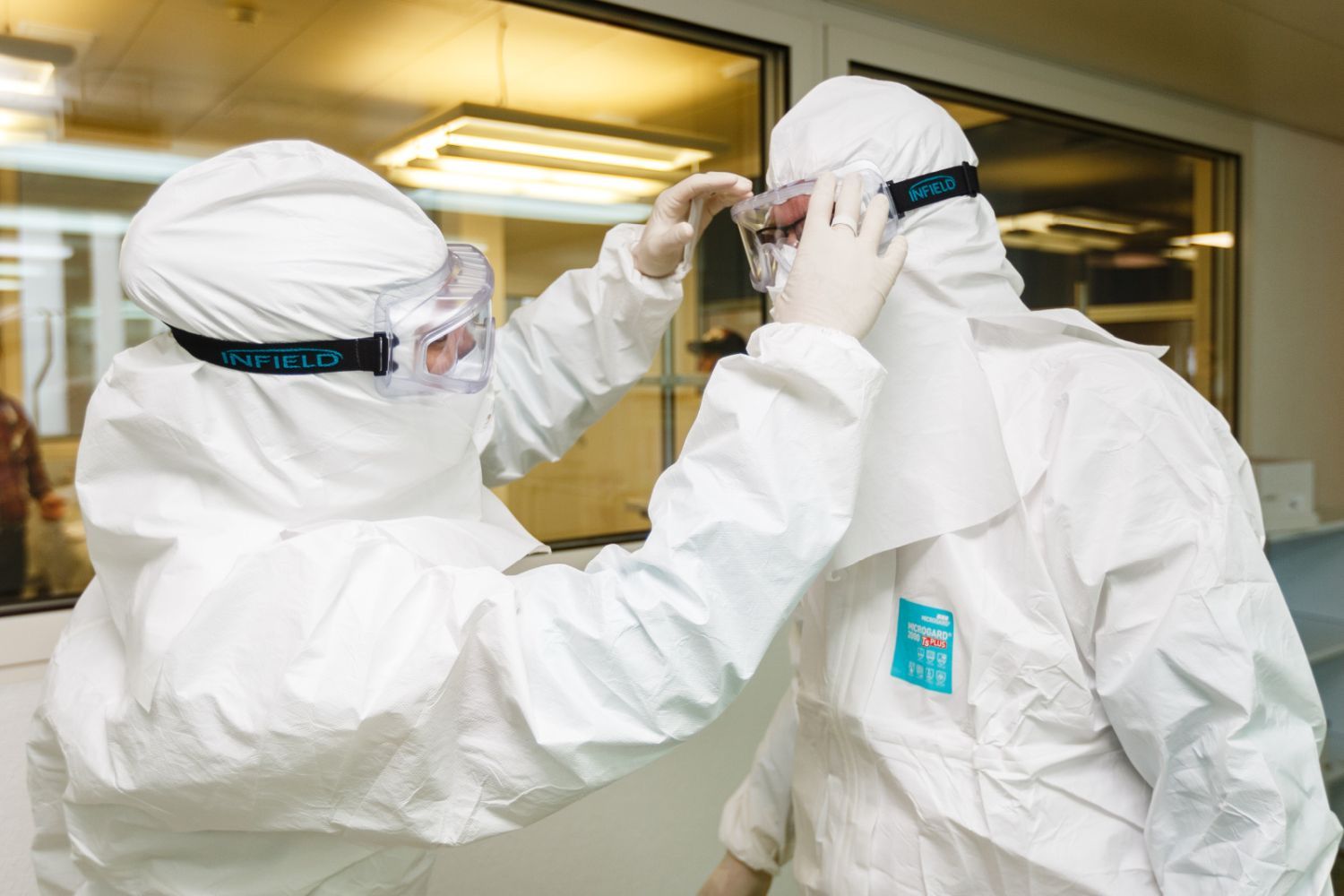
A highly specialized medical center such as the University Hospital of Zurich (USZ) can treat and care for Ebola patients in a specially equipped isolation ward. The staff working there wear full-body protective suits to prevent any viruses from entering.
Course and Prognosis: What Are the Consequences of Ebola?
If there is suspicion of Ebola virus infection, seeking medical treatment as early as possible is extremely important. Once Ebola virus disease has been overcome, those affected are immune to the Ebola pathogen that caused the illness because their bodies have produced antibodies. Researchers suspect, however, that this protection applies only to the Ebola virus that caused the illness and not to other Ebola pathogens. The evidence supporting this hypothesis is still very limited, however, and must be substantiated by further studies.
Even after recovery from the disease, Ebola virus genetic material can remain detectable in certain parts of the body—such as the testicles, the eye, or the central nervous system—for a long time afterward. In a study of the West African outbreak, this was still the case in the semen of about one-quarter of the men examined seven to nine months after they were discharged from treatment (source: Deen et al., N Engl J Med). The test does not indicate whether the virus is still contagious. The WHO therefore recommends that male survivors practice safe sex (using condoms) for 12 months from the onset of illness or until their semen has tested negative twice.
In some cases, survivors of an Ebola infection may develop what is known as post-Ebola syndrome. This term encompasses a variety of symptoms, such as muscle and joint pain, eye infections, or neurological symptoms (nerve disorders). These long-term effects of Ebola can persist for a long time and are believed to result from a malfunction of the immune system.
Prevention: How can an Ebola virus infection be prevented?
To date, the only approved vaccine that provides protection against the Ebola virus is effective against Zaire Ebola viruses (EBOV). The vaccine is administered as a single intramuscular injection designed to stimulate the immune system to produce antibodies against the virus. In the fall of 2026, it became known that such a vaccine—Ervebo—apparently can also trigger immune responses (so-called T-cell responses) against the dangerous Bundibugyo Ebola variant (BDBV). While this vaccine may not prevent the onset of Ebola, it could lead to a milder course of the disease and reduce the Ebola mortality rate. A pilot vaccination program in the Democratic Republic of the Congo is expected to provide further insights.
Even unvaccinated people can protect themselves from infection—by taking the right precautions. Strict hygiene is at the top of the list of the most important anti-Ebola measures. Thorough handwashing, in particular, can interrupt the chain of Ebola transmission, because even tiny amounts of saliva on a glass or utensils used by someone with Ebola can be enough to transmit the Ebola virus.
If you suspect that you may have come into contact with the Ebola virus—because you encountered an infected person in a high-risk area and touched that person or objects belonging to them—you should closely monitor yourself for the symptoms described above for 21 days. If any symptoms appear, make a note of what they are and when they began.
Details of the treatments