How do I read an audiogram?
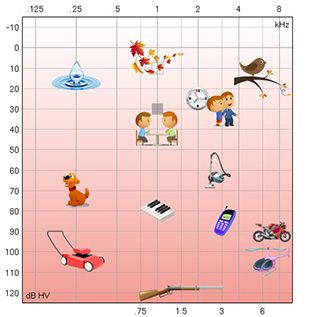
A pure tone audiogram is divided into frequencies Hz/kHz (x-axis) and volume dB (y-axis). The further to the left the measured value is in the display, the lower the frequency, the further to the right, the brighter it is. The higher up in the display the measured value is, the quieter the sound was heard; the further down, the louder the sound had to be in order to be heard.
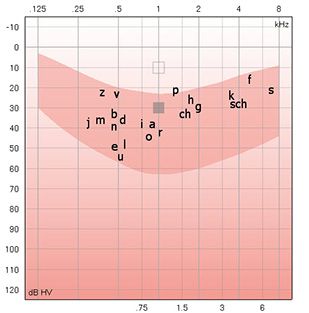
With audiograms of children, it must be taken into account that the recorded values often do not represent the actual hearing threshold, but are reaction thresholds. This means that the actual hearing threshold can be assumed to be slightly better than the recorded values, depending on the child’s developmental age. The so-called speech banana shows the frequency and volume at which individual speech sounds occur in a quiet room and at a distance of one meter from the speaker.
If the measured values of the hearing test are above the speech banana, all speech ranges will be clearly audible. If the measured values of the hearing test are below one of the letters entered, this means that these letters cannot be heard correctly or not at all, even under optimum conditions.
Frequently asked questions
Under certain circumstances, a reliable diagnosis can be made shortly after birth.
Yes. Hearing loss should then also be ruled out or, if confirmed, corrected all the more.
We recommend a detailed assessment of your hearing.
This is often due to a problem with the ventilation of the middle ear. We recommend a precise clarification.
Depending on the cause of the hearing loss, this may be the case. In most cases, however, permanent hearing loss in children must be treated with hearing aids.
Hearing tests at home, whether by means of online hearing tests or self-invented hearing tests, are rarely reliable for children. Children often react to other signals such as a breeze, slight vibrations or visual observations. You can’t be sure whether they have really only tested the hearing and that in its entire spectrum.