Research Group Caroline Ospelt
Synovial fibroblasts are the major stromal cells in the joint synovium and play a crucial part in inflammation and joint destruction in RA. In our work, we look at different aspects of fibroblast biology to decipher how these cells are activated in RA, how they contribute to disease and how they can be therapeutically targeted.
Our Projects
Genetic factors contribute 50% to the risk of RA and the heritability of RA is estimated to be approximately 60%. Genome-wide association studies (GWAS) have identified over 100 genetic susceptibility loci for RA. However, only a small proportion of RA risk loci have been functionally analysed to date. In this project, we align genetic data with in depth analysis of the epigenetic landscape of synovial fibroblasts and functionally analyse RA genetic risk loci in synovial fibroblasts to decipher their molecular and functional role in disease development.

We could show that synovial fibroblasts significantly differ between different joint locations in their epigenome, transcriptome and function. In particular, the expression of genes that are involved in embryonic limb development, namely HOX genes, substantially differ between joint regions. However, little is known about the function of HOX genes in synovial fibroblasts. Therefore, we analyse the properties of various HOX transcription factors and non-coding RNAs in synovial fibroblasts. We hypothesize that these site-specific transcriptional regulators substantially influence the inflammatory response, the influx of immune cells, the resolution of inflammation and thus disease development, outcome and therapeutic response.

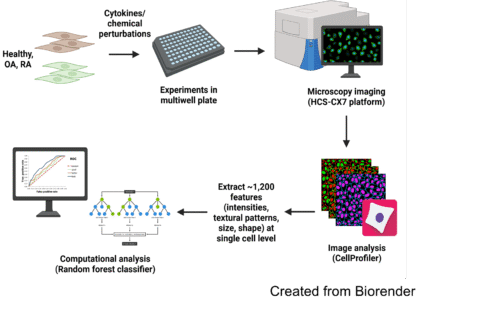
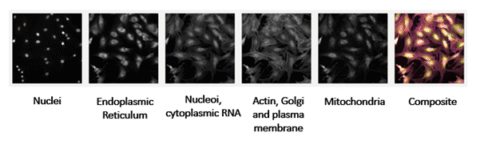
Currently, there is no reliable pre-clinical system to test how potential drugs affect synovial fibroblasts, the key cells driving joint damage in rheumatoid arthritis. To fill this gap, we developed a high-content imaging and machine learning pipeline combined with the Cell Painting assay to address fibroblast morphology under stimulation and drug treatment. The system sensitively detected activation- and drug-induced changes in fibroblasts, thus enabling future high-throughput drug screening in rheumatoid arthritis.
Workflow for fibroblast morphological profiling
Synovial fibroblast features captured using Cell Painting
Selected Publications
- Elhai M, Micheroli R, Houtman M, Mirrahimi M, Moser L, Pauli C, Bürki K, Laimbacher A, Kania G, Klein K, Schätzle P, Bertoncelj MF, Edalat SG, Keusch L, Khmelevskaya A, Toitou M, Geiss C, Rauer T, Sakkou M, Kollias G, Armaka M, Distler O, Ospelt C. The long non-coding RNA HOTAIR contributes to joint-specific gene expression in rheumatoid arthritis. Nat Commun. 2023 Dec 9;14(1):8172. https://pubmed.ncbi.nlm.nih.gov/38071204/
- Ge X*, Frank-Bertoncelj M*, Klein K, Mcgovern A, Kuret T, Houtman M, Burja B, Micheroli R, Shi C, Marks M, Filer A, Buckley CD, Orozco G, Distler O, Morris AP, Martin P, Eyre S*, Ospelt C*. Functional genomics atlas of synovial fibroblasts defining rheumatoid arthritis heritability. Genome Biol. 22, 247 2021.*equal contribution. https://pubmed.ncbi.nlm.nih.gov/34433485/
- Frank-Bertoncelj M, Trenkmann M, Klein K, Karouzakis E, Rehrauer H, Bratus A, Kolling C, Armaka M, Filer A, Michel BA, Gay RE, Buckley CD, Kollias G, Gay S, Ospelt C. Epigenetically-driven anatomical diversity of synovial fibroblasts guides joint-specific fibroblast functions. Nat Commun. 2017 Mar 23;8:14852. https://pubmed.ncbi.nlm.nih.gov/28332497/