Elbow: Epicondylopathia humeri radialis and ulnaris (tennis/golfer’s elbow)
Fingers: Soft tissue calcifications
Hip: trochanter calcifications, insertional tendinopathy at the greater trochanter or ischial tuberosity
Knee: patellar tendinopathy, insertional tendinopathy of the tibial tuberosity
Foot: Heel pain: plantar fasciitis, Achillodynia
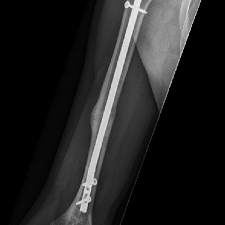
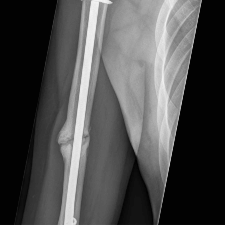
Bone: Poor fracture healing, non-union, pseudoarthrosis (with osteosynthesis material in place) and stress fractures in the bones of the extremities
What is the treatment procedure?
ESWT is performed on an outpatient basis without anesthesia or sedation. As a rule, three sessions are carried out at least one week apart. Each session lasts approx. 30 minutes.
Prior to ESWT, an initial consultation is held to check whether ESWT is possible and promising, the procedure is discussed and a cost approval is obtained (ESWT is not a mandatory benefit of the compulsory basic insurance, depending on the supplementary insurance, the costs may be covered).
What is special about our device?
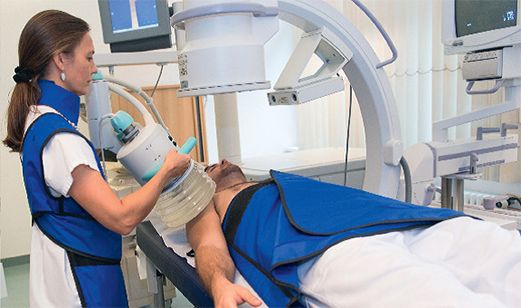
The device, which is used at the University Hospital Zurich, is characterized by an inline ultrasound and a coupled X-ray image intensifier. This means that during shock wave treatment, ultrasound and X-ray images can be used to continuously check whether the target area is exactly in the target area. This is particularly important if the calcification, the tendon insertion or the bone fracture gap is being treated selectively. In the treatment of slow bone fracture healing (non-union, pseudoarthrosis), the osteosynthesis material can be left in the bone. The shock waves are applied to the fracture gap with millimeter precision. Another special feature of this device is its very high energy (pressure up to 300 bar) and high penetration depth of up to 15 cm. Experience has shown that 2/3 of all patients are very satisfied with this therapy.
What are shock waves?
Shock waves are audible sound waves with very high energy. These sound waves are generated in the shock wave device and transmitted to the body through a water cushion. This therapy method became known through kidney stone disintegration. Extracorporeal shock wave therapy (ESWT) not only reduces calcifications, it is also used for painful tendon insertions and poorly healing bone fractures. For this purpose, the shock waves are focused, i.e. set with great precision to the area to be treated.
X-ray after ESWT
X-ray before ESWT
How do shock waves work?
The shock waves create a very high pressure, this causes tension in the tissue, which leads to a biological reaction. Blood circulation is increased, metabolism improves, and damaged tissue regenerates and heals.
What are the risks?
Temporary reddening of the skin may occur during shock wave therapy. In rare cases, the discomfort may worsen during a few days. Shock wave therapy itself does not cause radiation exposure. X-rays are used in low doses only to find the calcification or bone fracture.
Consultation
Shock wave therapy consultation
Extracorporeal shock wave therapy (ESWT) is used in our clinic mainly for pain of tendon insertions, calcifications and poorly healing bone fractures.
As a patient, you cannot register directly for a consultation. Please get a referral from your primary care physician, specialist. For questions please use our contact form.
 The device, which is used at the University Hospital Zurich, is characterized by an inline ultrasound and a coupled X-ray image intensifier. This means that during shock wave treatment, ultrasound and X-ray images can be used to continuously check whether the target area is exactly in the target area. This is particularly important if the calcification, the tendon insertion or the bone fracture gap is being treated selectively. In the treatment of slow bone fracture healing (non-union, pseudoarthrosis), the osteosynthesis material can be left in the bone. The shock waves are applied to the fracture gap with millimeter precision. Another special feature of this device is its very high energy (pressure up to 300 bar) and high penetration depth of up to 15 cm. Experience has shown that 2/3 of all patients are very satisfied with this therapy.