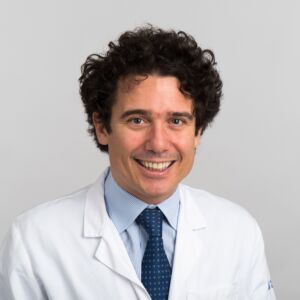
Giuseppe Esposito operates on patients' brains. This is demanding work that requires precise preparation and maximum concentration. Read the interview to find out how the Senior Attending Physician at the Department of Neurosurgery prepares himself and his team for such an operation, how he trains the next generation of neurosurgeons and what neurosurgery has in common with aviation.
Giuseppe Esposito, what is neurosurgery?
Neurosurgery is a fascinating surgical discipline. We operate on patients with brain tumors, brain aneurysms, vascular malformations, cerebral hemorrhages or strokes. Our spectrum also includes procedures on narrowed carotid arteries and the spine. These operations require the finest surgical precision, which we refer to as microsurgery. The operation is performed under a microscope. It is then a matter of millimeters or even less. Careful preparation is therefore essential.
What does the preparation look like?
Before a neurosurgical operation, it is important to know the patient’s individual anatomy perfectly. We use advanced imaging techniques such as computer tomography or magnetic resonance imaging, including three-dimensional reconstructions. Today, we also use holograms and augmented reality to prepare ourselves optimally. Every operation requires thorough planning, from positioning the patient to the choice of surgical instruments. This planning is also important with regard to interdisciplinary cooperation during the operation in order to optimize teamwork.
And then the operation starts?
Not quite. Before the start, the entire surgical team, consisting of specialists from the fields of neurosurgery, anesthesia, surgical and positioning care, goes through a checklist in the operating room. On the one hand, to discuss the procedure again, and on the other, so that the entire surgical team has the same level of knowledge. Pilots do something similar before taking off in an airplane.
That all sounds very comprehensive and time-consuming. What is the procedure for emergency operations?
Yes, indeed. The time pressure is then a challenge for the whole team. The USZ is a highly specialized center for such emergency operations, which are a matter of life and death. We are therefore used to being very well prepared even with little time and still adhering to all the required procedures.
You said that a millimeter can be decisive in neurosurgery. This is also an extreme pressure for the surgeon. How do you deal with this?
That’s our job! We have to be extremely well prepared, feel safe and know exactly where we are operating. It also means that we are highly specialized and train intensively. During the operation, we use various instruments such as advanced surgical microscopes and neuronavigation in order to be able to work precisely.
How do you become a neurosurgeon? Did you know early on that you wanted to pursue this profession?
During my medical studies, I found neuroanatomy very fascinating and decided to go into neurosurgery. To become a neurosurgeon, you need a lot of hard work, passion and motivation. You have to learn a lot and train for years in surgical skills and the microsurgical skills that we require in neurosurgery. The support of a mentor can also be of great importance. I personally learned an enormous amount from my mentor and clinic director Luca Regli.
Good keyword: How can surgical skills be trained?
Further training primarily takes place through the participation of junior doctors in operations. To provide additional training in microsurgery skills, we have set up a microsurgery laboratory, the Zurich Microsurgery Lab. There we train with innovative and hyper-realistic simulation models. These models simulate the situation exactly as in the operating theater. This allows the young surgeons to develop their skills in a safe environment. We also organize several microsurgery courses every year in which surgeons from all over Switzerland and Europe take part to hone their surgical skills.
Are you actually afraid or respectful of operations?
I’m not afraid, but I have respect for every operation and especially for the patients. Every operation is designed to treat and care for the patient in the best possible way. We are always highly focused in order to perform every operation as efficiently and without complications as possible.
What is neuronavigation?
Neuronavigation is a modern technology in neurosurgery that is used to make operations on the brain and spine safer and more precise. It uses imaging techniques such as MRI and CT to create detailed 3D images of the patient’s anatomy. These images are fed into a computer system that shows the surgeon exactly where his instruments are located in the patient’s body in real time. This is particularly important for operations on the brain, as even small deviations can have serious consequences.