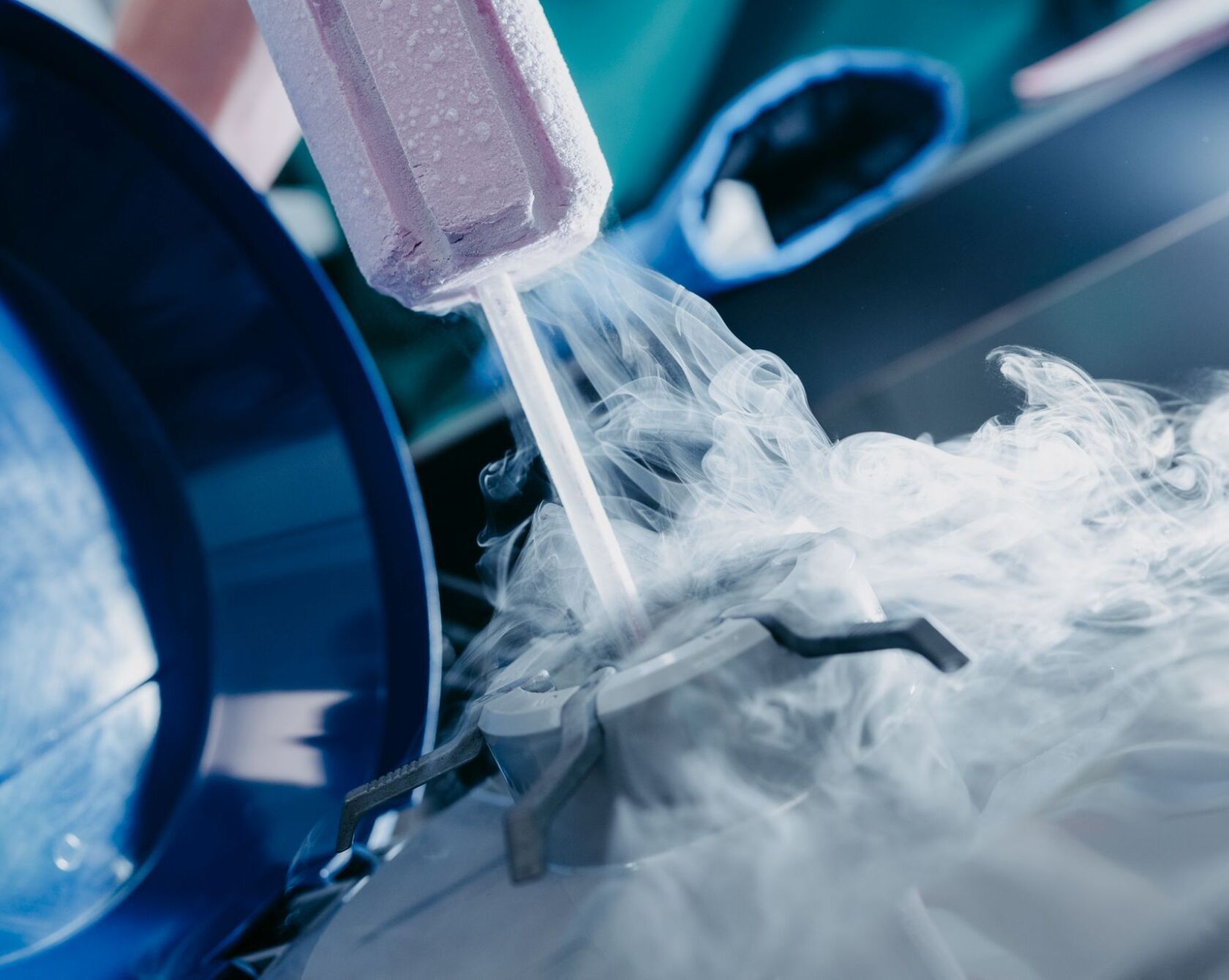
To preserve fertility, egg cells, ovarian tissue, testicular tissue and sperm can be frozen and stored before germ cell-damaging therapies.
“For many patients, the question of how their fertility will be affected by the planned treatment plays a major role when the diagnosis is announced,” says Ruth Stiller, Senior Physician meV at the Clinic for Reproductive Endocrinology at the USZ. The possibility of later parenthood is an important issue and should be addressed by the treating physicians at the latest when it has been established that a therapy has or may have germ cell-damaging effects in patients before or at fertile age. “With medical freezing, the freezing of eggs or ovarian tissue or sperm or testicular tissue before a treatment that restricts fertility or abruptly ends it, we now have proven options at our disposal,” says Ruth Stiller.
The most common reason for cryopreservation is imminent chemotherapy or radiotherapy for tumor diseases. However, the preservation of eggs, ovarian tissue or sperm and testicular tissue can also be considered if fertility is lost prematurely due to medication, genetic causes or surgical removal of the gonads.
Oocyte retrieval
If a woman decides to undergo egg retrieval and there is enough time from an oncological point of view, the process is similar tosocial freezing. A key difference with “medical freezing” is that the therapy can be started independently of the menstrual cycle, i.e. without waiting for the period, so that treatment of the underlying disease can begin as quickly as possible. The patient receives stimulating medication for 10 to 14 days to allow several eggs to mature in her ovaries. At the optimum time for egg retrieval, the follicular fluid is aspirated from the individual follicles transvaginally with a fine needle in a procedure lasting around twenty minutes under ultrasound guidance. The mature eggs contained therein are frozen and can be thawed and fertilized if a child is desired at a later date.
Removal of ovarian tissue
If cancer treatment has to begin within a few days, there is no time for stimulation and subsequent egg retrieval. “In these cases, ovarian tissue can be surgically removed and frozen. This option can of course also be chosen by women for whom stimulation and cryopreservation of mature eggs would be an option. If the ovaries are irreversibly damaged by the cancer treatment, the ovarian tissue can be thawed and reimplanted after the cancer treatment has been completed if the woman wishes to have children.” This method is the only fertility-preserving measure that can be considered for prepubertal girls.
When cryopreserving ovarian tissue, a whole ovary or part of it is surgically removed, usually via laparoscopy. The outer surface (cortex), which contains the oocytes, is removed from the medulla of the ovary and cryopreserved in approx. 5 x 5 mm pieces. This tissue can later be thawed and retransplanted. This method led to the birth of a child for the first time in 2004. Around 300 children have been born worldwide using this method, which enables both spontaneous pregnancies and pregnancies assisted by reproductive medicine – several of these have been the result of retransplants at the Clinic for Reproductive Medicine at the USZ.
Preservation of fertilized eggs and embryos
If there is sterility before the start of the germ cell-damaging therapy, it is legally permitted to fertilize the retrieved egg cells, create embryos and cryopreserve them. Here, the mature eggs obtained are fertilized with the partner’s sperm by in vitro fertilization (IVF) or intracytoplasmic sperm injection (ICSI), i.e. the insertion of a sperm directly into the egg. The fertilized eggs are then frozen either immediately or a few days later as embryos and stored for later treatment. Ovarian stimulation with egg retrieval takes around two weeks.
Medical freezing for men
Sperm can be frozen in men and boys. Because retrieval is possible at any time and access to the sperm is more direct, the process is easier and faster than for women and girls. Sperm is primarily collected via ejaculation. If this is not possible due to illness or age, sperm retrieval from testicular tissue is an alternative. In prepubertal boys, however, the cryopreservation of sperm from testicular tissue is not yet as mature as the use of ovarian tissue in prepubertal girls.
Secure and indefinite storage, assumption of costs
To ensure safe storage, all containers in the cryo-bank at the USZ are continuously connected to an alarm system and monitored around the clock. Unfertilized and fertilized eggs, sperm and embryos from women and men with infectious diseases are stored separately. “Our medical freezing enables us to keep all options open for our patients once their treatment is complete. This was not possible just a few years ago. A therapy that damages germ cells no longer means the end of fertility,” says Ruth Stiller, summarizing the advantages.
Since 2019, the costs of fertility-preserving measures and the storage costs of ovarian tissue, eggs or sperm have been covered by health insurance for five years. If the permanent damage to the germ cells is confirmed after 5 years, the storage fee is covered by the health insurance fund for a further 5 years. According to the Swiss Reproductive Medicine Act, the storage period for egg cells, ovarian tissue and sperm is unlimited.
Special consultation on fertility preservation for him and her
To preserve fertility – often before chemotherapy for tumors, but also for other reasons – we can freeze and store sperm, eggs or ovarian tissue depending on the situation.