An interdisciplinary specialist unit at the USZ takes care of people with chronic physical complaints who have not yet received a clear diagnosis. A unique offer throughout Switzerland.
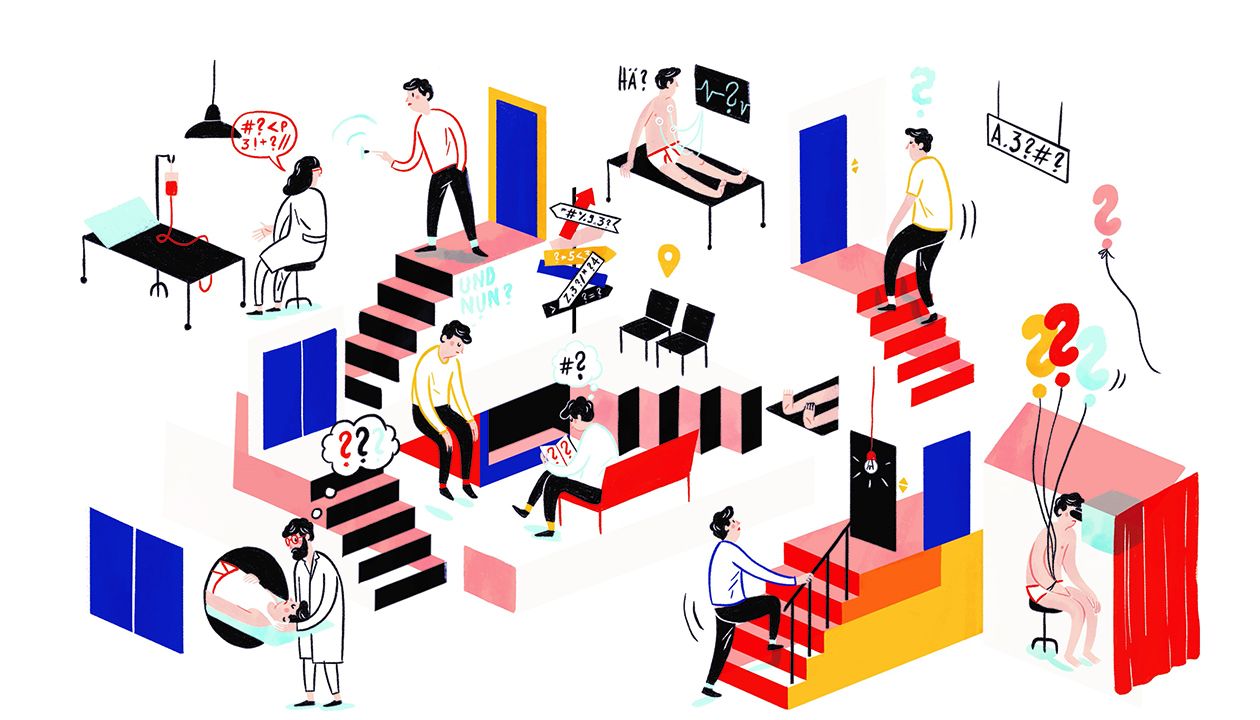
Just the thought of it makes you ill: no one, absolutely no one, helps when your health is in a bad way or you are in constant pain. A marathon through doctors “and therapists” surgeries is the order of the day, without the goal coming even one step closer. “Patients without a clear diagnosis often go through a very long ordeal,” says Prof. Dr. med. Dominik Schaer, Deputy Director of the Clinic and Polyclinic for Internal Medicine at the USZ. Dominik Schaer heads the contact point for patients without a diagnosis, which was launched by the USZ and the Children’s Hospital in 2017 as part of the “Highly Specialized Medicine” strategy initiated by the Canton of Zurich.
Last chance for answers
In the two years of its existence, the interdisciplinary unit has already scrutinized over a hundred complex cases. “This ranges from generalized pain problems, muscle weaknesses or metabolic disorders to rare genetic inflammatory diseases,” explains Dominik Schaer. What the individual cases have in common is not only the long path of suffering, but also the extent of the medical records, the list of previous medical consultations and the unsatisfactory outcome for the person concerned. “For most of our patients, we are something like the last chance to get an answer to the question of what they don’t have or are missing,” notes Dr. Jana Habermann, senior physician and coordinator of the contact point.
Normally, the patient is referred to the contact point by their family doctor or a specialist. However, patients can also contact us directly via the Internet (Center for Rare Diseases). “In order to take action, we need access to the medical history, among other things,” explains Jana Habermann. An initial consultation between doctors and patients usually takes place a good three months after the written application. Expectations need to be lowered at this meeting. “The chances of us tracking down a mysterious illness like Dr. House or finding a quick solution to a problem are rather slim,” emphasizes Dominik Schaer.
Anything but Dr. House
Dominik Schaer and his team have little in common with Dr. House, the misanthropic diagnostician from the US TV series of the same name. The publicity spectacle at the USZ is limited, says the head of the contact point with a grin. “For us, success is primarily the result of hard work.” And hard work in this context primarily means hard work. It is not unusual for the medical reports submitted by patients to run to several hundred pages. Sifting through these for clues from which a clear diagnosis can be derived or an existing one substantiated takes a lot of time. And many people: depending on the case, up to half a dozen specialists from various disciplines and students who work on the case during their medical studies.
A way out of powerlessness
Although the hopes of those affected may go in a different direction, sometimes the specialists at the contact point come to the same conclusion as the doctors consulted by the patient beforehand. “As we know, physical problems can have a long-term effect on the psyche,” explains Dominik Schaer. As a result, it is often psychosomatic illnesses that are ultimately diagnosed. In view of the powerlessness to which those affected have been exposed for a long time, such a finding can certainly be a relief – and represent the end of a long odyssey.