
Bone metastases can be precisely localized and irradiated using image-guided and computer-assisted targeting systems. This means that metastases can also be permanently destroyed in long tubular bones, such as those in the arms and legs, without an increased risk of fractures.
Around a third of all cancer patients suffer from metastases in the bones. These occur when cancer cells migrate away from their original tumor (metastasize) and settle in the bone. Bone metastases are extremely painful and have a massive impact on quality of life. In addition, the bone structures are often weakened, leading to fractures. Longer bones in the extremities are particularly affected as they have to withstand high mechanical stress.
Radiotherapy is an important pillar of treatment for cancer. It helps with various types of cancer. High-energy beams are used, which can be directed specifically at the malignant tumor. The cancer cells are damaged and die.
More about radiotherapy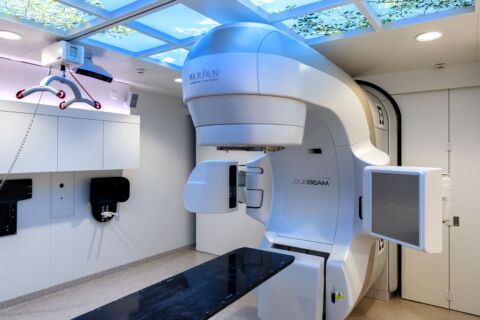
TrueBeam linear accelerator in the Department of Radio-Oncology, University Hospital Zurich
Radiation is often used with the aim of controlling pain and bone pain over a longer period of time. The current challenge is to optimize this so-called palliative radiation. However, the focus is now not only on short-term relief of pain and symptoms, but also on long-term control of metastatic growth. This is particularly important in view of the fact that, thanks to new treatment methods such as immunotherapies, a longer lifespan can be achieved even with metastatic tumors.
More about immunotherapies at the CCCZRecent studies have shown that the use ofstereotactic radiotherapy (SRT) can achieve pain relief, preservation of neurological function and bone stability in spinal metastases. SRT uses image-guided (X-ray, CT, MRI) and computer-assisted targeting systems to enable precise localization of the metastasis and very accurate irradiation.
So far, there has been little data on how the use of SRT works for metastases in longer bones, such as those in the arms and legs. Fractures of these bones were a concern, as they would have a major impact on the mobility and quality of life of those affected.
Matthias Guckenberger: “High-precision radiotherapy enables better control of advanced cancer while improving the quality of life for our patients”
In the world’s largest multicenter, retrospective study, i.e. a study that includes data already collected from many different clinics, it has now been shown under the leadership of the Department of Radiation Oncology at the USZ that the risk of fractures after SRT irradiation of longer bones (upper arm, thigh, tibia) is very low, lower than after traditional treatment of bone metastases with conventional radiotherapy. These results suggest that SRT prevents bone weakening by permanently killing the metastases and thus has a protective effect against fractures.
In summary, SRT permanently controls metastases in long bones without increasing the risk of fracture. These results must now be investigated and confirmed in further studies.