Overview
In hemodialysis, the blood is brought into contact with a dialysate through a membrane. This allows the toxins and fluid to be removed. The therapy must be performed three times a week for about four hours. For most patients, this takes place at a dialysis center, but it can also be arranged as home hemodialysis.
Vascular access is required for effective hemodialysis. Currently, the best access method is a so-called dialysis shunt (a connection between an artery and a vein) created using the patient’s own blood vessels. A plastic container is an alternative. The least favorable option is hemodialysis via a catheter, as it carries a high risk of infection and thrombosis. Since dialysis shunts take time to “mature” before they can be used (about six to eight weeks), such an access must be created in a timely manner to avoid the need for catheters.
Our Assessment and Treatment Options
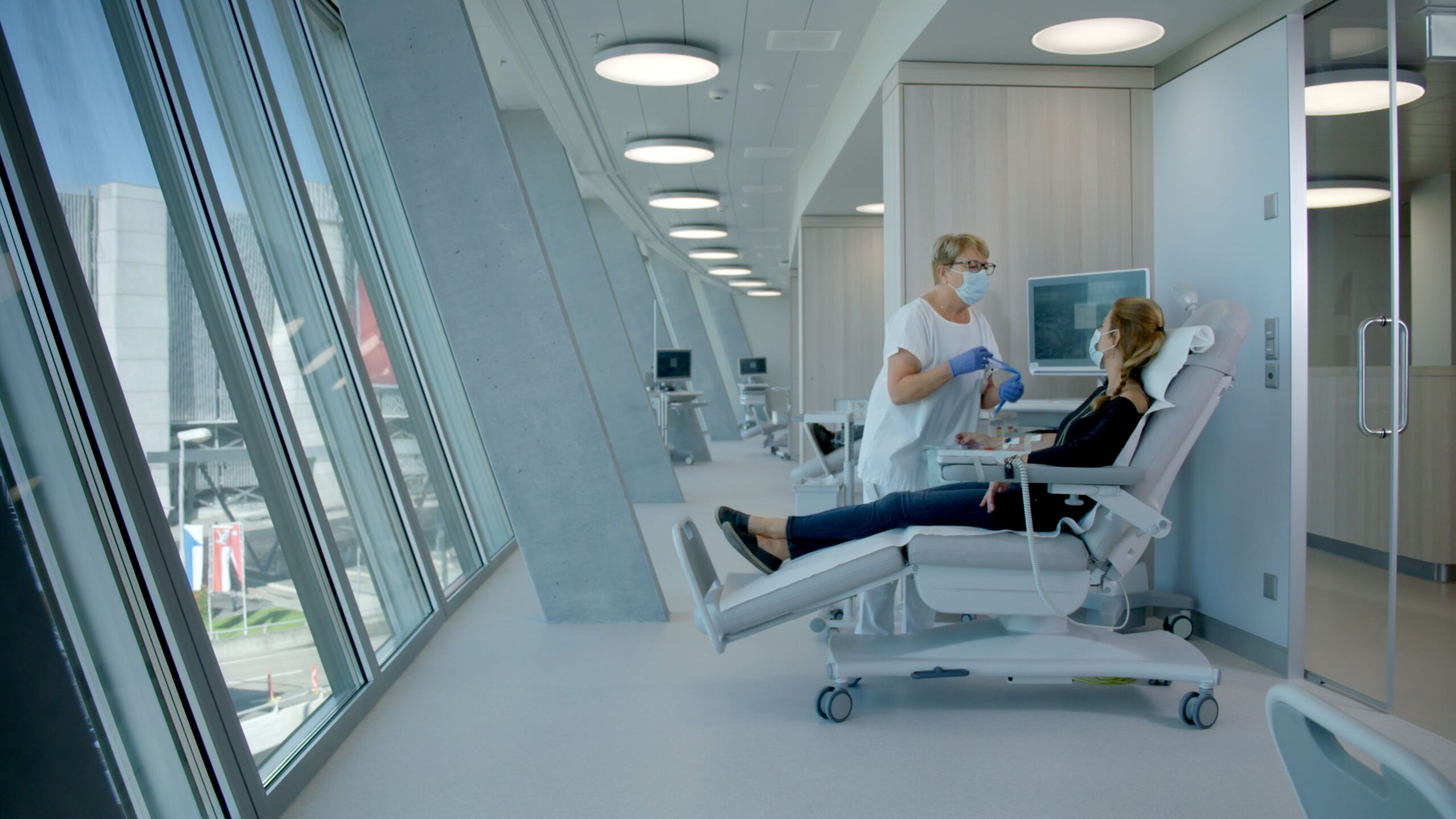
At the heart of our work is the comprehensive care for patients requiring renal replacement therapy. If kidney function is no longer sufficient, we help select the dialysis method that best meets the patient’s needs and ensures the greatest possible independence.
Depending on whether you choose hemodialysis or peritoneal dialysis, we will provide the appropriate training.
For chronic dialysis treatment, we have a modern dialysis unit with bright rooms (and a 1:4 nurse-to-patient ratio). We have 13 dialysis stations here, which operate six days a week in two shifts. We also offer an evening shift, which is especially popular among working people. Approximately 8,500 hemodialysis treatments are performed at our center each year.
Dialysis Center at the USZ Airport
The University Hospital of Zurich also operates a dialysis center with 16 treatment stations at the USZ Airport Outpatient Clinic. We would be happy to provide you with university-level care in a pleasant setting.
Collaboration at the USZ
In collaboration with the Department of Angiology, every patient undergoes a duplex ultrasound examination of their blood vessels prior to a scheduled shunt procedure. The shunt procedure is performed by the staff in the Department of Visceral Surgery. An interdisciplinary team of specialists in angiology, surgery, interventional radiology, and nephrology meets every 14 days to discuss complex dialysis access procedures (VAM).