Overview: What is acne inversa?
Despite the similar name, acne inversa (Acne inversa) should not be confused with “common acne”(Acne vulgaris), which affects many adolescents during puberty. Rather, it is a chronic skin condition that is difficult to treat, in which painful and often weeping skin changes (skin lesions) form on various parts of the body—usually in flare-ups.
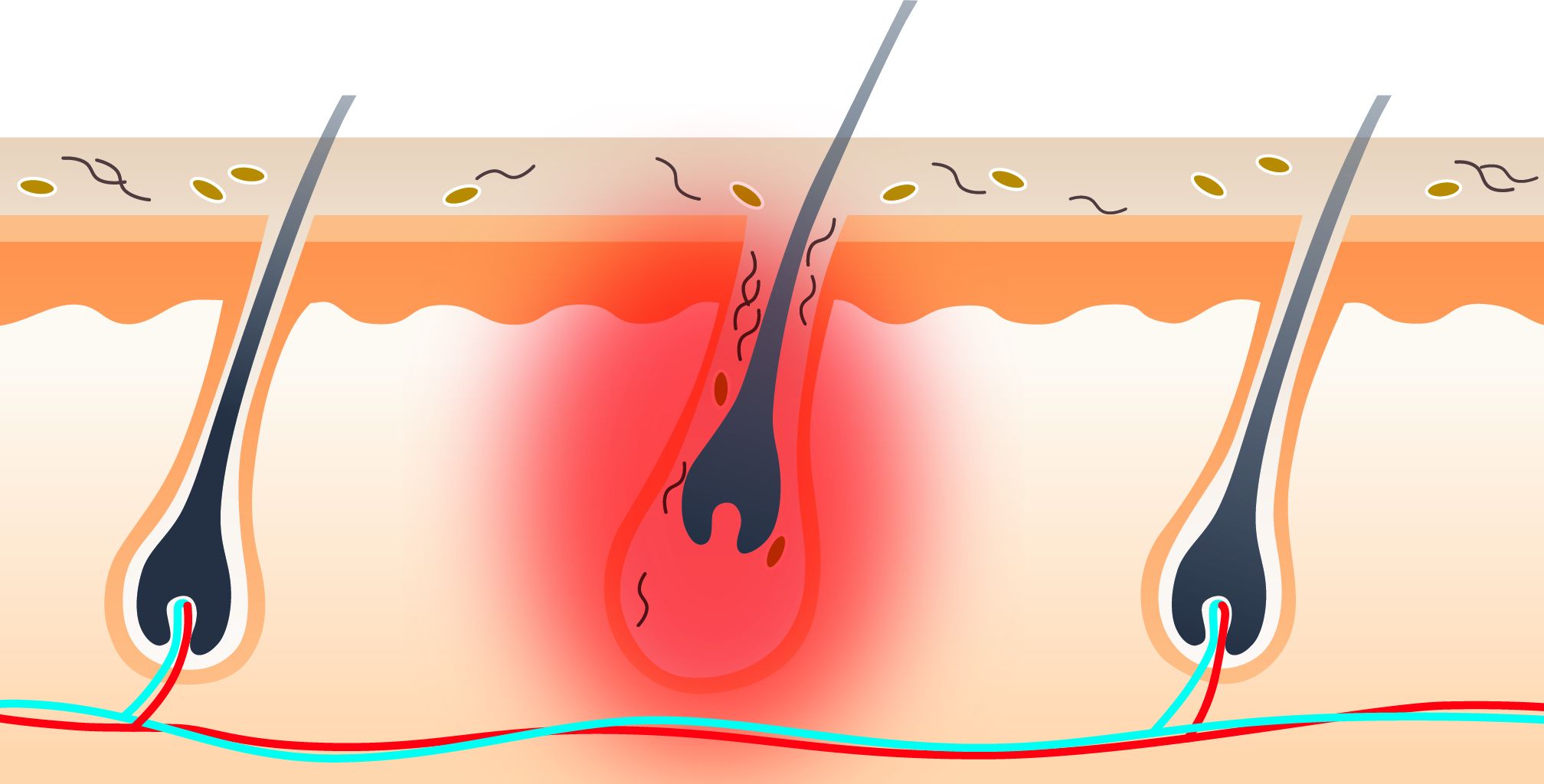
Ruptur, Alexander Navarini
Acne inversa – Prevalence and Age
In Western Europe, an estimated 1 percent of the population suffers from acne inversa. Women are affected more often than men. The disease usually begins in early adulthood—more specifically, after puberty and before the age of 30. In principle, however, acne inversa can occur at any age.
Acne inversa: causes and risk factors
Thickening of the stratum corneum (hyperkeratosis) around the hair follicles appears to play a key role in the development of acne inversa. This can cause the openings of adjacent sebaceous and sweat glands to close. Sebum and sweat become trapped, causing deep-seated localized inflammation—which can lead, among other things, to the formation of painful nodules and encapsulated collections of pus (abscesses).
The exact causes of these severe skin changes are not yet known. However, it is likely that several factors contribute to the development of acne inversa. We assume that there is a genetic predisposition to the disease because it sometimes runs in families. In combination with other factors, it could then lead to an outbreak. The following triggers (trigger factors) for acne inversa have been proven or are under discussion:
- Smoking
- severe overweight ( obesity)
- Excessive sweating (hyperhidrosis)
- mechanical irritation of the skin (e.g., from shaving)
Acne inversa—often associated with other conditions
Acne inversa occurs more frequently in association with certain other conditions. These include, for example, the two chronic inflammatory bowel diseases—Crohn’s disease and ulcerative colitis—as well as rheumatic diseases.
Symptoms: Acne inversa
Acne inversa typically causes painful, bright red, firm skin nodules and lumps to form. These can develop into encapsulated collections of pus (abscesses), which can merge with one another deep beneath the skin and rupture outward. Then a purulent or bloody, watery discharge oozes out. The skin changes may resolve on their own, but they can also recur or persist for a long time. In addition, branched tubular passages, known as fistulas, can form in the tissue. They can open onto the skin’s surface and secrete a fluid. When the inflammatory skin changes heal, they often leave scars.
Acne inversa: Three Severity Levels
Depending on the severity of the disease, we differentiate between three stages (Hurley Score):
- Stage one: isolated abscesses, no formation of fistulas or scarring
- Stage two: one or more widely spaced abscesses, as well as fistula tracts and scarring
- Stage three: widespread involvement with abscesses, fistula tracts, and scar tissue
Acne inversa: Which areas of the skin are affected?
The inflammatory skin lesions associated with acne inversa primarily affect areas of the body that have skin folds or where areas of skin rub against each other. These mainly include:
- Armpits
- groin area
- Genital and anal regions
Sometimes the inflamed areas of skin can also be found on other parts of the body, such as under the breast (in women) or on the inner thighs. The face, the scalp, and the back are rarely affected.
Online Skin Check: Quick and Convenient from Home
Please submit a photo of the affected area of skin and fill out the short questionnaire. Within 24 hours on business days, you’ll receive a reliable diagnosis from our experts. Clicking the button will take you to our partner’s external platform, where you can securely enter your information. These are forwarded to the USZ in a secure manner for further evaluation.
Diagnosis of acne inversa
First, we will have a detailed conversation with you to get a picture of your medical history (medical history). Possible questions include, among others:
- What are your symptoms?
- When did you notice the first skin changes?How have they changed since then?
- Are there any known cases of acne inversa in your family?
- How tall are you, and how much do you weigh?
- Do you smoke?
We can calculate your Body Mass Index (BMI) based on your height and weight. This will then indicate whether you are overweight. As mentioned above, being severely overweight—just like smoking—contributes to the development of acne inversa.
The medical history interview may be followed by various examinations, although not all of them are necessary in every case:
- Examination of the affected skin areas.We carefully examine the inflamed areas of skin.If necessary, we will examine fistula tracts more closely by inserting a small probe into their mouths.
- Swab.In order to prove the involvement of bacteria in the inflammatory processes, we can take a smear from deeper tissue areas and send it to the laboratory for analysis.
- Blood test. Sometimes we take a blood sample to measure markers of inflammation, such as C-reactive protein (CRP).
- Imaging procedures.In some cases, ultrasound or magnetic resonance imaging (MRI) is used to examine how deep the inflammation has spread into the tissue.
These tests can not only help confirm a suspected case of acne inversa, but also rule out other conditions with similar symptoms. These so-called differential diagnoses for acne inversa include, among others:
- Recurrent inflammation of hair follicles (folliculitis)
- Boil (a painful, pus-filled inflammation of a hair follicle and the surrounding tissue)
- Carbuncle (deep, painful, collective inflammation of several adjacent hair follicles)
- Cutaneous Tuberculosis
- Trichophytosis (an infection of the skin and its appendages—such as hair—caused by fungi of the genus Trichophyton)
- in the anal region, e.g., anal fistula and Crohn’s disease
In summary, the path to an accurate diagnosis of acne inversa is often a long one. It is not uncommon for the disease to be diagnosed and treated only years after its onset. One reason for this is that many people affected delay seeking medical care out of shame. In addition, diagnosing acne inversa is often difficult. As a result, the skin lesions associated with this serious disease are sometimes mistaken for ordinary abscesses, especially in the early stages, or attributed to inflammation of the hair follicles (folliculitis).
Acne inversa: prevention, early detection, prognosis
Since the exact causes of acne inversa are not yet known, it is difficult to effectively prevent the condition. If there is a family history of acne inversa, it may be helpful to avoid known risk factors such as smoking or being severely overweight.
Acne – Course and Prognosis
Acne inversa is a chronic condition that usually occurs in flare-ups. Treatment can alleviate symptoms, but it does not cure the condition. Even after surgical removal of affected skin lesions, abscesses and other skin changes may develop again later.
Complications are rare in acne inversa. These include, for example, erysipelas and swelling caused by lymphatic congestion (lymphedema). It is also rare for the skin lesions of acne inversa to develop into a specific form of skin cancer (squamous cell carcinoma).
As severe as the physical symptoms of acne inversa can be, the associated psychological distress should not be underestimated. It can cause those affected to withdraw from social life and even become depressed.
Acne inversa: treatment is planned individually
The treatment for acne inversa depends largely on the severity of the disease.It can include various medications and/or surgical interventions.
Details of the treatments