What is Duchenne muscular dystrophy?
Duchenne muscular dystrophy (DMD) is the most common of more than 30 chronic, genetically caused muscle disorders that are collectively referred to as “muscular dystrophy.” In all of these conditions, functional muscle mass is gradually lost.
Duchenne muscular dystrophy usually begins in early childhood and leads to progressive muscle weakness. As the disease progresses, not only the skeletal muscles but also the cardiac and respiratory muscles become significantly impaired, making nighttime ventilation necessary (usually around the ages of 18–20) and, as the disease advances, daytime ventilation as well. However, early diagnosis and specialized treatment can positively influence the course of the disease and often help maintain quality of life for many years.
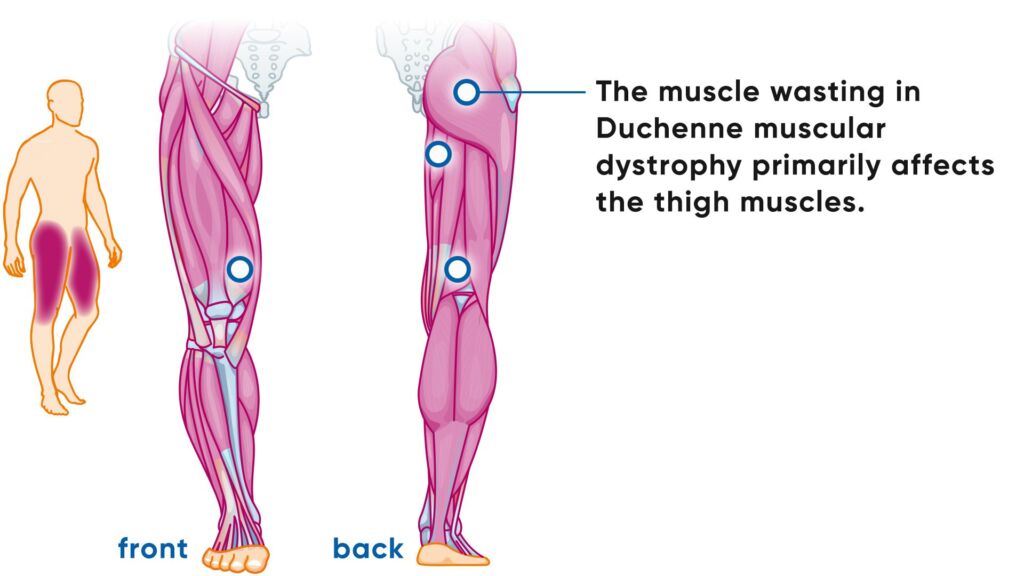
Duchenne or Becker muscular dystrophy—what’s the difference?
Duchenne muscular dystrophy (DMD) and Becker-Kiener muscular dystrophy (BMD) are both types of dystrophinopathies and result from mutations in the dystrophin gene. Both conditions lead to progressive muscle wasting, but they differ significantly in terms of onset, course, and severity.
Duchenne muscular dystrophy begins as early as infancy. Due to the near-total absence of the protein dystrophin, the disease progresses relatively quickly, and involvement of the respiratory and cardiac muscles becomes apparent earlier.
Becker-Kiener muscular dystrophy, on the other hand, has a milder course. Although those affected produce dystrophin, it is altered and has limited functionality. The first symptoms often do not appear until school age, adolescence, or young adulthood. Many people with this condition retain their ability to walk for much longer—in some cases, well into adulthood or beyond. Life expectancy is also generally higher than in Duchenne muscular dystrophy, although heart problems play a significant role as the disease progresses.
| Duchenne Muscular Dystrophy |
Becker-Kiener Muscular Dystrophy |
| Onset usually occurs between the ages of 2 and 6 |
Onset usually occurs after age 7, though in some cases not until adulthood |
| Dystrophin is almost entirely absent |
Dystrophin is present, but altered |
| Faster progression of the disease |
Slow progression of the disease |
| Early Loss of the Ability to Walk |
The ability to walk is often maintained well into adulthood |
| Heart and respiratory muscles are affected early on |
Cardiac involvement is common; the respiratory muscles are usually affected later |
| The most common form of muscular dystrophy |
Significantly less common |
Duchenne Muscular Dystrophy: Prevalence and Age
Duchenne muscular dystrophy is rare, but it is by far the most common form of muscular dystrophy: it occurs in about one in 3,500 newborn boys. Girls are not affected, as the disease is inherited through the X chromosome (see Causes and Risk Factors).[9.1] The Becker-Kiener muscular dystrophy (BMD) variant is significantly rarer. The first signs of DMD appear between the ages of two and six. BMD typically begins after the age of 7, often by the age of 20; however, in rare cases, the first symptoms may not appear until middle or late adulthood.
Duchenne muscular dystrophy: causes and risk factors
DMD is caused by a genetic defect in the dystrophin gene. As a result, the body can no longer produce the dystrophin protein. This is a protein that is essential for maintaining a stable cell membrane in muscle fibers. As a result of the dystrophin deficiency in people with Duchenne muscular dystrophy, muscle fibers are progressively broken down.
The milder form of BMD is also caused by a defect in the dystrophin gene. It causes those affected to produce dystrophin, but only in a truncated form with limited functionality, so that muscle fibers are gradually broken down here as well, though much more slowly than in DMD.
Symptoms of Duchenne Muscular Dystrophy
The first symptoms of Duchenne muscular dystrophy usually appear between the ages of two and six. The disease typically begins with weakness in the pelvic and thigh muscles and progresses slowly over time. As the illness progresses, other muscle groups, as well as the heart and respiratory muscles, may be affected.
Typical symptoms are
- delayed motor development, such as learning to walk late
- frequent tripping or falling
- Difficulty running, jumping, or climbing stairs
- distinctive waddling gait
- Difficulty getting up from the floor (Gowers’ sign)
- Progressive muscle weakness, initially mainly in the pelvic and thigh areas, and later also in the shoulders and arms
- Enlarged calves due to the replacement of muscle tissue with fat and connective tissue (pseudohypertrophy)
- Shortening of tendons and joints (contractures)
- Curvature of the spine (scoliosis), particularly after losing the ability to walk
- progressive loss of the ability to walk
- Weakness of the respiratory muscles accompanied by breathing difficulties, especially during sleep
- Involvement of the heart muscle leading to the development of a heart muscle disorder (cardiomyopathy)
The course of the disease can vary from person to person. Early diagnosis and specialized, interdisciplinary treatment can alleviate symptoms, detect complications at an early stage, and often help maintain quality of life for many years. If there are signs of motor development issues, repeated stumbling, increasing muscle weakness, or a family history of such conditions, a medical evaluation should be conducted. An early diagnosis allows for timely specialized care and treatment.
Duchenne Muscular Dystrophy – Treatment at Our Clinic
Since Duchenne muscular dystrophy can affect not only the skeletal muscles but also the heart and respiratory muscles, we examine these organ systems at the time of diagnosis and on a regular basis as the disease progresses.
These include:
- Electrocardiography (ECG): Assessment of the electrical activity of the heart muscle.
- Echocardiography: An ultrasound examination of the heart to assess heart function and possible involvement of the heart muscle.
- Lung function tests: spirometry, respiratory muscle strength measurements, and cough testing for the early detection of respiratory muscle weakness.
- Arterial blood gas analysis: Assessment of ventilation and gas exchange, as well as early detection of respiratory failure.
- Sleep studies: Polysomnography and transcutaneous capnometry to detect nocturnal hypoventilation or sleep apnea.
Interdisciplinary Neuromuscular Center
As a specialized center, the USZ cares for the largest Swiss cohort of adults with muscular dystrophy and, as an interdisciplinary neuromuscular center, has a team of experts from the fields of pneumology, neurology and therapists who work closely with other specialist disciplines such as cardiology, gastroenterology and orthopaedics/paraplegia. In addition, there is close cooperation with the Mathilde Escher Foundation, which specializes in the care of patients with Duchenne muscular dystrophy and whose care model works exceptionally well in collaboration with the USZ.
Duchenne muscular dystrophy: prevention, early detection, prognosis
The genetic defect that causes DMD cannot be prevented. If you are a woman who already has a son with DMD and are planning to have more children, genetic counseling and genetic testing during pregnancy may be advisable. This is because half of any other sons could also develop muscular dystrophy. Half of your daughters could carry the genetic defect, just like you. Genetic testing for expectant mothers is possible starting in the tenth week of pregnancy. It can detect or rule out a genetic defect in the dystrophin gene in the unborn child with a high degree of certainty. It is also important that, as a gene carrier, you undergo a cardiological examination so that any heart muscle disease you may have can be detected and treated early.
If you are the sister of a boy with Duchenne muscular dystrophy, genetic counseling and genetic testing might also be a good idea. This will help determine whether you are a carrier of the genetic defect and whether genetic counseling regarding family planning and a cardiological examination would be advisable for you.
Duchenne Muscular Dystrophy – Course and Prognosis
Duchenne muscular dystrophy progresses continuously. The first symptoms usually appear as early as toddlerhood and initially affect mainly the pelvic and thigh muscles. As the condition progresses, muscle weakness increases and spreads to other muscle groups. Many people with this condition lose the ability to walk over time. Later on, the respiratory and cardiac muscles are also affected, which is why regular interdisciplinary care is particularly important.
There is currently no cure for Duchenne muscular dystrophy. However, thanks to modern treatment options and specialized care, it is possible to slow the progression of the disease, significantly extend survival, detect complications early, and maintain quality of life for many years.
Before the introduction of long-term mechanical ventilation, many patients died around the age of 20, usually as a result of respiratory failure. Today, life expectancy is significantly higher thanks to long-term mechanical ventilation and improved medical care.
In Becker-Kiener muscular dystrophy, the disease progresses much more slowly. Many people with the condition do not lose the ability to walk until 25 to 30 years after the onset of the disease; some never lose it at all. However, life expectancy may be limited, particularly due to involvement of the heart muscle.
Self-Help Groups
Talking with others who are going through the same thing can be a great source of support when coping with an illness. If you are looking for a suitable self-help group , you can get advice from Selbsthilfe Zürich. Selbsthilfe Zürich and the University Hospital of Zurich are partners in the national project “Health Literacy Through Self-Help-Friendly Hospitals.”
Duchenne muscular dystrophy: treatment is individually adapted
Therapy for Duchenne muscular dystrophy aims to maintain the remaining muscle strength of those affected for as long as possible and to manage disease-related problems (e.g. in everyday life) with aids, for example. In addition, factors that can worsen the course of the disease (e.g. obesity) should be treated and the treatment of heart problems is also very important.
FAQs on Duchenne Muscular Dystrophy
In Duchenne muscular dystrophy, a genetic mutation results in the absence of the protein dystrophin. As a result, muscle cells become increasingly damaged and are replaced by fat and connective tissue. The disease leads to progressive muscle weakness and, as it progresses, can also affect the heart and respiratory muscles.
There is currently no cure for Duchenne muscular dystrophy. However, modern treatment options can slow the progression of the disease, alleviate symptoms, and improve quality of life and life expectancy.
Life expectancy has improved significantly in recent decades. Thanks to early diagnosis, specialized care, and modern treatment and ventilation options, many people with this condition now live into adulthood and beyond. An individual prognosis depends, among other things, on the course of the disease and the treatment.
Early signs often include delayed motor development, frequent stumbling or falling, and difficulty running, jumping, or climbing stairs. Symptoms usually appear between the ages of two and six.
Because of X-linked inheritance, women do not develop Duchenne muscular dystrophy. However, they may be carriers of the mutated gene. In rare cases, female carriers may also develop mild symptoms or heart muscle involvement.
Duchenne muscular dystrophy is inherited through the X chromosome. Women can pass the mutated dystrophin gene on to their children. Boys are significantly more likely to develop the disease because they have only one X chromosome.