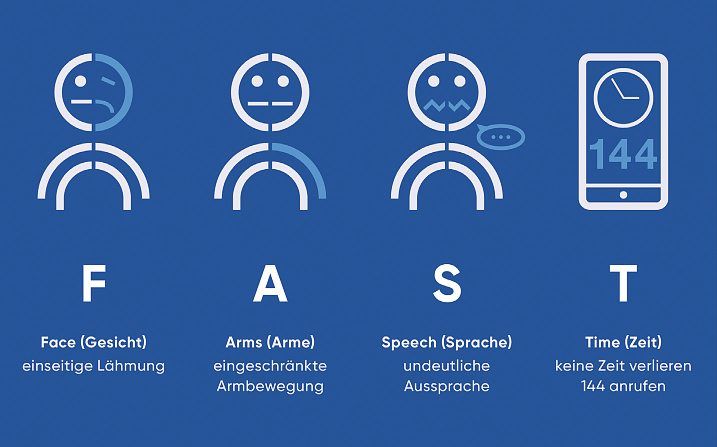
It affects more than 40 people in Switzerland every day: they suffer a stroke. It is one of the most urgent emergencies, because every minute that passes before intervention worsens the prognosis.
Anna is having coffee with her friend Ruth. They talk, everything is as usual. But suddenly Anna sees that Ruth’s coffee is running down the side of her chin and her left cheek is hanging limply. It is immediately clear to the paramedic who is called: Ruth has suffered a stroke.
React quickly, dial 144
Strokes do not announce themselves. They occur suddenly, sometimes even during sleep. “Alarm signs are signs of paralysis on one side of the body, sudden confusion or slurred speech,” explains Andreas Luft, Head of the Stroke Center at the USZ. He adds: “If there is the slightest suspicion, there is only one thing to do: call the emergency services immediately!” Ideally, the emergency services will take the patient directly to a stroke center, where a team specializing in strokes is on duty around the clock. There are ten such centers in Switzerland. One of these is at the USZ.
Cerebral hemorrhage or cerebral infarction?
There are two types of stroke: the so-called “hemorrhagic” and the “ischemic”. In the first case, a cerebral hemorrhage is the cause of the stroke, in the second a blocked vessel. Cerebral hemorrhages are usually the result of high blood pressure. Ischemia is much more common and is usually caused by arteriosclerosis or heart disease. The most important risk factors are high blood pressure, high cholesterol and sugar (diabetes) as well as smoking. Ultimately, the effect is the same for both types of stroke: A certain area of the brain is no longer supplied with blood and therefore no longer supplied with oxygen. However, the therapy is completely different, because only in the case of ischemia can the stroke be prevented by reopening the vessel. It is therefore important to know as quickly as possible whether a hemorrhage or ischemia is present, which today is done using computer tomography or magnetic resonance imaging.
Interdisciplinary cooperation is key
If the patient has suffered a cerebral hemorrhage, surgery can be performed in individual cases. Then the specialists in neurosurgery are called upon. If, on the other hand, it is a vascular occlusion, the first step is to administer blood thinners. In addition, attempts are often made to penetrate the blockage using a minimally invasive catheter and either dissolve the blood clot locally or reopen the vessel using a stent. The neuroradiologists perform this task together with the neurologists. “Every case is different, because only one single vessel can be affected or several. It also depends very much on where the blockage is located,” explains Andreas Luft. The prognosis is therefore also very individual. But one thing applies in any case: time is of the essence.