An analysis from the Tumor Profiler project shows that personalized treatment decisions do not increase the risk of serious side effects.
A comprehensive molecular analysis of tumors can help tailor treatment for people with advanced melanoma to individual patients—without increasing the risk of serious side effects. This is the conclusion reached by a new study from the Tumor Profiler Project, which was published in the journal *JCO Precision Oncology *.
In recent years, targeted therapies and immunotherapies have significantly transformed the treatment of melanoma—also known as malignant melanoma. Nevertheless, the disease often remains difficult to treat. Tumors differ greatly from one another biologically, and not all patients respond equally well to treatment. In addition, tumors can develop resistance during the course of treatment.
Precision oncology therefore aims to tailor treatments more closely to the biological characteristics of an individual tumor. The Tumor Profiler project uses particularly comprehensive molecular analyses of tumor tissue for this purpose.
“The better we understand the biological characteristics of a tumor, the more precisely we can select treatments.” “The results show that this data-driven approach can open up additional treatment options without compromising treatment safety.”
More comprehensive tumor analyses support treatment decisions
The study focuses on an approach known as multi-omics profiling. In this process, tumors are examined using several modern technologies simultaneously to obtain the most comprehensive picture possible of their molecular characteristics.
For the analysis, the researchers compared treatments for patients with advanced melanoma—in which treatment decisions were guided by multi-omics data—with a comparable group of treatments that did not involve comprehensive tumor profiling. A total of 98 treatments from the Tumor Profiler project were compared with 98 carefully matched treatments from the control group.
Both groups were treated in the same clinical setting, which made it possible to largely rule out differences in medical care.
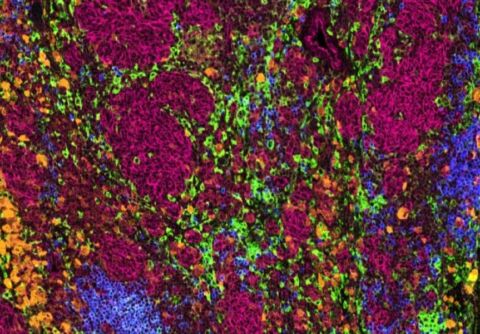
Tumor cells embedded in tissue are stained magenta (Photo: Bodenmiller Lab, University of Zurich).
The incidence of serious side effects remains the same
The analysis showed that severe side effects occurred with similar frequency in both groups. About 40 percent of the treatments resulted in severe side effects—a rate that was comparable in both the group receiving multi-omics-based therapy and the control group.
The study thus suggests that the use of extensive molecular data—even when it leads to additional or more unusual treatment options—is not associated with an increased risk of serious complications.
More mild side effects—but a shorter duration
In the group receiving multi-omics-guided therapy, slightly more side effects were reported overall. However, these were predominantly milder events, such as fever during targeted therapies or temporary changes in liver function tests during immunotherapies.
These side effects often occurred earlier in the course of treatment, but on average lasted for a shorter period of time and resolved completely more often than in the comparison group. There was also no significant difference between the two groups in the number of hospital admissions or in the costs of treating side effects.
More Treatment Options Through Detailed Tumor Profiles
Another important finding concerns the variety of therapies used. Thanks to the comprehensive molecular characterization of the tumors, the Tumor Profiler group was able to employ a wider variety of treatment approaches. This also included combinations of medications or treatments outside of established standard therapies, such as those used in clinical trials or as off-label therapies.
Despite these expanded therapeutic options, the safety profile of the treatments remained comparable to that of conventional treatment strategies.
The results thus provide important evidence that comprehensive molecular analyses can help make treatment decisions more personalized without creating additional risks for patients. Further prospective studies will now examine how this approach affects treatment outcomes in the long term.
The Tumor Profiler Center Switzerland
The Tumor Profiler Center Switzerland (TPC) is a research and clinical network that advances precision oncology in Switzerland. It brings together basic researchers and clinicians from ETH Zurich, the University of Zurich, the University Hospital of Zurich, and the University Hospital of Basel.
At the heart of the project is a particularly comprehensive analysis of tumors using so-called multi-omics technologies. These provide detailed information about genetic changes, biochemical processes, the interactions among the various cell types within the tumor, and how tumor cells respond to different drugs.
The data collected is interpreted jointly by researchers and oncologists in an interdisciplinary Molecular Tumor Board to discuss treatment options for individual patients. Modern artificial intelligence methods help analyze large amounts of data and identify new biomarkers or potential targets for future therapies.