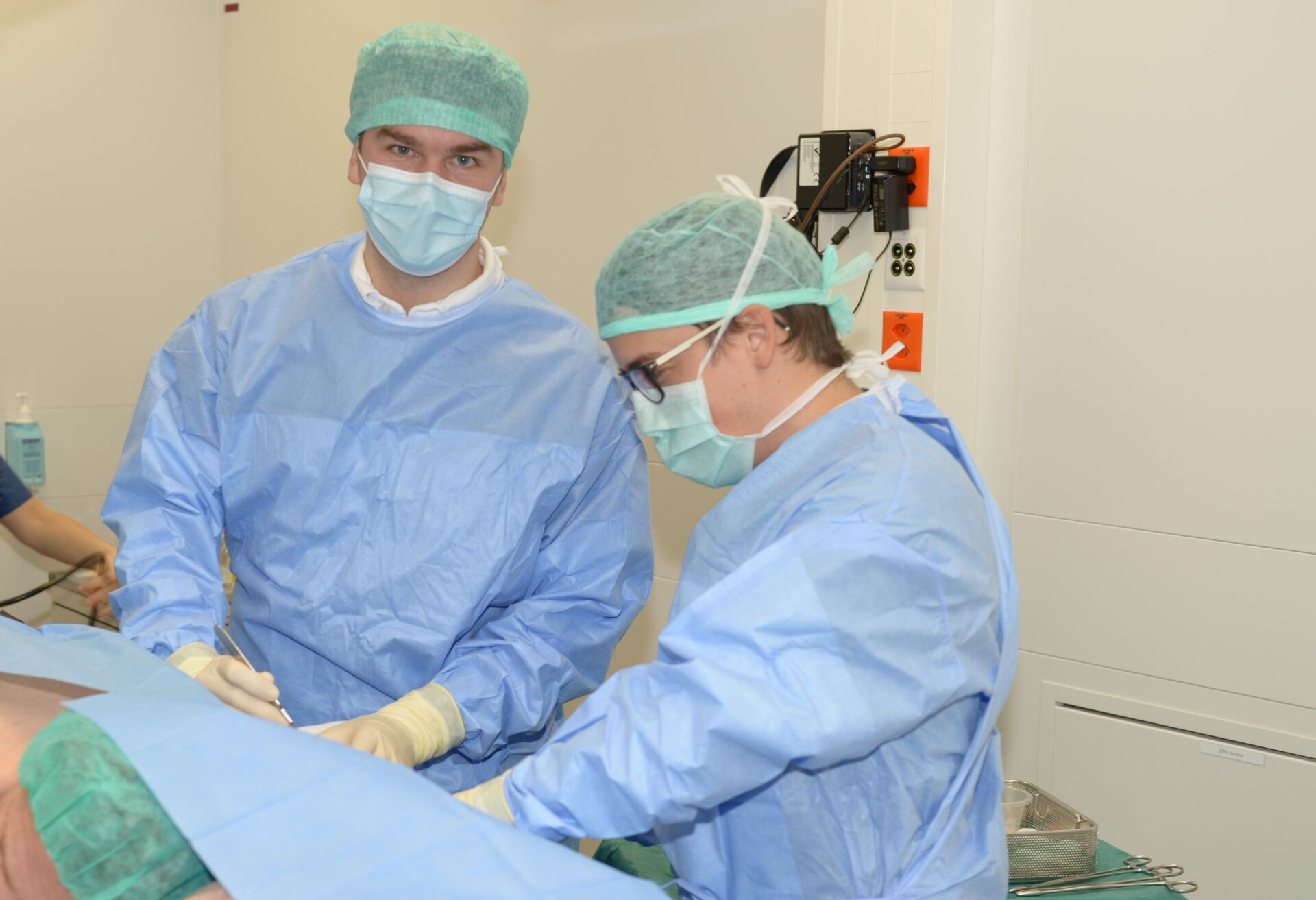
Close cooperation in dermatosurgery
A particular specialty of our clinic is Mohs surgery, with which skin tumors can be treated with the greatest certainty that the tumor has been completely removed, but with a minimal excision defect (see my.derma.ch). A characteristic of our form of dermatosurgery is the close and friendly cooperation between the various clinics within the USZ, which leads to excellent coordination of specialist and surgical expertise.
Mohs surgery
Treatment of skin cancer
Our dermatosurgery department mainly treats patients with skin cancer:
Basal cell carcinoma of the skin
Simple excisions, defect reconstruction with suture flap plasty, Mohs surgery (micrographic surgery, classic method using a quick incision or “slow Mohs” according to the “Tübingen cake”). Further information and short video clips on the Mohs surgery method can be found below.
Spinocellular carcinoma (squamous cell carcinoma) of the skin
Analogous to basal cell carcinoma. Poorly differentiated tumors, tumors with deep infiltration or perineural invasion, and patients under immunosuppression (organ transplant patients, patients with chronic lymphocytic leukemia) must be treated quickly and, as a rule, surgically. If necessary, there is intensive collaboration with reconstructive surgery, ORL and facial surgery and maxillofacial surgery, including for any lymph node surgery.
Malignant melanoma of the skin
The most important step in treatment is the early surgical removal of any suspicious pigment lesion, initially without a safety margin, and histological examination in the laboratory. From a certain tumor thickness, we recommend a sentinel lymph node biopsy of the “sentinel lymph node” in the groin, armpit or neck.
Patient brochures
Various patient brochures are available for download as PDF files. You can also order printed copies of the brochures.
Most frequently asked questions
Dermatosurgery refers to surgical procedures on the skin and structures close to the skin (e.g. nails). This includes both medically necessary operations (e.g. for skin cancer) and procedures to remove benign skin changes.
Dermatosurgery primarily involves the surgical treatment of skin tumors. Depending on the issue, the range of services also includes the removal of benign skin changes, laser therapies, wound surgery and nail surgery.
The vast majority of patients can be treated under local anesthesia – i.e. without general anesthesia. Whether a different anesthesia is appropriate in your case will be clarified individually during the consultation.
Many dermatosurgical procedures can be performed on an outpatient basis. Whether an outpatient procedure is an option for you depends on the procedure, localization, concomitant diseases and, if applicable, the reconstruction.
First of all, your skin changes will be assessed by a specialist. If necessary, additional examinations are carried out (e.g. reflected light microscopy or a tissue sample). The procedure, the operation and aftercare will then be discussed with you.
Removed tissue is usually sent for histological examination. In this way, the diagnosis can be confirmed and it can be assessed whether the change has been completely removed.
Depending on the size and location, the wound can be sutured directly. In other cases, reconstruction (e.g. with a skin flap) or – in selected situations – open wound healing may be appropriate. The aim is to achieve a good functional and aesthetic result.
A scar cannot be completely avoided during surgical procedures. Their appearance depends, among other things, on localization, wound closure, tension on the wound and individual healing. You will receive advice on scar care and check-ups.
As with any operation, bleeding, infection, impaired wound healing, swelling, hematoma or temporary sensory disturbances are possible. Before the procedure, your treatment team will inform you of any risks that are particularly relevant in your case.
You will receive specific instructions in advance. If you are taking blood-thinning medication, please inform the team in good time. Never stop taking medication on your own, but only after consulting your dermatologist.
You will receive instructions on wound care and follow-up appointments. Depending on the diagnosis (e.g. skin cancer), regular follow-up checks are advisable in order to detect new or recurring changes at an early stage.