A meniscus tear does not usually heal by itself. Only smaller, degenerative tears can initially be treated conservatively.
How is a meniscus injury diagnosed?
A variety of clinical tests can be used by the knee specialist. If the diagnosis is uncertain, an MRI of the knee joint is also carried out. In addition to the exact extent of the meniscus damage, other concomitant injuries to the knee joint can also be diagnosed here.
How is a meniscus injury treated?
A meniscus tear does not usually heal by itself. Only smaller, degenerative tears can initially be treated conservatively. However, an acute meniscus tear is unlikely to heal itself. Rather, there is a risk that an existing meniscus tear will worsen due to the constant strain of everyday life. Therefore, the indication for arthroscopic surgery (clavicle hole surgery) should be given generously. The decision for or against surgery is made primarily on the basis of the clinical symptoms and the clinical examination, if necessary in addition to the MR findings.
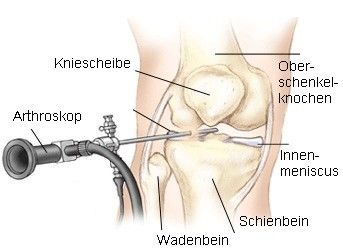
Knee joint endoscopy (arthroscopy)
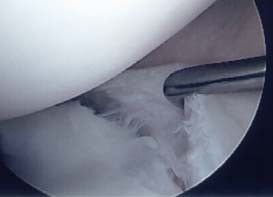
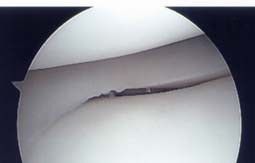
Findings during an arthroscopy of the knee joint (arthroscopy)
Image of an extensive longitudinal tear in the medial meniscus
What happens during the surgical treatment of a meniscus injury?
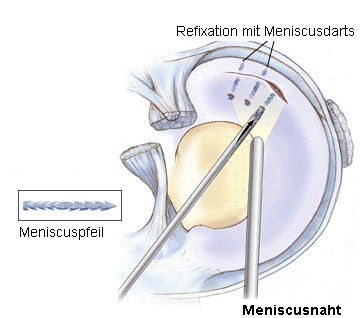
The aim is always to remove as little meniscus tissue as necessary. However, the problem is that meniscus tissue in most areas has a very poor healing tendency. However, if the tear is in an area where healing is expected, the meniscus is sutured. This suture must then be protected by a postoperative relief phase lasting several weeks. However, only about 10% of all meniscus tears are sutureable.
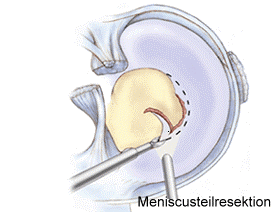
In about 90% of meniscus tears, the tear cannot be sutured. The damaged part of the meniscus must then be removed. This is done as sparingly as possible in order to keep the remaining meniscus tissue as large as possible. During resection, only the torn or frayed area is resected, while the majority of the meniscus is usually left in place. The more meniscus tissue has to be removed, the more buffer the knee joint lacks. This in turn means a higher risk of knee joint wear and tear(osteoarthritis) occurring later on.
If meniscus tissue is removed, the postoperative follow-up phase is significantly shorter than with meniscus suturing. The patient can usually move and put weight on the knee joint normally again very quickly. In contrast, meniscus suturing requires a longer relief phase and restriction of flexion.
Meniscus tear: removal of part the meniscus
Meniscus tear: suturing using various methods, e.g. meniscal darts.
For patients
As a patient, you cannot register directly for a consultation. Please get a referral from your primary care physician, specialist. For questions please use our contact form.