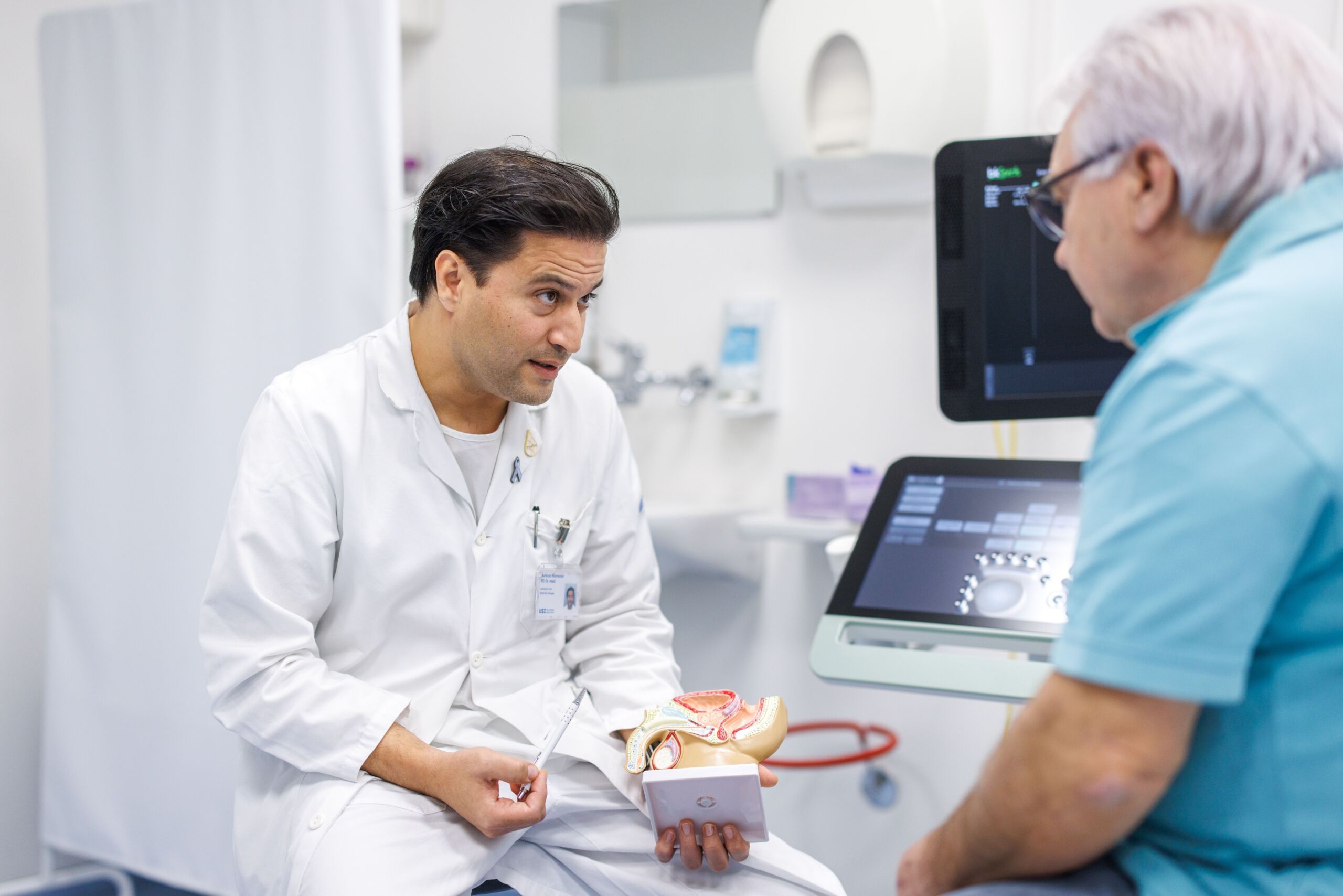
An elevated PSA value or abnormal changes in the imaging can indicate prostate cancer – but do not necessarily have to. A tissue sample (biopsy) from the prostate is necessary to clarify the situation. MRI fusion-assisted template biopsy is one of the most modern and precise methods for clarifying a suspected prostate carcinoma. It combines the precise imaging of magnetic resonance imaging (MRI) with the millimeter-precise control of a biopsy using a so-called template system.
What is an MRI fusion biopsy?
Fusion biopsy combines magnetic resonance imaging (MRI) and ultrasound. First, the prostate is visualized in detail using an MRI scan. This allows conspicuous areas that could indicate a tumor to be precisely localized.
These MRI images are then “fused”, i.e. digitally overlaid, with a real-time ultrasound image during the biopsy. In this way, tissue samples can be taken specifically from conspicuous areas – and no longer randomly, as is the case with conventional biopsies.
The template system – even more precise thanks to millimeter-accurate guidance
In our clinic, the MRI fusion biopsy is performed transperineally, i.e. through the skin between the scrotum and anus. A template grid (a fine template with defined openings) is used for this. This template enables the systematic and reproducible removal of tissue samples from all regions of the prostate – both from suspicious MRI areas and from systematic standard positions. The combination of MRI fusion and template guidance allows three-dimensional navigation of the biopsy needle with maximum accuracy.
How does a prostate biopsy work?
A prostate biopsy is usually performed on an outpatient basis under short anesthesia. Initially, planning is based on the MRI images. Suspicious regions are marked and stored digitally in the biopsy system. After the prostate has been examined and measured using ultrasound, several samples are taken from the areas that were conspicuous in the MRI and their surroundings. In addition, several systematic tissue samples are taken from the rest of the prostate using the template grid. After removing the tissue during the prostate biopsy, the pathologist examines the samples obtained under the microscope. He assesses whether benign or malignant changes are present and classifies malignant findings according to histological criteria (Gleason score) in order to determine the aggressiveness of the tumor. The results of the examination are available within two weeks of the biopsy.
FAQ on the subject of prostate biopsy
A biopsy is necessary if there are abnormal PSA values and suspicious changes in the MRI in order to clarify whether prostate cancer is present. By taking several small tissue samples, it can be determined with certainty whether cancer cells are present. Only histological examination (histology) enables a clear diagnosis of prostate cancer and is a prerequisite for any targeted treatment decision. The histological examination can also be used to classify the aggressiveness of the cancer, if present.
As a rule, 12 to 20 tissue cylinders are removed, in individual cases more, in order to confirm the diagnosis and determine the exact location of the tumor.
Due to the local anesthesia, there is usually only slight or brief discomfort. If necessary, additional sedative medication can be given.
There is often temporary blood in the urine, stool or seminal fluid. The risk of infection is low. If there is an increased risk of infection, an antibiotic is administered as a precaution during the operation.
The evaluation usually takes 7-14 working days, followed by a discussion of the findings with the attending physician.
The Gleason Score is a central evaluation system for prostate cancer that is used after a prostate biopsy and indicates the degree of malignancy and the prognosis of the tumor. The higher the Gleason score (scale from 6 to 10), the more aggressive and malignant the prostate carcinoma is – a score of 6 indicates a less aggressive tumor, a score of 8 to 10 indicates a significantly more aggressive tumor. The score is determined by the pathologist on the basis of the tissue structure in the biopsy and is decisive for individual treatment planning.
You may leave the clinic after the procedure as soon as a uroflow has determined that you can urinate without any problems. Take it easy physically on the day of the examination and drink enough. If you have a fever or severe symptoms, please contact the clinic immediately.
No. According to current scientific knowledge, there is no clinically relevant risk of tumor cell spread or metastasis when a prostate biopsy is performed. Several large studies and systematic reviews analyzed the rate of tumor cell seeding after prostate biopsies and showed that the occurrence is extremely rare and practically insignificant for the patient’s prognosis.
In Switzerland, prostate biopsies are covered by compulsory basic health insurance (KVG) if there is a medical suspicion of prostate cancer – i.e. if there are abnormal PSA values or abnormal imaging findings. The cost coverage includes both the outpatient procedure and the subsequent pathological examination of the tissue.
The examination then shows that no malignant cells are present in the examined areas. Depending on the MRI findings, PSA value and individual risk, your urologist will discuss whether further checks or follow-up checks of the PSA value are advisable.
MRI fusion-assisted template biopsy currently offers the highest hit rate of all biopsy procedures. The combination of MRI imaging and millimeter-precise guidance means that even small or hard-to-reach tumors can be targeted. Despite state-of-the-art technology – as with any medical examination – a very small tumor can theoretically be overlooked. This is why regular follow-up checks of PSA levels and findings remain important.
If tumor cells are detected in the biopsy, the first step is to determine exactly how aggressive the tumor is (so-called Gleason score) and how far it has spread. Based on these results, your urologist will discuss the best possible treatment options with you – from active surveillance to surgical or radiotherapeutic procedures and individual treatment options. The aim is to work with you to find a gentle and safe decision for optimal oncological control.
Not every detected prostate cancer needs to be treated immediately. The decisive factors are tumor size, aggressiveness, spread and your personal state of health. In the case of slow-growing, less aggressive tumors, active monitoring with regular checks can often be sufficient. Every patient diagnosed with prostate cancer is presented to an interdisciplinary tumor board in order to find the best treatment strategy from the perspective of all the specialist disciplines involved and the current guidelines. Your urologist will explain all the findings and the tumor board’s recommendations to you in detail and help you choose the right strategy for you – always with the aim of optimally combining quality of life and oncological control.
