What is ligament damage to the wrist?
If a ligament is torn, the affected joint section can become unstable and the bones can assume an unfavorable position. This results in incorrect loading of the joint, which can lead to osteoarthritis over time. In osteoarthritis, the cartilage covering of the affected joint is damaged or depleted, resulting in inflammation with swelling and pain, especially when the joint is under strain.
Ligament damage to the wrist: causes and risk factors
The main cause is a trauma in which a ligament is torn. Typical examples include a fall on the outstretched wrist or an unexpected strong external rotational movement, such as when blocking a drill in use.
Rarer causes are inflammatory diseases of the wrist(rheumatoid arthritis, gout, pseudogout) in which the ligaments slowly break down.
Symptoms: Severe pain often occurs after a trauma
The trauma often leads directly to severe pain, which initially improves with immobilization and pain therapy, but never disappears completely under stress. It is typical, for example, that there is hardly any pain at rest or during everyday activities that do not involve much strain, but there is pain with a slight increase in strain. Ligament damage rarely leads directly to a permanent restriction of movement in the wrist. This is most likely to occur with damage in the area of the joint between the ulna and radius, where it manifests itself in a restriction of the turning movement of the forearm.
If ligament damage that leads to instability in the wrist is not treated, the incorrect loading often results in wear and tear of the joint (osteoarthritis) over time. The symptoms then correspond to those of osteoarthritis of the wrist.
Wrist ligament damage: diagnosis with us
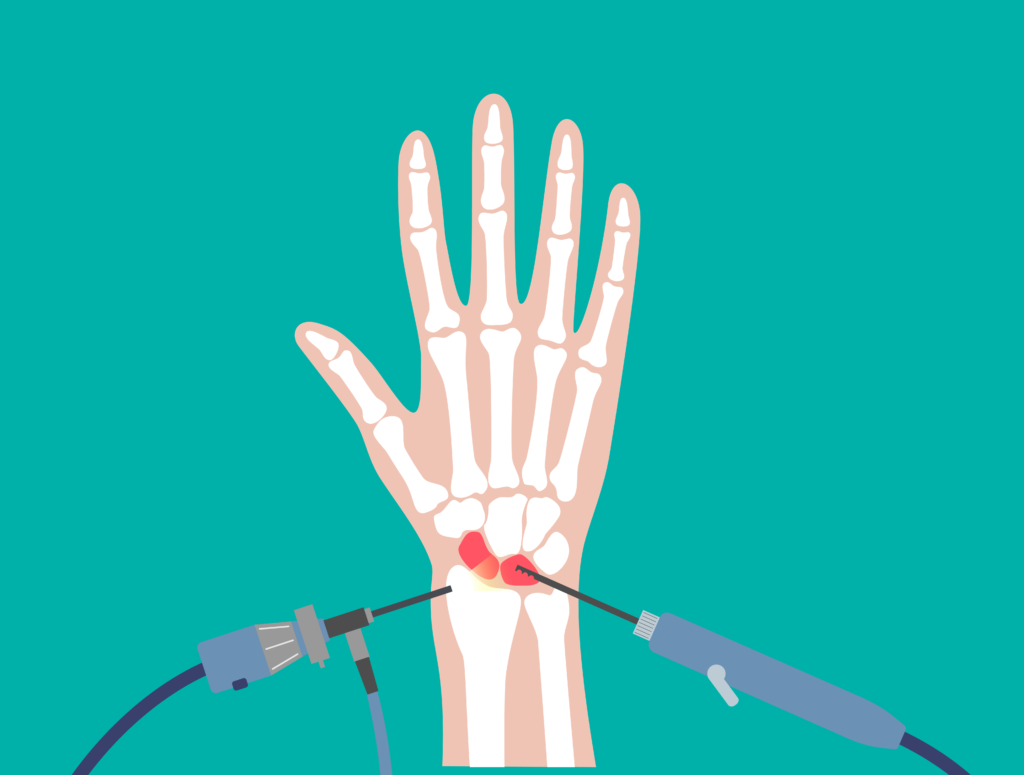
The medical history and clinical examination lead to a suspected diagnosis. X-rays can provide further indications of ligament damage if a misalignment of the bones can be detected. Since such deformities usually do not develop immediately but only over time, but early therapy is the most promising, the diagnosis often has to be forced by means of contrast MRI or a wrist endoscopy (an operation in which a camera is used to look into the joint).
Treatment
The treatment options depend on whether the injury is recognized early, i.e. in the first few weeks after the accident, or later. Basically, the aim of the therapy is to bring the affected bones back into the correct position and to heal the ligament.