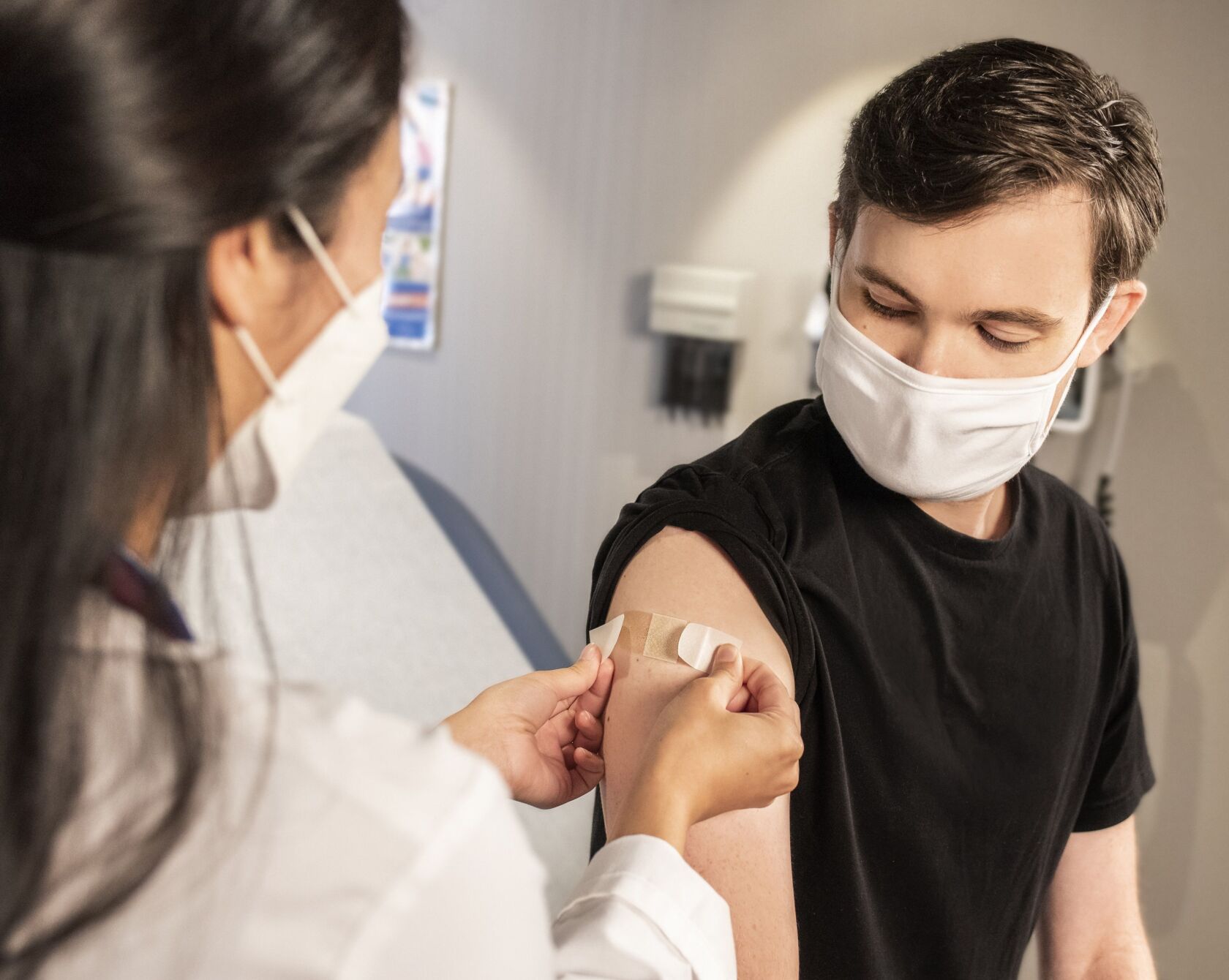
The majority of sexually active men and women are infected with the human papillomavirus. HPV - or HPV for short - is responsible for the development of various types of cancer, especially cervical cancer. Vaccination provides protection.
The human wart virus (human papilloma virus, abbreviated HPV) is one of the viruses that can cause cancer in humans. The vast majority of the 200 HPV types identified by science to date are occasionally annoying for humans, but are not really dangerous beyond that. They are responsible for warts on hands or feet, for example. However, a few HP viruses, primarily the “high-risk types” 16 and 18 as well as a good ten others, can lead to cervical, vaginal and vulvar cancer or to anal, oropharyngeal and penile cancer. It is estimated that 70 to 80 percent of sexually active men and women become infected with human papillomavirus (HPV) in the course of their lives.
An issue for men too
The latter in particular shows that HPV is not exclusively a “women’s issue”, as is commonly assumed. And yet, while most women are familiar with the term HPV after their first visit to the gynecologist at the latest, the majority of men are not aware of the problem. Wrongly so, as Gian-Piero Ghisu, senior physician at the Department of Gynecology, explains: “Men are less likely to develop HPV-related genital cancer, but they are basically just as affected as women – and they are also the direct carriers of the virus.”
Because this rarely develops clearly perceptible symptoms, it is usually passed on unconsciously. This is mainly via the mucous membranes during vaginal, oral and anal intercourse. As the highly contagious HP virus can be transmitted during petting, it is particularly dangerous for young, sexually inexperienced women and men. “The risk of infection increases with the number of sexual partners. That’s why the 16-25 age group is now the most affected by the HP virus,” says Gian-Piero Ghisu.
Early detection is the be-all and end-all
HPV itself is not curable. In the vast majority of cases (+/-70 percent), however, the virus disappears again within a year of infection, and in 90 percent of cases within two years. Despite all this, according to the Federal Office of Public Health, more than 5,000 women in Switzerland are diagnosed with precancerous lesions of the cervix caused by HP viruses every year. In the same period, around 80 women die from cervical cancer. Cervical cancer is the fifth most common type of cancer in women aged between 20 and 49. This makes early detection all the more important. “The fact that we actually have very few severe cases compared to the general spread of the virus is precisely thanks to this precaution,” says Gian-Piero Ghisu. “Thanks to the early detection of cervical cancer, Switzerland has one of the lowest rates of new cases in the world.”
Prophylaxis is the most important factor in dealing with HP viruses. Strict adherence to safer sex rules, such as the use of a condom or a femidom, reduces the risk of infection, but cannot completely prevent it. Vaccination against HPV is far more effective in this respect. This has been possible in Switzerland since 2006, and the approved vaccines are effective against both tumor-causing HPV types and those that lead to genital warts. “The vaccination triggers a defense reaction in the immune system that is far stronger than if you had had direct contact with the virus,” explains Gian-Piero Ghisu. Among other things, the vaccination protects against the seven HP viruses most frequently responsible for the development of cancer.
“Thanks to the early detection of cervical cancer, Switzerland has one of the lowest rates of new cases in the world.”
Ideally, the vaccination should be carried out before sexual contact takes place. The optimal age for HPV vaccination is between the ages of 11 and 15. As the vaccine has only been available for a few years, revaccination is recommended for young adults up to the age of 26. Adolescents up to the age of 15 need two HPV vaccinations every six months, after their 15th birthday they need three. For adults, the probability of benefiting from the vaccination decreases with the number of changing or previous sexual partners, as infection may have already occurred.
Are the costs of the vaccination covered by health insurance?
As part of the cantonal vaccination programs, vaccination is free of charge for 11- to 26-year-old girls and boys as well as young women and men in accordance with the above recommendations. From the age of 27, health insurance occasionally covers part or all of the costs, which amount to around CHF 800. Health insurance companies and doctors can provide information on this.
Positive experiences with vaccination
Gian-Piero Ghisu explains that the experience with the HPV vaccination at the USZ has been consistently positive; the Gardasil 9 vaccine used is also characterized by high tolerability. Vaccinated people would still have lasting protection against the HP virus after ten years. “This suggests a long-term effect,” says Ghisu. “Whether a booster will be necessary at some point is not clear at the moment.” International studies confirm that the vaccination not only reduces the infection rate of human papillomavirus, but also of less dangerous warts. In Switzerland, experts believe that 80 to 180 new cases of cancer in men and 300 cases of cancer in women can be prevented every year thanks to the HPV vaccination. “Vaccination therefore makes perfect sense,” emphasizes Gian-Piero Ghisu. “You’re not only doing yourself a favor, but also your partner and, last but not least, society.”
HPV in figures
- against 90%…
of all people become infected with HPV in the course of their lives - over 200…
Various HPV types are known - 5 %…
of all cancers worldwide are due to infections with the HP virus - 50 %…
of all infection-related cancers in developed countries are linked to HPV - 5000 women…
in Switzerland are diagnosed with precancerous lesions of the cervix every year - 2400 men…
in Europe are diagnosed with anal cancer every year
Frequently asked questions about the HPV vaccination
The consistent use of condoms provides very effective protection against infection with sexually transmitted diseases and HIV, but is less effective against infection with HPV. Since 2007, the HPV vaccination has offered the most lasting and effective protection against infection. The Gardasil9® vaccine is directed against the cancer-causing types 16, 18, 31, 33, 45, 52 and 58 as well as against the genital wart-causing types 6 and 11. The vaccine also provides partial protection against other related cancer-causing HPV types.
The HPV vaccination protects against human papillomaviruses, which can lead to various types of cancer (e.g. cervical, anal or throat cancer) as well as genital warts. Early vaccination – ideally before the first sexual contact – significantly reduces the risk of HPV infections and associated diseases.
The vaccination has a preventive, not a curative effect. As the vaccination protects against 7 dangerous HPV types and you have hardly ever been infected with all these HPV types, the vaccination is useful against the virus types with which you have had no previous contact. However, the vaccination also offers some of those affected additional protection against re-infection after an HPV infection has already occurred. After the treatment of precancerous lesions, it can also reduce the risk of recurrence.
In nature, the viral genetic material (DNA) is packed in a protein envelope. These envelope proteins are produced artificially for the vaccine. They trigger an excellent defense reaction in the body, which provides excellent protection against HPV infections. As the HPV genome is missing in the vaccine, you cannot become ill as a result of the vaccination. The vaccine also contains no questionable additives, such as mercury or allergenic egg whites.
An HPV vaccination provides the best protection if it is given before an HPV infection, ideally before sexual activity begins. As men can develop genital warts just as often as women and rarely cancer, the HPV vaccination is also recommended for boys and young men. Indirectly, they also protect their partner, as they no longer transmit the viruses covered by the vaccination. The optimum age for vaccination is between the ages of 11 and 15. A booster vaccination is recommended up to the age of 26, which is also reimbursed as part of the cantonal vaccination programs. However, the benefit of catch-up vaccination is lower, as adults with an increasing number of previous sexual partners may have already been infected.
The vaccination consists of three injections into the muscle of the upper arm. The first and second injections are administered one and two months apart respectively, followed by a final third injection six months after the first. For adolescents up to the age of 15, 2 vaccinations every 6 months are sufficient.
As with any vaccination, there may be slight pain, redness and swelling at the injection site for a short time. However, there are no known serious or permanent side effects.
As the vaccine has been on the market for just over 10 years, the duration of vaccine protection is still unclear. It is assumed that the protection lasts for at least 10-20 years. If there is a decrease in protection over the next few years, a booster vaccination may be recommended.
In Switzerland, 40.9% of young women are vaccinated, but only 7.8% of young men. The reasons for this are gaps in knowledge, a lack of information, the late inclusion in the vaccination recommendation and the persistent image of the HPV vaccination as a “women’s vaccination”. Many men are also unaware that the vaccination also benefits them.