Sustainability in construction
Sustainability aspects play an important role in the planning and construction of the MITTE1|2 buildings. The new buildings will take the hospital another big step forward in terms of sustainability.
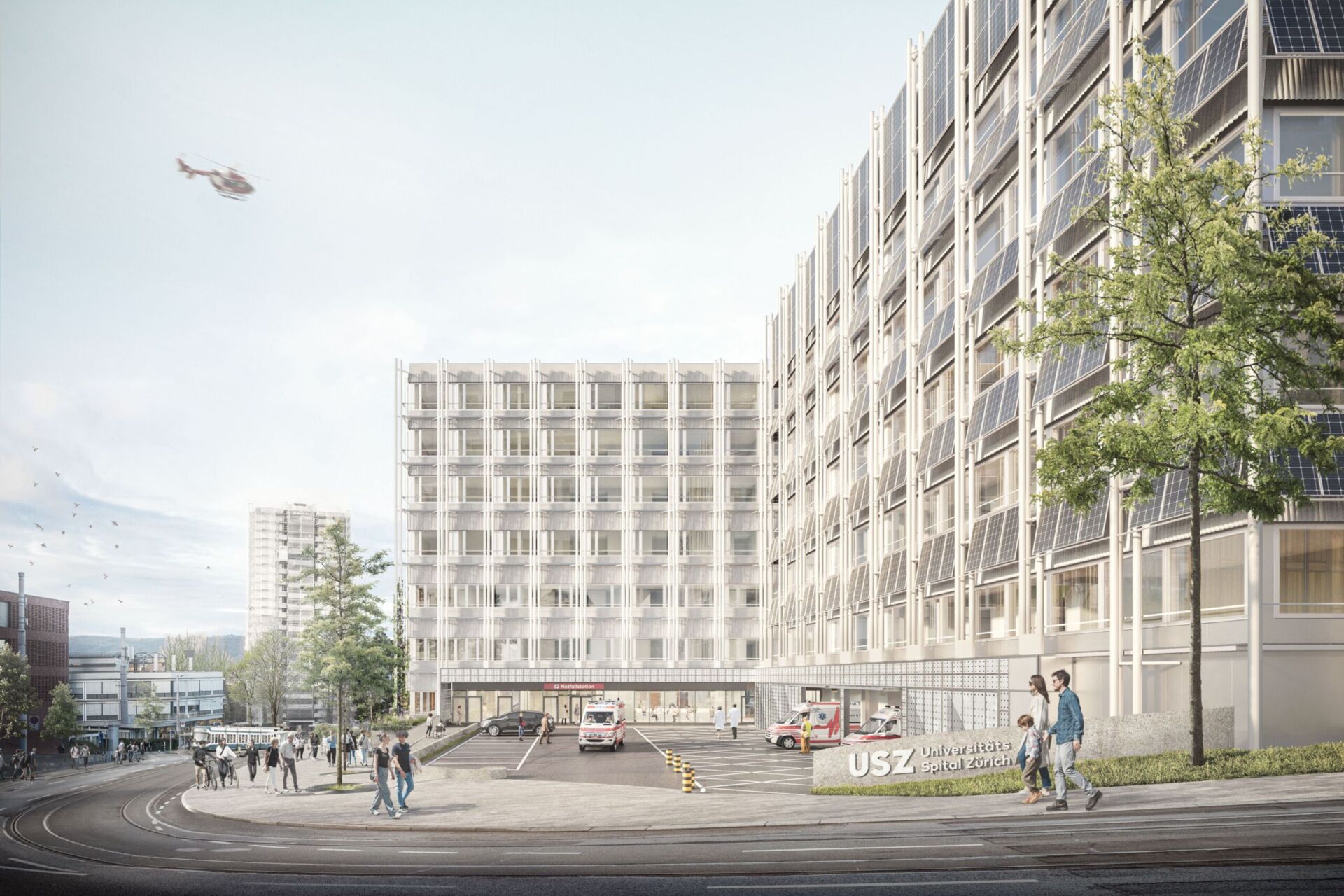
Die Fassaden liefern Solarstrom: Neubauten MITTE1|2. (Visualisierung: Nightnurse)
Opportunity for more sustainability
New buildings are a great opportunity to further increase sustainability. This can be achieved, for example, by improving energy efficiency. Energy-efficient new buildings and ecological energy sources will significantly reduce the amount of energy consumed by the mid-2040s and cut energy-related emissions. The environmental impact of the development of the Zurich-Zentrum university area was already analyzed for the entire perimeter at the structure planning stage. With the environmental impact report for the USZ Kern-Areal Neubau MITTE1|2, the planned development complies with the legal requirements for environmental protection.
Recyclable materials and flexible usage options
For the new MITTE1|2 buildings, we use recyclable materials such as wood and steel wherever possible and ensure that the materials used are free of harmful substances.
The new MITTE1|2 buildings are designed in such a way that they can adapt well to future developments in cutting-edge medicine. For example, the building will be constructed in such a way that most of the walls are non-load-bearing, making it easier to adapt the floor plan if the medical needs of the future should change. The ceilings can also support the potentially heavier medical technology devices of the future.
Photovoltaics on the facades
The façades also contribute to ecological sustainability: Some of them are fitted with photovoltaic elements that convert sunlight into electricity. The roof of the new MITTE1 building will also be planted with plants to help cool the increasingly warm urban climate in a natural way.
Geothermal probes
132 geothermal probes were installed on the MITTE1|2 construction site. These contribute to the hospital’s sustainable heat supply and enable the efficient use of surplus energy. These probes make an important contribution to reducing the University Hospital Zurich’s CO₂ emissions by using renewable heat sources. The technology also stores excess heat from the summer months in the ground and uses it for heating and hot water supply in winter, further improving the hospital’s energy efficiency. The electricity used to operate the heat pumps also comes from renewable wind power.
Rooms to feel comfortable in
The new buildings will also increase the social sustainability of the USZ, for example by making the rooms easily accessible for patients and visitors and meeting high accessibility requirements. In order to operate the planned buildings efficiently, the USZ relies on short distances and easy orientation in the space. Peace and quiet, pleasant colors and materials in the rooms and plenty of daylight ensure that patients feel comfortable in the hospital of the future and can recover under optimal conditions.
To ensure that visitors also feel comfortable, the MITTE1|2 campus creates a wide range of quiet, recreational and meeting zones. Many areas are open to the public, such as the spacious hospital park and restaurant facilities.
Certified with Gold Standard
The SGNI (Swiss Sustainable Building Council) has awarded the USZ new-build project MITTE1|2 the “Gold Standard” pre-certificate. This certifies that the new buildings meet comprehensive quality requirements in terms of sustainable construction and are in line with over 40 sustainability criteria (see Swiss DGNB system of the SGNI).