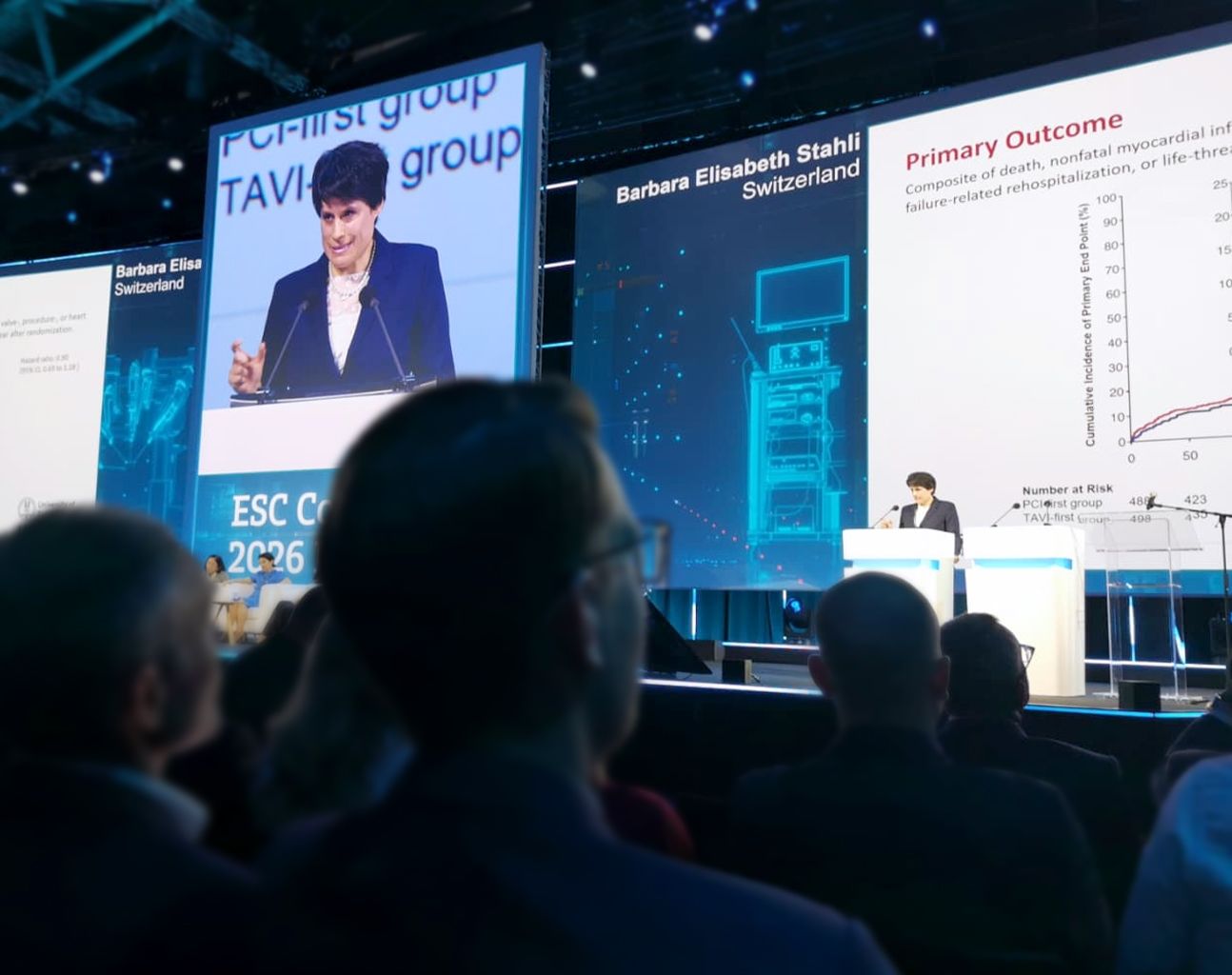
The TAVI PCI study examined the treatment of patients with severe aortic valve stenosis and narrowed coronary arteries. The results were presented at the European Congress of Cardiology in Munich and published simultaneously in the New England Journal of Medicine.
To date, there has been a lack of evidence from large-scale endpoint studies regarding the optimal sequence of treatment for patients with severe aortic valve stenosis and narrowed coronary arteries.
“Many patients who need a new heart valve also have narrowed coronary arteries. Until now, coronary arteries have usually been treated first, even though we lacked evidence from large endpoint studies to show that this is actually the better strategy. “We were able to fill this gap in our knowledge with our study,” says Prof. Dr. med. Barbara Stähli.
Study Results
The multicenter, randomized TAVI-PCI study enrolled 986 patients with severe aortic valve stenosis and coronary artery disease at 48 European centers. Participants were randomized to either a TAVI-first group or a PCI-first group. The primary endpoint was a composite endpoint. It included death, heart attack, ischemia-related revascularization, rehospitalization due to the valve, the procedure, or heart failure, as well as life-threatening, disabling, or severe bleeding after one year.
The study showed that a TAVI-first strategy is not inferior to a PCI-first strategy. Some patients will benefit if their narrowed coronary arteries are treated first. For others, initial treatment of the aortic valve will be advisable. Symptoms, anatomy, risk of bleeding, the severity of coronary heart disease, and the overall clinical context all play an important role in this regard.
“We now have a choice. Instead of following a set protocol, we can decide what is best for each individual patient. “That is exactly what patient-centered medicine is,” summarizes Prof. Dr. med. Barbara Stähli.
Initiated and coordinated at the University Hospital of Zurich
Prof. Barbara Stähli, M.D., Prof. Markus Kasel, M.D., and Prof. Frank Ruschitzka, M.D., initiated the TAVI PCI study at the University Hospital of Zurich. The Andreas Grüntzig Clinical Research Center at the Department of Cardiology conducted and coordinated the study. The center is led by Prof. Dr. med. Barbara Stähli and Dr. sc. nat. Led by Rahel Kesterke.
The study was successfully completed this year. The results were published simultaneously in the New England Journal of Medicine and were presented on August 30 at the European Congress of Cardiology in Munich.