Brain injuries or brain surgery can lead to cognitive and motor impairments. Early rehabilitation begins in the intensive care unit so that patients can return to everyday life as quickly as possible.
Some people are lucky in misfortune: they suffer a stroke, develop a tumor or are injured in an accident to the head without their brain being damaged. In many cases, however, brain damage occurs and motor skills, cognition or speech – or all of these together – are impaired.
Early rehabilitation begins in the intensive care or monitoring ward so that these functions can be regained as fully as possible. “Right from the start, we support and encourage patients in their normal movement behavior,” explains Yvonne Schaller, Head of Therapy Clinics North. This may mean, for example, that those affected have to learn to turn in bed again or sit on the edge of the bed. A careful assessment of the swallowing ability is just as important. If people cannot swallow properly, they cannot eat, or they choke on their saliva.
“After any type of brain injury, patients may have to relearn everyday activities,” explains neurologist Andreas Luft. There are still hardly any differences in therapies following traumatic brain injury, stroke or brain surgery – experts simply know too little about how the therapy works. They all have one thing in common: the therapy is very individual and at the same time interdisciplinary. Nurses, neurologists, occupational therapists, neuropsychologists, physiotherapists, speech therapists and sometimes also nutritionists, psychotherapists or social services are involved.
Active training is necessary
Together, they aim to enable those affected to carry out as many everyday activities as possible independently again as soon as possible. In addition to motor impairments, speech, reading, writing or comprehension are often impaired. “In everyday life, a lot happens through spoken and written language,” explains Leonora Graber, Head of Speech Therapy Neurology.
For people with aphasia, even grocery shopping can be an insurmountable hurdle. Restrictions in writing and reading text messages can also make participation in social life even more difficult. “First of all, those affected have to realize that something is not working,” says Leonora Graber. For example, in the case of a neglect: “These people ignore the side that is impaired after a stroke,” explains care expert Nicole Schubiger. “First of all, we work together to make them aware of this.” Only then is active training possible. This is necessary so that the brain can get used to a movement again and relearn it. “When one side of the body is paralyzed, people often compensate for movements with the side that is still functioning.
As far as possible, the brain should not get used to it, but should learn through therapeutic support that the affected side can perform a movement again,” adds Yvonne Schaller. “Thanks to its plasticity, there is a chance that the brain will relearn lost functions.” On the care side, too, the aim is to promote patients’ independence. Some have to learn to move an entire side of their body again, others have a perceptual disorder, and sometimes it is primarily about training speaking, reading or writing. Every person needs a different therapy and has different requirements.
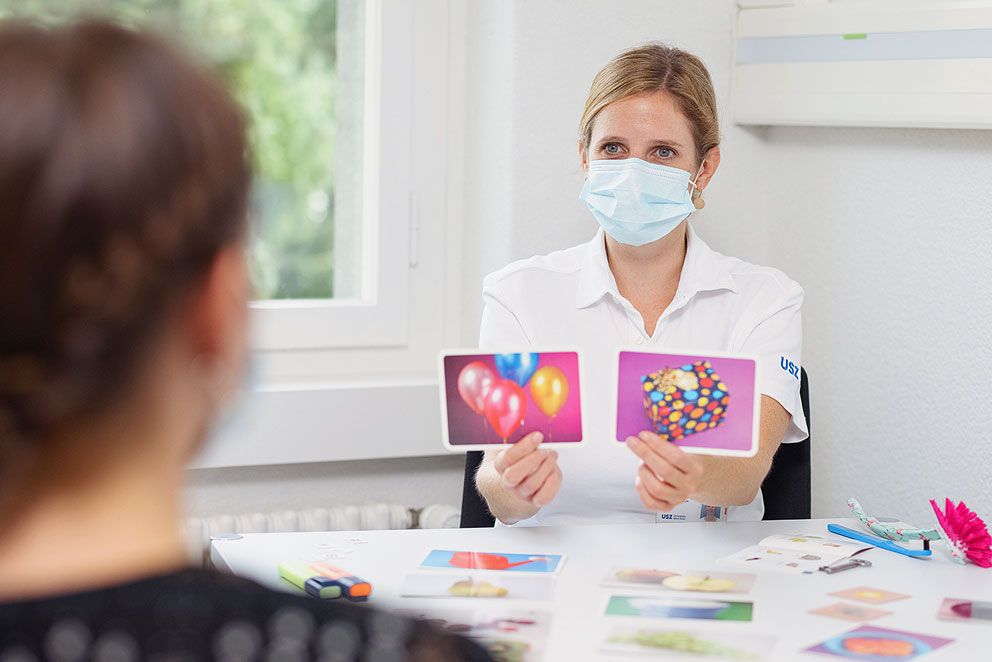
After a brain injury, many things have to be relearned, such as speaking, reading, writing or understanding. Speech therapist Leonora Graber specifically trains these functions with the people affected.
The brain reacts to rewards
“The main thing is that those affected receive comprehensive therapy as early as possible and exercise regularly,” explains Andreas Luft. That takes a lot of motivation. This is where the latest study by the neurologist and his team comes in. Scientists have discovered that there is a connection between the centers that encode motivation and reward in the brain and the motor cortex – the brain region from which voluntary movements are controlled. “We want to find out whether learning is improved by reinforcing the reward,” he explains the idea.
Stroke patients with arm dysfunction were divided into two groups: One group received a small amount of money for arm training, while the other group received no reward for training. Initial preliminary results indicate that the rewarded people learn faster. You can be rewarded with money, music, food or feedback on your training success. “Of course, research is also being carried out in the field of medication,” says Andreas Luft. Experts are working on substances that can increase the brain’s plasticity.
A lot of work after hospitalization
“Patients often make great progress in the first two weeks after brain surgery or brain injury,” says Leonora Graber. “But the work then continues in rehab after the hospital.” The problem: there are practically no quality indicators for neuro-rehabilitation. “The potential of neuro-rehab is far from exhausted,” emphasizes Andreas Luft. So it’s worth sticking with it at home even after rehab.