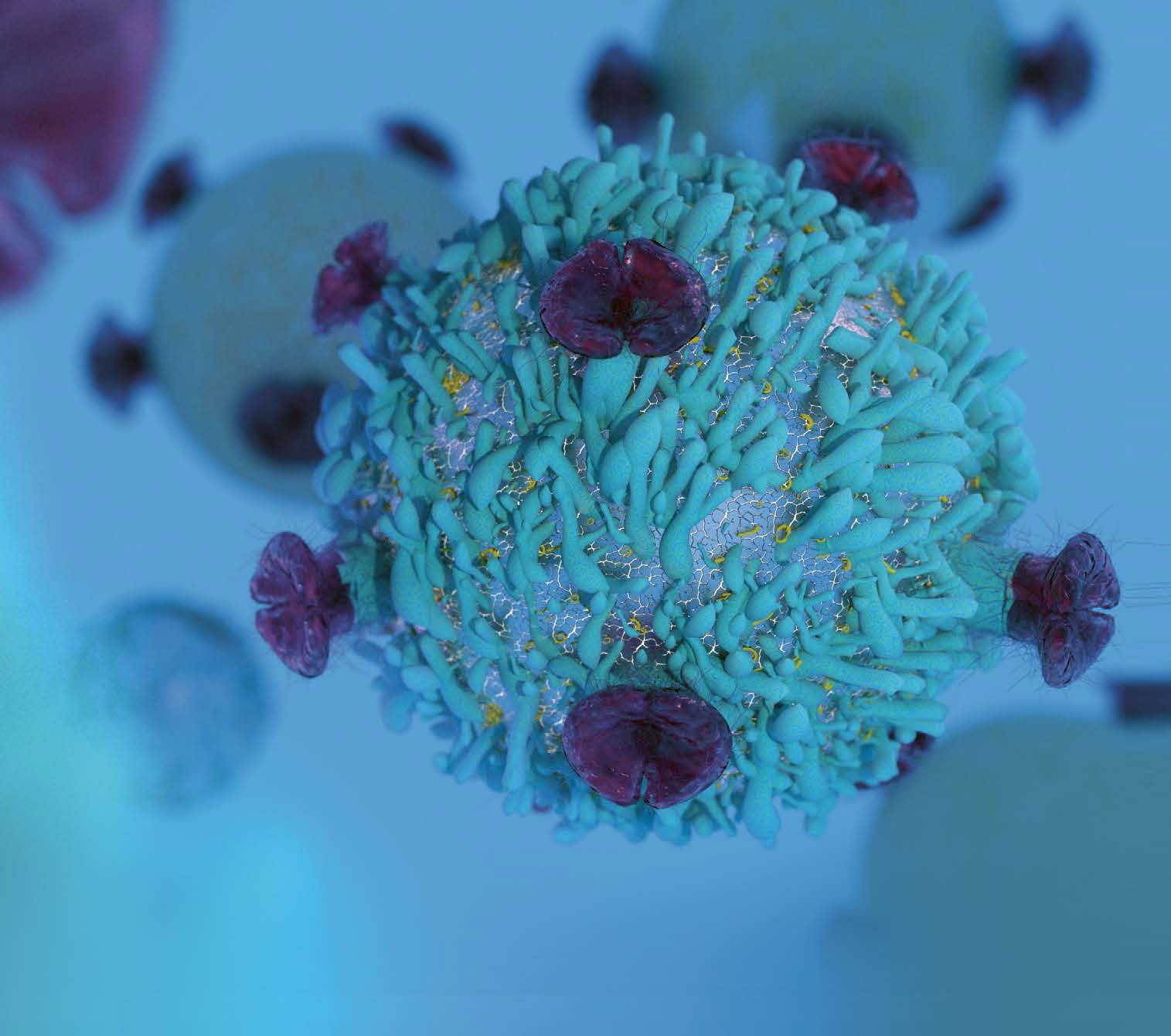
In the fight against cancer, immunotherapy has been making headlines in recent years. We asked Prof. Dr. med. Markus G. Manz, director of the Center for Hematology and Oncology at the USZ, how immunotherapy actually works.
How does a tumor develop?
The human immune system protects the body from damage caused by infectious diseases by recognizing and fighting off “invaders” as foreign, while at the same time preserving healthy tissue and allowing it to regenerate. First and foremost, cancer consists of the body’s own tissue—that is, tissue that is not foreign to the body. However, it carries genetic mutations that trigger uncontrolled growth and do not occur in healthy tissue. However, these changes are often subtle, do not manifest sufficiently on the surface of the tumor cells, and increase only slowly in both type and quantity.
As a result, the tumors closely resemble healthy tissue, and the body’s own immune system is either unable to detect the changes at all or is not activated. Or, while the change is recognized, the immune response is suppressed, meaning that a form of immune tolerance develops. The result is an absent or inadequate immune response and, consequently, tumor growth.
These days, there’s a lot of talk about immunotherapy. What does that mean?
“Tumor immunotherapy” is an umbrella term for a wide variety of approaches that use the immune system to fight cancer. These can either be immunotherapeutic agents administered externally, such as via infusion (e.g., antibodies against tumor cells that the body does not normally produce in this form), or it may involve reactivating the body’s own immune system—which has been suppressed—by, so to speak, loosening the immune system’s “brakes” and thereby lifting immune tolerance.
There are various types of cancer treatment. Could you briefly describe these and explain how immunotherapy fits into the picture?
Broadly speaking, other principles of cancer treatment include surgery, radiation therapy, and conventional chemotherapy, as well as new molecular, targeted therapies that aim to disrupt the cancer-driving changes within tumor cells.
The main goal of surgery is to remove the primary tumor. For many tumors, this is the gold standard. One problem with this is that, in cases of extensive tumors, it can be associated with significant side effects. If the disease has spread to multiple sites—that is, if it has metastasized—then, with a few exceptions, surgery is no longer the appropriate course of action, because it causes more harm than good for the patient and a cure is not possible.
The situation is similar with radiation therapy, although significant progress has been made in this area as well—particularly in cases of limited tumor spread or spread to critical areas—and radiation therapy has become more targeted and associated with fewer side effects. However, in cases of extensive metastasis, radiation therapy is usually not advisable due to the numerous side effects.
Conventional chemotherapy is used either to remove minute “tumor remnants” following, for example, surgery, or in cases of advanced cancer. In cases of widespread cancer, chemotherapy is still often the gold standard. Because tumor cells divide much more rapidly than healthy body cells, and because chemotherapy targets the cell division apparatus, they are highly susceptible to chemotherapy. This often helps to alleviate the disease and prolong life. However, even with chemotherapy, cures are very rare in cases of advanced disease and are limited to only a few types of tumors. Another problem with chemotherapy is that it also affects other tissues that divide rapidly. This leads to side effects such as a weakened hematopoietic system, inflammation of the mucous membranes, and hair loss. In addition, metabolic and detoxification organs (such as the kidneys) can also be damaged, meaning that significant collateral organ damage may occur.
Molecular, targeted therapies against intracellular tumor drivers and immunotherapies against molecules on the cell surface are, overall, more specific. In other words, these therapies represent important steps toward damaging only the tumor as much as possible while sparing healthy, vital tissue.
How can the body’s own immune system recognize cancer, and how can it be strengthened?
With this type of immunotherapy, which aims to release the brakes on the body’s own immune system, our goal is to strengthen the existing but inactive immune response so that it can fight the cancer. The immune response is based on the fact that cancer cells may have a tumor antigen on their surface—that is, they may carry a surface marker that differs from that of healthy tissue. As a result, the immune system may perceive the tumor cell as a type of foreign cell. Some tumors have many of these different surface characteristics, while others have only a few.
In addition, tumors can also produce specific “inhibitory molecules” that suppress the immune system. It is interesting and logical that immune activation therapy targeting the body’s own immune system generally works well precisely in those patients whose tumors, compared to healthy tissue, express many different surface markers and many of these inhibitory molecules. By blocking the inhibitory or regulatory signal—these substances are also called “checkpoint inhibitors”—a tumor immune response is then triggered.
One side effect of this activating immunotherapy may be that it also releases the brakes on other immune cells, leading to side effects similar to those of autoimmune diseases—that is, the immune system may also attack healthy tissue. So there’s a problem with selectivity here. However, depending on the type of cancer, the resulting side effects may be acceptable and, in some cases, can be well managed. Overall, it can be assumed that there are fewer and different side effects than with traditional chemotherapy.
Targeted Immunotherapy at the CCCZ
At the CCCZ, we use targeted immunotherapies to enable the body’s own immune system to recognize tumor cells and eliminate them in a targeted manner.
What other types of immunotherapy are currently available?
In addition to the activation of the body’s own immune system described above, there are immunotherapies in which components of the immune system are produced externally. These are then infused. The simplest and most classic example is what are known as antibodies, which bind to the surfaces of tumor cells and attack them. Either the antibodies target tumor-specific sites (which is rare), or the targets are also present in healthy tissues—though at a lower density—or the tissue can be temporarily spared and will regenerate after treatment.
Recent developments in what is known as “designer immunology” show that it is also possible to produce antibodies or antibody fragments to which chemotherapy, radiation therapy, or cellular signaling molecules can then be attached, allowing them to be delivered to the tumor with relative selectivity. Similarly, antibodies can be produced that act as an activating bridge between tumor cells and the body’s own immune cells. In other words, these antibodies stimulate the immune cells to kill the tumor cells. Another development is the genetic manipulation of the body’s own immune cells.
In this way, antibodies can be introduced into “killer cells” so that they can then attack the tumor cells with a high degree of selectivity. These include, for example, what are known as CAR-T cells. Another interesting development is the possibility of immunologically activating phagocytes. The goal is to achieve the most selective elimination of tumor cells possible in combination with immunotherapy. For all of these types of immunotherapy, there are now exemplary treatments that are either already approved for clinical use or are in early-stage clinical trials.
These treatments are not without side effects either. For example, massive artificial activation of the immune system can trigger conditions similar to those seen in sepsis, such as high fever and circulatory failure. That can be dangerous, but there are already countermeasures in place that are effective.
How does the USZ use immunotherapy?
All of the immunotherapy methods mentioned above, including CAR T-cell therapy and phagocyte-activating therapy, are used at the USZ. This type of therapy, which activates the body’s own immune system, is now being used very successfully, particularly in the fight against melanoma and lung cancer. In the field of CAR T-cell therapy and bispecific T-cell-activating antibody therapy, the focus is particularly on lymphomas and plasma cell disorders. In the preclinical phase, we conduct research on antibody engineering and CAR T cells, including, for example, as part of a clinical research collaboration with the University of Zurich and ETH Zurich.