Contact for questions about the General Consent
If you have any further questions about the further use of data and samples for research, please contact:
How you enable medical progress with your health data
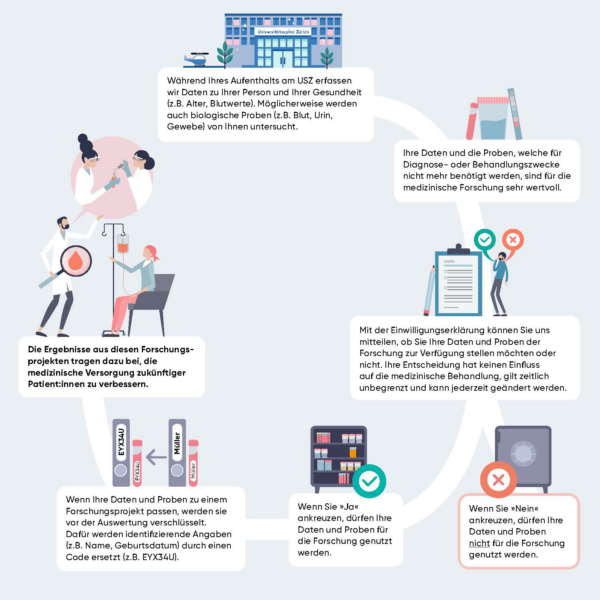
Large volumes of clinical data are recorded and biological samples examined at the USZ every day. Data from everyday clinical practice and samples that are no longer needed for the diagnosis or treatment of patients are very valuable for medical research. Research projects with data and samples help to detect diseases earlier, treat them better and thus improve medical care. With your consent, you can make your collected data and samples that are no longer required for diagnosis available for research.
With the declaration of consent, also known as general consent, you can tell us whether or not you wish to make your data and samples available for research.
Your decision:
Only the further use of anonymized, non-genetic data is permitted.
In a few exceptional cases, data and samples may also be used for research purposes if there is no expression of opinion (Art. 34 HRA). This often concerns older data. In order for this data to be used for research, an application must be made to the ethics committee for an exemption.
Examples:
During your stay at the USZ, data on your health and person will be collected for your diagnosis and treatment. This includes results from laboratory analyses and physical examinations (e.g. blood pressure), x-rays, photos of skin changes, age, etc.
Biological samples (e.g. blood, urine, tissue samples) are also required for some tests. It is possible that there will be leftovers from your samples after an examination, as more material is usually taken than is needed for the laboratory analysis. This ensures that the laboratory analysis can still be repeated with the surplus material despite any problems (e.g. incorrect analysis).
Tissue samples or material removed during operations can also be used for research.
If you wish to withdraw your consent, please inform the clinic treating you in writing or contact generalkonsent@usz.ch.
Your data and samples may no longer be used for new research projects. Research projects that have already begun and in which your data and/or samples are used may still be completed.
If you have changed your mind, whether for or against consent, please let us know in writing. Please contact your treating clinic for this
Your decision affects all existing data and samples as well as those collected during future hospital stays at the USZ. Consent does not imply that additional samples may be taken and is valid indefinitely until revoked. You have the option to change your mind at any time without justification. If you do not make a statement, it remains unclear whether you wish to make your data and samples available or not. No matter what you decide, it has no influence on your treatment and there are no additional costs for you or your health insurance company.
Genetic data is information about hereditary or acquired characteristics in your genetic material. This can be information about your biological ancestry, predisposition to certain diseases or information about your metabolism, for example. This data is obtained through genetic testing (e.g. DNA analysis).
Health data is particularly worthy of protection. In Switzerland, the Human Research Act and the Human Research Ordinance regulate research with data and samples. In addition, the Data Protection Act must be complied with when processing them.
In principle, only researchers who have received approval for a research project from the relevant ethics committee may analyze your data and samples with your consent.
Your data and samples may also be passed on to other research institutions (e.g. other hospitals, universities or research-based pharmaceutical companies) in Switzerland or abroad. Data is passed on outside the USZ, e.g. for national or international projects in which researchers work together. Before data and/or samples are passed on to other institutions, they are encrypted or anonymized. In addition, the transfer of data and samples is always carefully checked and contractually regulated by the USZ.
All research projects involving data and samples must be reviewed and approved by an ethics committee that is independent of the hospital. The Ethics Committee reviews whether the research projects and their implementation comply with the ethical, legal and scientific requirements of the law. In particular, they check whether the protection of the data subjects and their data is guaranteed. A committee also examines the projects internally at USZ before the researchers are given access to the data. Various quality controls are also possible during the implementation of the projects.
If you have consented to the further use of your data and samples, your samples and associated data can be stored in the USZ BioResource Biobank and made available for research.
The aim of a biobank is to collect samples at a central location and store them professionally. This means that these samples and data can be made available to researchers in a structured manner. For medical questions, researchers can refer to these samples and the data from the respective medical history. Both samples and data are fully coded before being handed over to the researchers so that it is not possible to draw conclusions about individual patients.
The conditions for accessing, using and passing on the samples are set out in a set of regulations.
For questions or additional information, please contact:
Dr. med. Michael Weisskopf
Research Biobanking Service Center (RBSC)
Raemistrasse 100
8091 Zurich
Tel. +41 43 253 01 06
Mayl rbsc@usz.ch
As with all data, criminal misuse of health data (e.g. hacker attack on the hospital) cannot be ruled out 100%. The risks are minimized as far as possible through data protection measures throughout the hospital (technical data protection systems) and in research projects (e.g. anonymization, encryption).
In addition, your data is protected from unauthorized access by being accessible only to people who are involved in your treatment or in a research project.
For encrypted data and/or samples, identifying details (e.g. name, date of birth) are replaced by a code (e.g. EYX34U). The key (the list linking the code and name) is only accessible to a very small number of authorized persons and is stored in a secure location. If necessary, the data can be decrypted again in compliance with strict rules.
In the case of anonymized data or samples, the name, date of birth and other information that allows conclusions to be drawn about your identity are irreversibly removed. In this case, it is no longer possible to assign the data or samples to your person.
The further use of your data or samples can contribute to important findings for the prevention or treatment of diseases. This enables, for example, the development of new therapies or procedures that allow more precise and faster diagnoses. In most cases, future patients are the first to benefit from the research projects.
In rare cases, a result may be relevant to your personal health. If this is the case, you will be informed if possible (not possible for research with anonymous data and samples).
You are not entitled to any potential profits arising from research findings from your data and samples.
No, you will not be informed if your data and samples are used for a research project. If there is an important result for you, you will be contacted if possible. This may be the case, for example, if you are diagnosed with a disease for which treatment options or preventive measures are available. Such situations are rare because the data and samples are not usually analyzed individually. Information about such findings is not possible in research with anonymous data and samples.
Everyone has the opportunity to actively contribute to medical research. There are several ways to do this:
If you have any further questions about the further use of data and samples for research, please contact:
If you wish to withdraw your consent, please inform your treating clinic in writing or contact generalkonsent@usz.ch.