Possible cause of fecal incontinence
There are numerous causes that can lead to fecal incontinence. Fecal incontinence is most frequently the result of birth injuries (perineal tears) which manifest themselves years or decades later in the form of scarring and the resulting weakness of the sphincter muscle. Pre-existing proctological conditions can also result in long-term fecal incontinence due to repeated injuries to the sphincter muscle. If bowel movements tend to be too liquid, they are also much more difficult for the sphincter to control than well-formed bowel movements.
The causes of recurrent diarrhea and liquid stools are again very varied: excessive alcohol consumption and coffee, fruit juices, milk in the case of lactose intolerance and artificial sweeteners are just a few examples of possible causes. Previous operations on the bowel (e.g. gastric bypass), bacterial colonization of the bowel, hormonal over- or under-functions as well as deficiencies in blood salts can also make bowel movements thin.
Self-treatment
You can carry out the following therapies yourself to improve faecal incontinence:
- Consume sufficient fiber and drink enough so that the fiber can swell well.
- It is best to take regular notes and keep a food and stool diary. This will help you find out which foods and drinks have a positive or negative effect. You may then be able to adjust your diet.
- Pelvic floor training: Take a course in pelvic floor exercises. Specially trained physiotherapists will show you exercises to strengthen your pelvic floor. This often also improves fecal incontinence. Pelvic floor training is also an effective protection against incontinence of all kinds – whether urinary or fecal incontinence.
Clarifications
We recommend the following examinations in the event of new fecal incontinence:
- Colonoscopy in gastroenterology
- Functional diagnostics using manometry
- Ultrasound examination of the sphincter muscle to visualize any scarring and injuries
- If a bowel movement disorder is present at the same time, an MR defecography can provide additional information to help understand the problem
Conservative treatment
The first step in any treatment for fecal incontinence is stool regulation, which aims to improve the consistency of bowel movements and thus prolong the time of stool passage in the bowel. Sometimes a stool diary is useful in order to recognize the connection between food and thin stools or stool loss.
A high fiber content in the diet is essential for normal stool consistency. This can be achieved with fruits, vegetables, legumes and whole grain products. To “thicken” the stool, 1-2 teaspoons of flosam shells or Metamucil® can be helpful. Taken with a little water, it binds the liquid in otherwise watery stools. ). If the stool is still too soft or too frequent despite these measures, loperamide (Imodium®) can be helpful.
Physiotherapeutic pelvic floor rehabilitation is an established therapy for fecal incontinence. After a targeted examination of the pelvic floor muscles, the physiotherapist specializing in pelvic floor rehabilitation will show you a training program based on the findings. Muscle strengthening is a process that requires daily practice and can take several months.
In order to normalize bowel function, behavioural strategies and, depending on requirements, also apparative biofeedback, electrostimulation or balloon training are used.
Surgical therapy
If conservative treatment, i.e. non-surgical therapies, does not result in a decisive improvement in continence, surgery may be considered as a therapy. When choosing the right form of surgery, the cause of the faecal incontinence, its severity and the patient’s expectations or wishes must be taken into account.
If the cause of the incontinence is a defective sphincter muscle, the existing muscle defect can be sutured (so-called sphincter repair). This operation is usually performed on younger patients, typically with recent sphincter injuries following childbirth. This operation is delicate and should only be performed in specialized centers. The success rate after this operation is around 50%.
A real revolution in the treatment of faecal incontinence came in 1995 with sacral nerve modulation (SNM) (also known as sacral nerve stimulation (SNS)). This therapy uses electricity to stimulate the pelvic floor nerves, which are important for continence. This leads above all to improved sensitivity of the rectum, so that the stool is noticed earlier. This stimulation goes unnoticed by the patient or is perceived as a fine tingling sensation in the area of the anus. The operation is carried out in 2 phases, a test phase and a permanent phase. In the test phase, the pelvic floor nerve is first localized with a needle in the area of the sacrum, and then a fine electrode is inserted near the nerve. This is followed by 2-3 weeks of test stimulation to assess the success of the therapy. If the symptoms improve by at least 50% during this test phase, a small battery (similar to a pacemaker) is implanted under the skin in the area of the pelvic blade.
SNS is only offered at specialized centers and is one of the most promising treatments for faecal incontinence today. We have achieved a success rate of over 85% with our patients. The indications for SNS are being increasingly expanded. It includes not only incontinence caused by sphincter damage or nerve damage (e.g. due to childbirth, multiple sclerosis, etc.), but more recently also chronic, therapy-resistant constipation, chronic anal pain or LARS (low anterior resection syndrome) following surgery for rectal cancer.

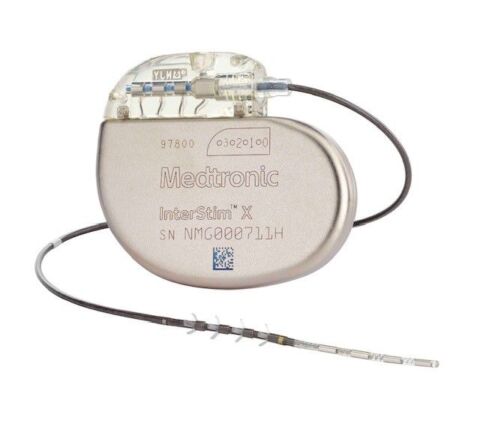
With the kind permission of Medtronic Schweiz AG
Dynamic gracilioplasty is intended for patients for whom conventional surgical therapies have not been successful. The gracilis muscle is a fine muscle on the inside of the thigh that is exposed during this operation and is wrapped around the anus as a sphincter replacement. As with SNM/SNS, this muscle is also stimulated with electricity, which puts the muscle under permanent tension and thus closes the anus. Two out of three patients benefit from gracilisplasty in terms of a significant improvement in continence. This operation is technically very demanding and should therefore only be performed at clinics that have the relevant experience.
If none of the above measures or operations have led to an improvement in fecal incontinence, an artificial bowel outlet (stoma) can also be evaluated. The small or large intestine is passed out through the abdominal wall and the stool is collected in a bag.
Aids for fecal incontinence
There are also some aids for faecal incontinence that can make your everyday life easier and help you avoid unpleasant situations. Examples are:
- Incontinence pads and mesh pants for the pad
- Incontinence pants and pads
- Bag to collect the stool
- Foam anal tampons for the rectum
Our specialized continence advice team will be happy to assist you.
If you have faecal incontinence, also ensure good anal hygiene. This is because any remaining stool residue can irritate the skin in the anal region and lead to inflammation.