Brain Aneurysm Treatment

The goal of treating a brain aneurysm is to prevent the risk of a brain hemorrhage or, if a hemorrhage has already occurred, to prevent another one. Whether treatment is necessary and which procedure is appropriate depends, among other things, on the size, location, and shape of the aneurysm, as well as on the patient’s individual situation. At the USZ, treatment is planned on an interdisciplinary basis and decided in close consultation with the patients.

Procedure

Not every brain aneurysm requires treatment. For small aneurysms with a low risk of bleeding, regular imaging follow-up may be sufficient.

More about the clinical picture

If treatment is necessary, there are generally two established methods available:

Microsurgical Clipping

Through an incision in the skull (craniotomy), the cerebral aneurysm is visualized under a surgical microscope and permanently isolated from the bloodstream using a specially designed titanium clip. Blood flow to the adjacent vessels is maintained. For unruptured cerebral aneurysms, this surgery is typically performed at the USZ through a very small incision (mini-craniotomy).

Catheter-based treatment (endovascular therapy)

Fine instruments are guided to the brain aneurysm through a thin catheter, which is usually inserted through the groin. Depending on the situation, this is either closed from the inside using platinum coils (coiling) or treated with stents or flow diverters, which alter blood flow in such a way that the aneurysm closes.
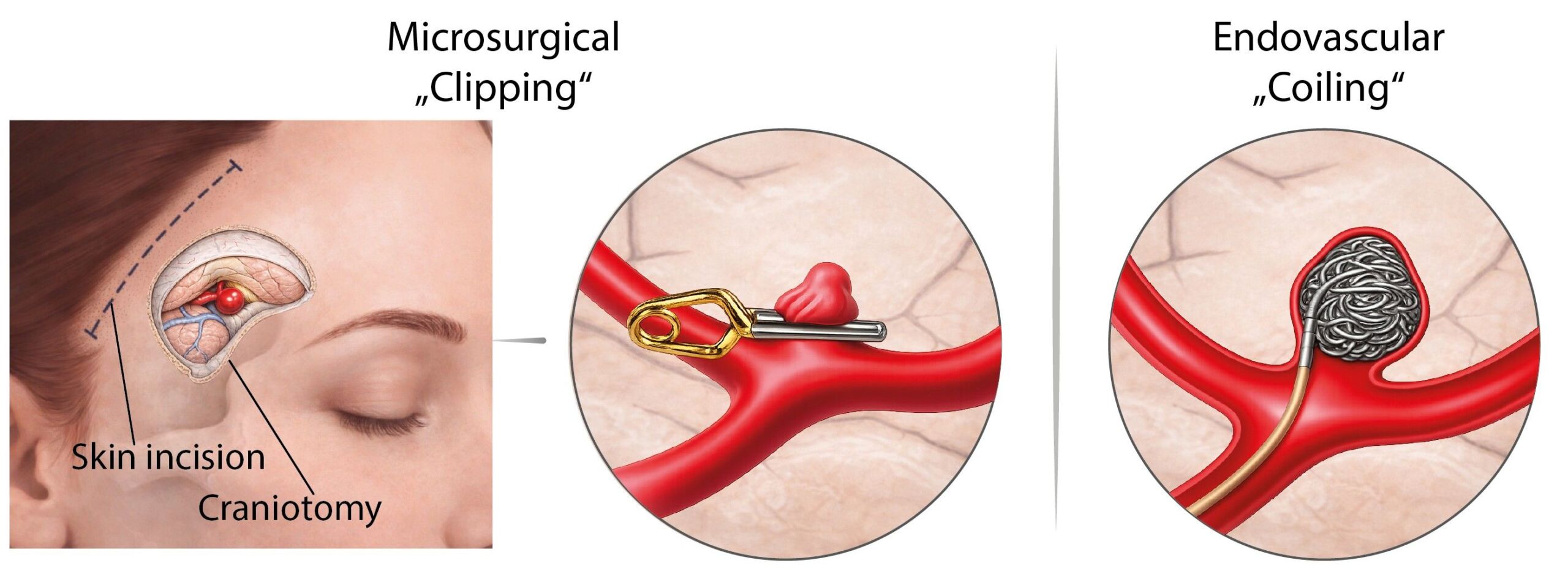
Behandlungsmethoden von Hirnaneurysmen.

Figure 1: Treatment methods for cerebral aneurysms. Left: In microsurgical clipping, a small incision in the skin is used to create an opening in the bone to gain access to the brain (known as a “mini-craniotomy”). The aneurysm is then visualized and closed from the outside using a titanium clip. Right: In catheter-based “coiling,” the cerebral aneurysm is filled from the inside with fine platinum coils delivered through a thin tube, thereby sealing it off.

Experienced specialists in neurosurgery and interventional neuroradiology work together to determine which procedure is recommended. At the USZ, patients are actively involved in the decision-making process by having treatment options explained to them in a way they can understand. The goal is to permanently isolate the cerebral aneurysm from the bloodstream while minimizing the risks associated with the procedure as much as possible.

Treatment for a ruptured brain aneurysm is immediate. The goal is to seal the ruptured aneurysm as quickly as possible to prevent further bleeding. The choice of procedure is made around the clock by an interdisciplinary team.

Preparation

Preparation depends on the chosen treatment method and the individual situation. In the case of an unruptured cerebral aneurysm, treatment planning takes place during a consultation and after a careful assessment of the risks. A ruptured brain aneurysm is a medical emergency, so treatment is initiated immediately.

Follow-up Care for a Brain Aneurysm

After treatment, follow-up visits are scheduled to assess the success of the treatment and monitor the patient’s progress. In the case of a ruptured cerebral aneurysm, monitoring and treatment in a neuro-intensive care unit are necessary after the procedure so that any complications can be detected and treated early.

Depending on the treatment method and the individual course of the disease, additional outpatient follow-up visits and imaging studies will be scheduled.

Responsible Professionals

Luca Regli, Prof. Dr. med.

Director of Department, Department of Neurosurgery

Tel. +41 44 255 29 92

Menno Germans, Ph.D., PD Dr. med.

Senior Physician, Department of Neurosurgery

Tel. 043 253 68 51
Specialties: Vascular neurosurgery, Tumor and skull base surgery, Complex spinal surgery

Giuseppe Esposito, Prof. Dr. med.

Senior Physician, Department of Neurosurgery

Tel. +41 44 255 37 90
Specialties: Vascular neurosurgery (aneurysms, AVM, dAVF), Brain revascularization (brain bypass surgery, carotid endarterectomy, Moyamoya), Microneurosurgery of brain tumors and skull base surgery

Jorn Fierstra, Ph.D., Prof. Dr. med.

Senior Attending Physician, Department of Neurosurgery

Tel. +41 44 255 31 69
Specialties: Vascular neurosurgery with special interest in brain revascularization (brain bypass surgery for ischemia, moyamoya disease, complex aneurysms & carotid endarterectomy) (aneurysm surgery, AVM, dAVF), Microsurgery of brain tumors and skull base surgery (incl. awake operations)

Martina Sebök, Ph.D., PD Dr. med.

Attending Physician, Department of Neurosurgery

Tel. +41 44 255 86 87
Specialties: Vascular neurosurgery (aneurysms, brain revascularization (brain bypass surgery, carotid endarterectomy), AVM, dAVF, cavernomas), Microsurgery of brain tumors, Skull base surgery

For Patients

Patients can be referred to the University Hospital of Zurich by their primary care physician, by referring specialists, or following an appropriate examination. For cerebrovascular diseases, the USZ offers specialized consultation hours during which test results, risk assessments, and possible treatment options are discussed in detail.

For Referring Physicians

Simply assign your patient online.

University Hospital of Zurich
Department of Neurosurgery
Frauenklinikstrasse 10
8091 Zurich

Tel. +41 44 255 26 60
Assign Online

Why to USZ

At the USZ, brain aneurysms are treated by a specialized neurovascular team comprising specialists in neurosurgery, interventional neuroradiology, neurology, and neurointensive care. All cases are evaluated through an interdisciplinary approach to determine the most appropriate treatment for each patient.

At the USZ, all established treatment methods are available in one location—from microsurgical procedures to endovascular therapies and neurointensive care. State-of-the-art technologies such as high-resolution imaging, intraoperative fluorescence angiography, neuronavigation, and neuromonitoring support precise and safe treatment.

The USZ is also one of the leading centers for the treatment of complex brain aneurysms and was once again recognized as Switzerland’s top-ranked neurosurgery department in the “World’s Best Specialized Hospitals 2026” ranking.

Responsible Department

Related diseases