Research Group Raphael Johannes Morscher

Keywords
Childhood Cancer, Metabolism, Stable Isotope Tracing, Regulation of Protein Translation, Neuroblastoma
Summary & Mission statement
- My laboratory develops and applies advanced technologies to understand metabolic reprogramming in cancers and the crosstalk of metabolism with protein translation.
- Our mission is to leverage metabolic insights for clinical applications, aiming to create effective and better-tolerated therapies for children with cancer
Overview
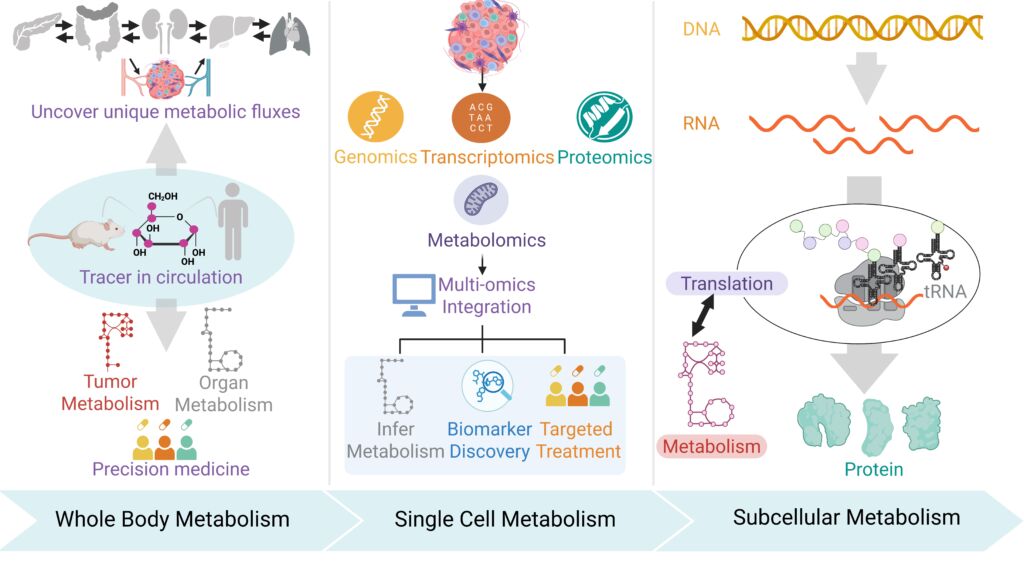
Metabolism is the process by which food is converted into energy and building blocks. The Morscher lab is dedicated to understanding metabolism in human health and disease, with a focus on childhood cancer. In order to meet their specific requirements, cancers reprogramm metabolism for cell growth and survival. We study the peculiarities of cancer metabolism by addressing three levels:
Whole-Body Metabolism
We foster a personalized understanding of metabolism by studying the metabolic crosstalk of healthy organs and its reprogramming in response to mutations or cancer. For treatments, we explore how targeted changes in whole-body metabolic state by diets or enzymes impact tumor growth and therapy response. Projects include polyamines, amino acids and one-carbon metabolism.
Single Cell Metabolism
We develop technology investigating cellular heterogeneity in metabolism by metabolic flux profiles at single cell level. Elucidating metabolic networks at baseline and under treatment pressure informs treatments targeting defined sub-populations in cancer. Projects focus on technology development for tracing and the intersection with drug response.
Subcellular Metabolism
We study the regulation of protein translation in cancers. Our core interest lies in the intersection of cellular metabolic state and translation beyond classic signaling. We investigate changes in translation dynamics and related phenotypes based on epitranscriptomic modifications and ionic interactions (polyamines). Current projects focus on differential regulation of proliferation and differentiation in stem cells and childhood cancers.
Publications