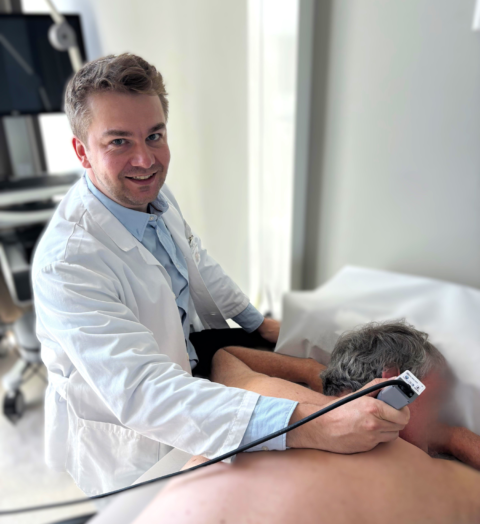
Line-field Confocal Optical Coherence Tomography (LC-OCT) is a modern, non-invasive imaging technique available at the Dermatology Clinic of the University Hospital Zurich. The method enables high-resolution real-time images of the skin and can help to assess suspicious skin changes more precisely – in selected situations without immediate tissue removal.
LC-OCT is currently particularly relevant for white skin cancer, especially basal cell carcinoma. This is where the scientific data is strongest, and this is also where AI-supported image analysis is at its most advanced: it supports the medical assessment of unclear lesions, increases diagnostic certainty and can standardize clinical decision-making.
What is LC-OCT?
LC-OCT combines the principles of optical coherence tomography and confocal imaging. The procedure generates histology-like images in vivo and in real time. Vertical sections, horizontal planes and three-dimensional volumes of the epidermis and the superficial to middle dermis area can be visualized [5,6].
What does AI do for basal cell carcinoma?
The AI analyzes vertical LC-OCT images for BCC-typical patterns during the examination. It outputs a probability value and optionally a color code that marks the areas of the image that appear suspicious.
When can LC-OCT with AI be useful?
- for clinically or dermatoscopically unclear lesions with suspected basal cell carcinoma
- if an additional, standardized second assessment of the LC-OCT images is helpful
- for blurred skin changes, especially in the facial area
- for preoperative assessment of the horizontal extent of the tumor
- for therapy planning when weighing up between conservative and surgical treatment
- for follow-up after surgery, radiotherapy or systemic therapy, if scar tissue and residual or recurrent tumor are difficult to distinguish clinically
Your advantages
- Non-invasive and generally painless examination
- histology-like real-time images directly in the consultation
- AI-supported assessment especially for lesions suspected of being BCC
- Greater diagnostic certainty in unclear cases of basal cell carcinoma
- Support for treatment decisions and preoperative planning
- Potentially fewer unnecessary diagnostic biopsies with high clinical safety
What are the limits of LC-OCT?
LC-OCT is a very helpful additional tool, but does not always replace histology. This also applies to AI assistance. In the case of deep-seated, high-risk or still unclear findings, the biopsy or histological examination remains the reference standard.