Even if you know that radiation therapy is important for you and will help you, starting treatment can be a source of uncertainty and anxiety. That's understandable: Now that you've been diagnosed with your illness, you're in a new situation and don't yet know what to expect from radiation therapy.
The therapy is divided into several parts
Radiation therapy will not be administered during your first visit to the radiation oncology clinic. During this initial consultation with your treating radiation oncologist, you will have a detailed discussion about your condition and symptoms, as well as a physical examination. We will then explain the exact procedure, as well as the effects and side effects of radiation therapy.
Before radiation therapy begins, radiological images—such as computed tomography (CT) or magnetic resonance imaging (MRI)—are taken. Over a period of about 1–2 weeks, we will carefully plan your treatment and conduct quality assurance checks.
For radiation safety reasons, our irradiation devices are located in sealed rooms in the basement. You’ll quickly become familiar with the technology and the treatment process—which you won’t feel at all.
Please remember: We’re the ones behind the technology, and we’re here for you. Please let us know right away if any problems arise. We’re sure to find the best solution for you.
Initial Consultation
After your treating radiation oncologist has reviewed your medical reports and test results, an initial appointment will be scheduled at the outpatient clinic. Patients may also be accompanied by family members or close friends to this appointment. The nature of the cancer, treatment options, prognosis, and the duration and course of treatment—including possible side effects—will be explained during a detailed consultation. Pre-existing medical conditions, medication use, and allergies are assessed during the medical consultation; a physical examination by the radiation oncologist is supplemented, if necessary, by any pending diagnostic tests.
Following the medical consultation, there will be a brief discussion with the nursing staff.
If you have any questions after your initial consultation or during radiation therapy, please feel free to contact us at any time. You will receive further appointment dates and our contact information after your initial consultation.
Planning CT
In order to plan and calculate your treatment accurately, we need information about the location of your organs and bones. This is the only way we can define the target area to be irradiated and the structures that must be spared. We obtain these during the planning examination, also known as a planning CT scan.
To ensure millimeter-precise positioning of the individual CT images, our planning CT scanner is equipped with the same laser system that is installed on the radiation therapy machines.
Depending on the body part, it may be necessary to mark the points where the laser lines intersect on the head mask or directly on the body. These markings are used to position the patient before each radiation therapy session. In this case, the markings on the body are made using small, permanent dot tattoos to ensure consistent quality throughout the therapy.
For tumors that move significantly within the body due to breathing, we perform a 4D CT scan.
Treatment Planning
Based on the planning CT scan, we determine the optimal radiation treatment plan for each patient. The goal of radiation treatment planning is to deliver a sufficiently high radiation dose to the tumor while sparing the surrounding healthy tissue as much as possible.
Based on the CT images, the treating radiation oncologist defines the target volume in the individual CT slices. This often includes not only the tumor but also any microscopic spread, as well as an additional small safety margin. The plan is calculated using complex computer systems.
The computer then generates a 3-dimensional model of the treatment area. Radiology technicians, physicists, and physicians then determine the optimal radiation settings. Nowadays, planning is done using state-of-the-art radiation techniques. At the end of the process, it will be clear from which directions, with what beam shape, and at what intensity radiation must be delivered in order to create an optimal treatment plan tailored to your needs.
Irradiation
Depending on the treatment plan, radiation therapy can last from just a few sessions to a period of up to six weeks. During this time, you will see your treating radiation oncologist at least once a week so that they can answer any questions you may have and monitor the progress of your treatment.
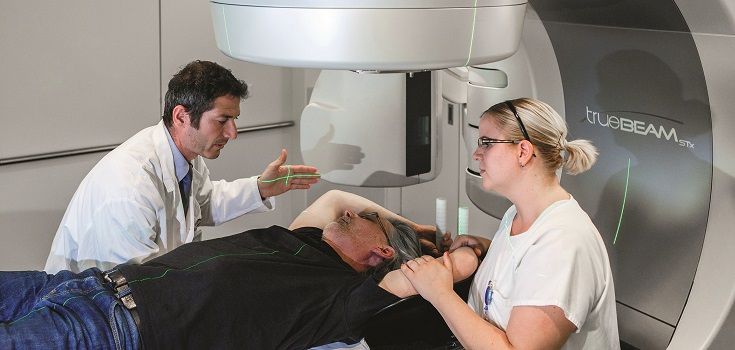
For each radiation treatment session, we position the patients in exactly the same way as we did during the planning CT scan. After installation, another check is performed to ensure that the optimal settings and positioning have been implemented.
Our radiation therapy machines are equipped with additional imaging systems. This allows us to double-check whether the target has actually been hit. The radiation treatment itself takes only a few minutes.
Radiation Treatment Process
External content
Please accept cookies to display this content from an external website.
Follow-up Care
Even after you have completed radiation therapy, we want to continue to support you. To assess the success of your treatment and any possible side effects, you will therefore be asked to come in for checkups at our outpatient clinic at regular intervals.
Frequently Asked Questions
You can find an overview of frequently asked questions here.
For Patients
As a patient, you cannot schedule a consultation directly. Please ask your family doctor or specialist to refer you.