What are age spots?
Age spots (lentigines seniles), especially sun-induced age spots (lentigines solares), are harmless pigment changes to the skin. They are caused by years of UV exposure and occur mainly on sun-exposed areas such as the face, hands, forearms and décolleté.
Unlike freckles, age spots do not usually fade in winter. They usually occur from middle adulthood and appear as flat, light to dark brown patches. Age spots are a sign of skin ageing and have no pathological value, but can be perceived as annoying for cosmetic reasons.
Age spots: causes and risk factors for moles
Age spots are caused by excessive production of the skin pigment melanin. Pigmentation disorders of the skin are mainly caused by long-term exposure to UV radiation. Light-skinned people are affected more frequently than dark-skinned people, and women more frequently than men. If the skin is repeatedly exposed to the sun or artificial UV light (e.g. in a solarium) over the years, pigment deposits form in certain areas. These appear as brownish, sharply defined spots, particularly on the hands, face and other sun-exposed areas.
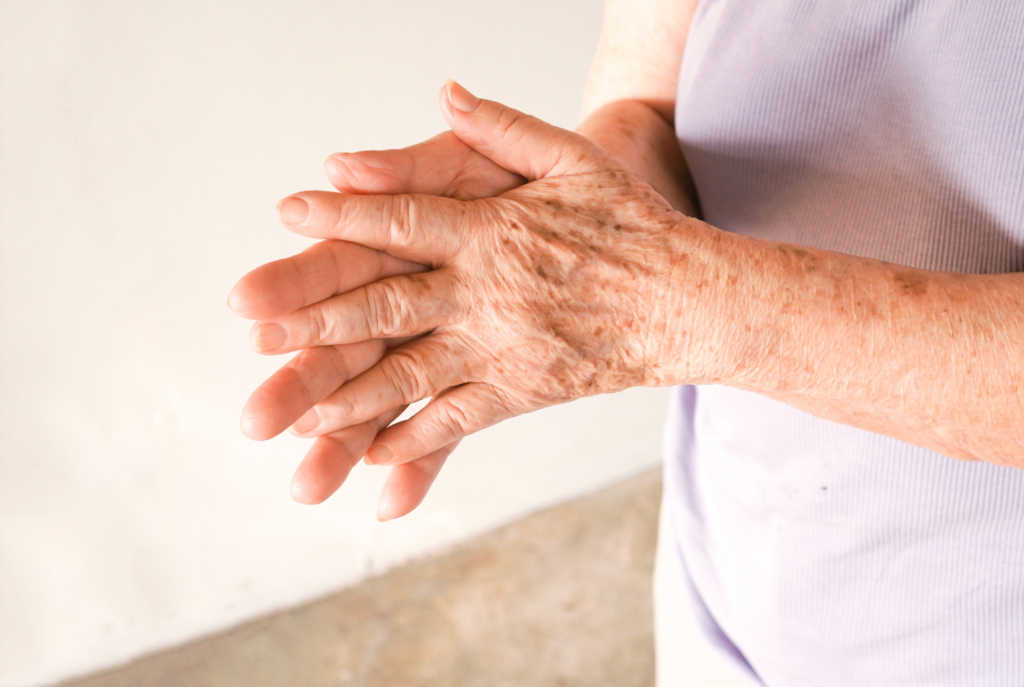
In addition to UV radiation, age is one of the most important risk factors, as the skin becomes less resistant to external influences over the years and pigmentation disorders occur more easily. Genetic predisposition also plays a role. Some people are more prone to age spots than others. Other contributing factors are hormonal changes (e.g. due to pregnancy or the pill), oxidative stress caused by an unhealthy diet, smoking or environmental toxins, as well as an overall unhealthy lifestyle.
Symptoms of age spots: Recognizing signs and warning signals
Typical symptoms of age spots are
- Flat, smooth, oval or irregularly shaped patches on the skin
- Light brown to dark brown coloration, depending on skin type and UV exposure
- initially small (a few millimeters), but can grow larger over time
- often on sun-exposed areas such as the face, hands, arms, shoulders, décolleté and back of the feet
- No complaints such as pain, itching or inflammation
Pigment changes: When to see a doctor?
Age spots are generally harmless and a purely cosmetic problem. However, if a spot suddenly changes, develops irregular edges, becomes significantly darker, starts to itch or bleed, it should be checked by a doctor. Such changes may indicate a more serious skin disease. An early examination by a dermatologist will give you clarity.
Medical checkup – more information
Send a photo of the affected skin area and fill out the short questionnaire. Within 24 hours on weekdays, you will receive a reliable diagnosis from our experts. Your data will be transmitted to us encrypted and treated confidentially.
Age spots: Diagnosis and examinations
To diagnose age spots with certainty, a clinical examination is carried out by a dermatologist. The pigment spots are examined and scanned using dermatoscopy in order to distinguish harmless age spots from other skin changes such as moles, melasma or skin cancer. In rare cases, a tissue sample (biopsy) is taken to ensure that it is not a malignant skin change.
It is important to have any new or changing skin changes checked by a doctor. Dark, irregularly shaped or rapidly growing spots in particular should be taken seriously and clarified promptly. A regular skin check can help to detect any malignant changes at an early stage.
Age spots: prevention, early detection, prognosis
How can I prevent age spots?
Prevention is better than aftercare. Your options for preventing age spots:
- Sufficient sun protection
- Daily use of sunscreen with at least sun protection factor 30, ideally SPF 50.
- Apply sun protection not only in summer, but all year round – especially on the face, hands and other areas exposed to light.
- Avoid the midday sun (between 11 a.m. and 3 p.m.), as this is when the UV radiation is at its most intense.
- Wear protective clothing such as long sleeves, hats or special UV-protective fabrics when the sun is shining.
- Healthy skin care and nutrition
- Antioxidants such as vitamins C and E help to ward off free radicals and protect the skin.
- Moisturizing skin care (e.g. hyaluronic acid and niacinamide) can strengthen the skin barrier.
- Gentle peelings (e.g. with fruit acids) support skin renewal and prevent pigmentation disorders.
- Healthy lifestyle
- Reduce smoking and alcohol, as both accelerate skin ageing.
- A balanced diet with plenty of fruit, vegetables and omega-3 fatty acids protects the skin from the inside.
- Minimize stress, as chronic stress can promote skin aging and pigmentation disorders.
- No self-experiments with home remedies or aggressive treatments
- Lemon juice or other aggressive home remedies can irritate the skin and even increase pigmentation spots.
Early detection
Age spots often occur in people over the age of 40 and are a normal sign of ageing. Early detection of age spots is important in order to recognize possible skin changes that could indicate skin cancer in good time. Regular skin examinations and the observation of changes in the size, shape or color of the spots can help to detect abnormalities at an early stage. If you suspect skin cancer, you should consult a dermatologist immediately.
Aesthetic dermatology and laser medicine: our services for age spots
Aesthetically disturbing skin changes are professionally reduced or removed by our dermatologists. At the same time, we specialize in detecting dangerous skin changes such as skin tumours at an early stage and initiating any necessary treatment. We also provide you with comprehensive information about the effects and possible side effects of cosmetic-aesthetic treatments.
Treatment of age spots: How can I treat pigmentation disorders?
Age spots can be treated in various ways. Common options are:
- Laser treatments: Laser therapy is an effective method for removing age spots. The affected skin is treated with a laser beam which, depending on its intensity, penetrates the epidermis or deeper layers of the skin. The laser destroys the pigment deposits, which are then removed by the body. Several sessions are usually necessary for an optimal cosmetic result. Possible side effects include redness, swelling, burning and hypopigmented areas. Consistent UV protection is essential during the healing phase in order to avoid post-inflammatory hyperpigmentation.
- Bleaching creams: Skin-lightening creams with active ingredients such as hydroquinone or retinoids can inhibit melanin production and thus gradually reduce pigmentation. The product should be used under dermatological control, as irritation, redness or allergic reactions may occur on sensitive skin.
- Chemical peels: Fruit acids (e.g. glycolic acid) or trichloroacetic acid (TCA) are used to remove superficial skin layers in a controlled manner, which can lead to a smoothing of the skin structure and lightening of pigmentation spots. These procedures should only be carried out by experienced dermatologists, as there are risks such as redness, inflammation or scarring if they are not carried out correctly.
- Dermabrasion: During dermabrasion, the doctor removes the top layers of skin with a fine cutter under local anesthesia. This can reduce age spots through the formation of new tissue. However, the skin may be reddened for several weeks and there is a risk of scarring or uneven pigmentation.
Consult a dermatologist to find out which method is best for you.
Can age spots reappear after treatment?
Age spots can reappear after treatment as they are often caused by UV radiation. To minimize the risk of recurrence, we recommend that you use a suitable sunscreen for your face, neck and hands all year round. You should also avoid prolonged exposure to the sun to prevent not only age spots but also other skin damage.
