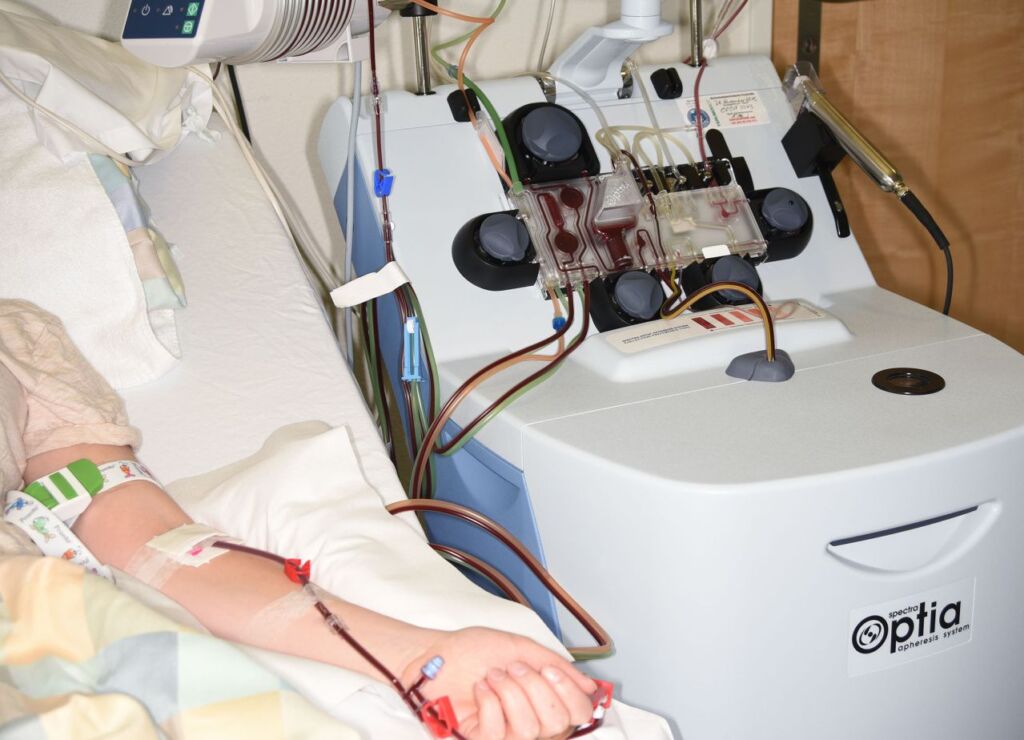
Patient Blood Management is a medical concept that strengthens the body's own blood reserves and thus increases patient safety. As a result, patients often do not require a blood transfusion during the procedure, suffer fewer infections and recover more quickly.
It is undisputed that blood transfusions can save lives in emergency operations with major blood loss. Any defensive reactions of the body are of secondary importance in this case. The fact is, however, that the human body can react negatively to foreign blood. This is because foreign blood is a foreign body in the system. The body’s own reactions range from fever to organ damage. It is not uncommon for patients to have to deal with additional symptoms after a blood transfusion, in addition to the healing of the initial condition.
This is where patient blood management comes in. For over ten years, the Institute of Anesthesiology has played a pioneering role worldwide. “Thanks to optimal blood values, patients who are not dependent on outside blood during an operation have a lower risk of infection, recover better and can leave the hospital more quickly,” says Donat Spahn, Head of the Institute until July 31, 2023, explaining the basic idea behind Patient Blood Management. “On the one hand, this serves the well-being of the patient and, on the other, is an economic factor for the hospital.” A hospital-wide analysis with data from almost a quarter of a million patients from 2012 to 2017 showed that the USZ was able to reduce the use of blood transfusions by 40 percent during the observation period. “This is in no way about denying the blood bank its raison d’être. On the contrary,” says Donat Spahn, emphasizing the good cooperation between the USZ blood bank and the Institute of Anaesthesiology. “We work hand in hand to provide patients with the best possible care, discuss the measures and work together to exhaust all the options available to us.”
Surgery appointments at the USZ are usually scheduled around two to three weeks in advance. “This is when the Patient Blood Management window of opportunity begins,” says Donat Spahn. The remaining time until the procedure is actively used to optimize the patient’s blood values. “Patient Blood Management uses all available means to minimize the need for a transfusion in the event of a loss of more than 500 millilitres of blood.” However, Patient Blood Management does not stop at the operating theater door.
Before the operation: increase the amount of autologous blood
It makes no sense to set off on a road trip with a half-empty tank. It is just as inadvisable to undergo surgery if your blood values are inadequate. “Many people unknowingly suffer from iron deficiency andanemia, which can have a negative impact during an operation,” explains Donat Spahn.
Haemoglobin and ferritin are determined as part of patient blood management. If the concentration of blood pigment (hemoglobin) is too low, patients suffer from anemia. The protein ferritin in the blood indicates how high the iron reserves in the body are. Iron deficiency is the cause of 40 percent of all anemias. Iron supplements, erythropoietin (EPO) for the formation of red blood cells, vitamin B12 and folic acid are used to optimally enrich the blood in the weeks before the operation. “Our experience shows that red blood cells and ferritin can still be significantly increased through targeted measures, even with operations scheduled at short notice,” emphasizes Donat Spahn. For the most part, patients carry out this part of the preparation for surgery together with their family doctor. Patient Blood Management maintains contact with GPs and monitors the improvement in blood values.
During surgery: Minimizing blood loss
Now clean craftsmanship and the latest technology are required. In recent years, the anesthesia team led by Donat Spahn has implemented processes and improved aids in the operating theater that significantly reduce blood loss. The surgeons use blood-saving surgical techniques to minimize blood loss. With automated autotransfusion, lost patient blood is collected, centrifuged and returned to the patient by retransfusion after a washing process. “For tumor patients, we even have the option of irradiating the blood before retransfusion.” Last but not least, the team can positively influence blood clotting and loss through active management of body heat. The threshold for transfusions during operations is now controlled by an algorithm and is relatively low.
After the surgery: Optimize blood values again
Anyone who has lost a significant amount of blood during an operation will receive iron, EPO, vitamin B12 and folic acid again afterwards. “This allows us to significantly improve and accelerate recovery,” explains Donat Spahn. Even the amount of blood taken for diagnostic purposes is kept as low as possible. “I am committed to helping patients through this difficult phase as safely as possible thanks to optimized blood values before, during and after an intervention.”
From treatment concept to standard
Around 15 years ago, Donat Spahn and a small group of colleagues from Australia, America and Germany developed the medical concept of Patient Blood Management. Together they developed it further over the years. In a memorandum adopted in 2011, the WHO called for the introduction of patient blood management in everyday medical practice. The University Hospitals of Basel and Lausanne have recognized the potential and are now also using Patient Blood Management. “However, setting up the logistics and, not least, implementing a functioning interface between surgical planning and patient blood management involves considerable effort in many hospitals,” admits Donat Spahn.
Incentive for patient well-being and economic efficiency
Donat Spahn emphatically points out the economic potential. “According to a study from Australia, operations that could not be carried out cost-effectively in the past are now profitable thanks to patient blood management.” This should also be attractive food for thought for smaller hospitals. The Zug Cantonal Hospital was convinced by Patient Blood Management and adapted the concept to its needs. There is great potential for hospitals with orthopaedic surgery in particular, says Donat Spahn. Given that older people are prone to iron deficiency and anemia, and that replacing hip and knee joints can be associated with considerable blood loss, optimal blood enrichment can be a success factor. After an operation without external blood, patients are back on their feet more quickly, can leave the hospital much sooner and thus reduce the burden on the infrastructure. “This is of great value – for the patients and for the clinic.”