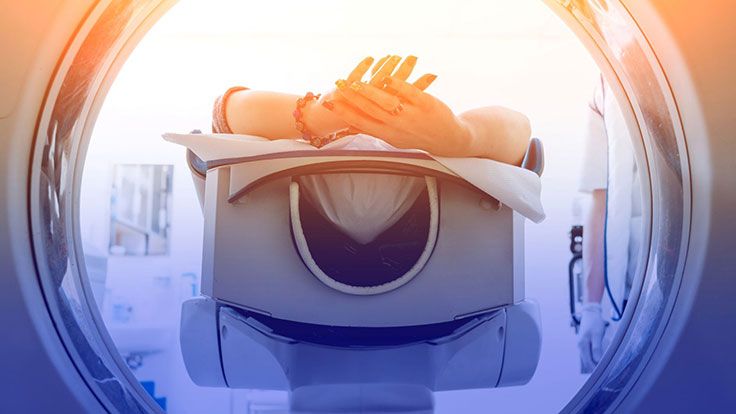
The world's first photon-counting computer tomograph was already in use at the USZ months before its presentation. Hatem Alkadhi, Head Physician at the Institute of Diagnostic and Interventional Radiology at the USZ, on the collaboration between manufacturers and specialists from the field and the advantages of the new CT for patients.
Mr. Alkadhi, in November the manufacturer Siemens Healthineers presented a computer tomograph with photon counting. However, the world’s first device has been in use at the USZ since April. How did this come about and what does this test phase consist of?
Experience and the needs of clinical operations are indispensable for improving medical devices. The USZ has been working with Siemens Healthineers, the manufacturer of this device, on research and development for many years. Testing a pre-series device, such as this innovative CT, is the final stage of development. The devices are then approved and ready for production. The aim is for professionals to use the device in everyday clinical practice over a longer period of time and gain practical experience with it, which can be helpful for other new users, for example with regard to operation or the work process. At the same time, our patients benefit from the most advanced technologies long before they are launched on the market. In addition, the devices are already available to us for research at this stage. Access to state-of-the-art technology is also a valuable asset for the training of young doctors.

3D reconstruction of a skull with a stent in a vein. The image shows the extremely high resolution (spatial resolution). (Source: USZ)
What distinguishes the new “Super CT” from conventional CTs?
The new technology delivers significantly better images than the previous CT. We can see the finest structures in bones or tissue that were previously only blurred or not visible at all. This is made possible by a tiny cadmium telluride (CdTe) single crystal in the device, the size of a pinhead, which converts individual X-rays directly into electrical pulses that can be counted without any loss of information. This process, known as “photon counting”, significantly improves the contrast and sharpness of the image – an effect similar to the improved resolution of digital photos with a high pixel count.
What are the advantages of this CT for patients?
The more precise the diagnosis, the more precise and targeted the treatment can be. Imaging contributes to this. Ideally, the images produced by this technology are so detailed that tumor types can already be determined in the CT scan or, in the case of patients with a heart condition, a cardiac catheter examination is unnecessary. The course of vascular and organ diseases can thus be tracked very well. This is a massive advance, particularly in the case of lung diseases, because lung tissue can be imaged even better with photon counting CT.
In addition, we can extract so-called multi-energy information from the images in all examinations. This means that we obtain additional information about the composition of tissue and pathological processes, which can be used for the benefit of diagnosis and therapy. There is also another important effect for patients: The radiation dose for the examinations can be reduced by up to 40 percent in some cases and the use of contrast agents can also be significantly reduced.
For which patients is the new CT used at the USZ?
We are trying to use the CT scanner specifically for those patients for whom we expect the greatest clinical benefit from the new technology. These are currently mainly cardiovascular issues relating to the heart and coronary arteries as well as the aorta. Other important areas of application are the lungs and the abdomen. As mentioned, with the CT scanner we are basically able to examine some indications with less radiation dose and/or with less contrast medium. This is a significant improvement for younger patients, for whom the radiation dose is often the main concern, and for older patients, who often have impaired kidney function but still need a CT scan.