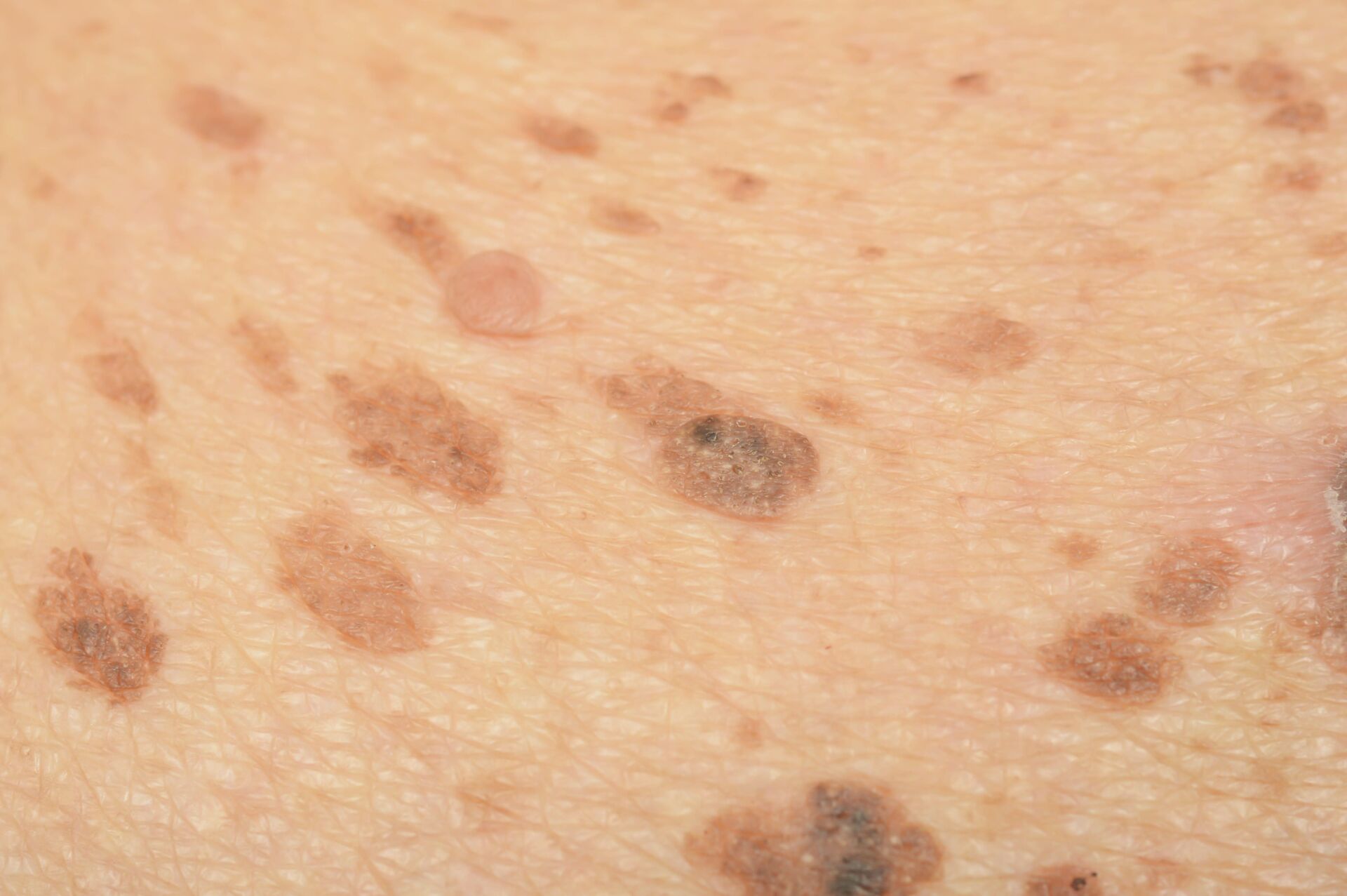
When the annoying skin bumps appear, it is particularly important to recognize them as age-related warts in good time and not to confuse them with other skin conditions – for example with dangerous skin cancer. Removing an age-related wart is no problem for trained doctors. However, anyone suffering from age-related warts should never undergo such a procedure themselves.
Overview: What are age warts?
Their name is misleading: unlike most other warts, senile warts are not caused by viruses. The skin growths, also known colloquially as “age warts”, are called seborrhoeic keratosis in medical terminology. Skin is called “seborrheic” when it is oily due to particularly active sebaceous glands – this naming results from the historical assumption that warts are particularly rich in sebaceous glands due to their nature. Keratosis is a change in the uppermost layer of the skin (epidermis). The senile wart is a benign, non-infectious tumor of the skin surface.
The term “tumor” sounds alarming to many people. However, it refers to nothing other than the swelling or increase in tissue. A benign tumor such as seborrheic keratosis does not destroy adjacent tissue and does not form metastases. A tumor that does not cause any damage does not necessarily have to be removed. Nevertheless, it can be perceived as a nuisance and impair the quality of life.
Seborrheic keratosis is common in all countries, in women and men alike and becomes more frequent with increasing age from the age of 40. Only a minority of 70- or 80-year-olds are free of age warts. Occasionally, however, the benign skin changes also appear at a younger age.
Age warts can occur in several (“multiple”) or as a single phenomenon (“solitary”). The areas of the body where age-related warts appear also vary from person to person. Areas of skin on the face are frequently affected, as well as the back of the hands, the front of the arms and legs, the chest and the back. However, seborrheic keratosis can occur on the entire body, with the exception of the palms of the hands and soles of the feet.
Online skin check: quick and convenient from home
Send in a photo of the affected skin area and complete the short questionnaire. You will receive a reliable diagnosis from our experts within 24 hours on weekdays. The button takes you to the external platform of our partner, where you can enter your data securely. These are sent to the USZ for further clarification.
Symptoms: How do age-related warts appear?
Age warts have a roundish or oval shape and are usually half a centimeter to a centimeter in diameter. However, there are also smaller and larger seborrheic keratoses. They usually feel soft and slightly greasy, as if they were made of wax and glued on. Their surface is furrowed or jagged, it can be flat or raised. The age warts form a sharp demarcation to the neighboring tissue. Their color can look very different: light brown, dark brown or black. Reddish tones also occur.
Age-related warts are often just a “blemish”. However, they can become a medical problem if they are in an unfavorable position. If they are repeatedly mechanically irritated, for example by rubbing clothing, small bleedings or infections can occur.
In addition to the very common, typical age warts, there are also a number of less common variants. These include:
- The stucco keratosis. Age warts of this type are flat, rather light in color and about the size of a lentil. They have white scales that can be easily scraped off. These age-related warts usually occur in clusters, often on the back of the foot or on the ankle, also on the lower leg. Men are more frequently affected than women.
- Melanoacanthoma. Age-related warts belonging to this form are particularly dark (“heavily pigmented”).
- The Verruca-plana. It has a very flat shape and is skin-colored to light dark. Age warts of this type often appear on the back of the hand and on the forearms. Especially in older people whose skin is damaged by UV radiation.
- Dermatosis papulosa nigra is a histological form of senile wart that is more common in women and in darker skin types. It often appears on the face, neck, chest or neck. This form runs in families.
- The reader-Trélat syndrome. Sudden appearance of a large number of seborrheic keratoses. Can occur in rare cases as a side effect of cancer.
Diagnosis: How can age-related warts be detected?
These skin changes can often be identified as age warts by their appearance to the naked eye. However, this is not always possible. If your doctor wants to be sure, a special magnifying glass (=dermatoscope) can help with the diagnosis. If a clear diagnosis is still not possible, a tissue sample can be taken. It is then analyzed in the laboratory, enabling a clear determination to be made.
Some age-related warts are of such a nature that they can easily be mistaken for another, potentially malignant skin change. Therefore, an exact diagnosis is very important in the assessment of seborrheic keratosis.
The following skin conditions can easily be confused with seborrhoeic keratosis:
- Dermatofibroma (=hard fibroma, histiocytoma). This benign growth resembles a mole. It often occurs on the arms or legs, often also in young women. If you squeeze a hard fibroma, it sinks into the skin.
- Bowen’s disease/actinic keratosis. The affected areas often appear in the form of reddish scaly skin with clear boundaries. It is a precursor of white skin cancer. This means that although the cells in the uppermost layer of the skin have undergone malignant changes, they do not penetrate destructively into the deeper layers of the skin. They feel dry and rough.
- Spinocellular carcinoma. It is also known as prickle cell carcinoma or squamous cell carcinoma and is a form of malignant skin cancer. The altered areas of skin are red and crusty, and can sometimes bleed spontaneously.
- Basal cell carcinoma. It is also called basal cell carcinoma. These malignant growths often have the same color as their healthy surroundings, grow slowly and penetrate deeply.
- Black skin cancer, also known as melanoma. This aggressive cancer usually appears as a dark or black spot. Its shape is also not uniform – the skin growth can be flat or raised.
Causes and risk factors: How do age warts develop?
It is not conclusively known why age warts appear on the surface of a person’s skin. Genetic factors may play a role. Age warts usually appear for no apparent reason. They are not contagious. UV radiation is very probably a risk factor. Too frequent, too long or unprotected exposure to the sun could promote the development of age-related warts. Several scientific studies indicate this.
Prognosis: How do age warts develop?
If they are not removed, seborrheic keratoses usually persist without further consequences. Occasionally, age warts fall off on their own. The benign tumors do not change into dangerous, malignant variants, but retain their largely harmless characteristics.
Further age-related warts often appear over time, but this is not essential. If a second age wart forms after the first one has appeared, this is not a proliferation but an independent new formation.
Treatment: How are age warts treated?
Doctors advise against attempting to treat or remove an age-related wart yourself for several reasons. Home remedies such as ointments or tinctures do not have the desired effect on seborrhoeic keratosis. Above all, however, before any treatment is carried out, it should first be determined whether the skin change that has appeared is really an age-related wart.
The removal of age warts belongs in experienced hands. Only doctors trained for this have the tools to diagnose and remove seborrheic keratosis safely. This is usually painless and without complications. Several methods are available:
- Ablation. The senile wart is anesthetized locally and removed with a curette, a sharp spoon or a scalpel.
- Laser treatment. Seborrheic keratosis can be removed by laser.
- Electrosurgery. The age wart is removed using a current-carrying snare.
- Icing. The age wart is sprayed with liquid nitrogen. This results in extremely cold temperatures. They cause the cells of the senile wart to be destroyed and fall off by themselves after a few days. This method is also known as cryotherapy.
You should discuss which of these procedures is most suitable for you with your doctor before treatment. Also ask about the advantages and disadvantages of each method. In most cases, the treatment of age warts goes smoothly and leaves no visible scars. You should avoid direct sunlight on the treated area until the wound has completely healed.