Overview: What is osteoarthritis?
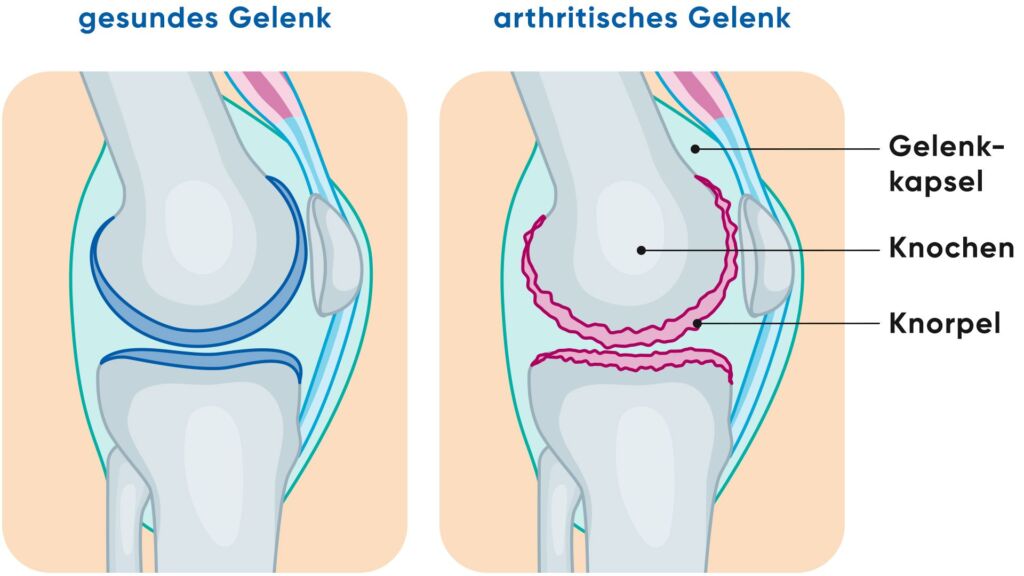
In osteoarthritis, the cartilage layer in the joints wears down more and more as a person ages. It’s getting thinner and rougher. Sometimes the cartilage wears down so much that the bone beneath the cartilage is exposed in certain areas of the joint. Because of the progressive loss of cartilage, doctors also refer to osteoarthritis as a degenerative joint disease. Typical symptoms include, for example, pain associated with movement and brief stiffness (lasting a few minutes) or stiff joints. However, some people with the condition have few symptoms.
Types of Osteoarthritis
Types of Osteoarthritis Osteoarthritis is classified according to various criteria, including its cause, the number of joints affected, and their location:
By cause:
- Primary osteoarthritis: Occurs without any identifiable underlying condition or specific cause. It is often attributed to the natural aging process and genetic predisposition, and it follows a very characteristic pattern of joint involvement.
- Secondary osteoarthritis: Develops as a result of a known cause or pre-existing damage to the joint. These include joint injuries (e.g., fractures, ligament injuries), deformities (e.g., bowlegs, hip dysplasia), inflammatory joint diseases (e.g., rheumatoid arthritis, crystalline arthropathies), metabolic disorders, or chronic overuse of the joint.
By number of affected joints:
- Monoarthrosis: Describes joint degeneration that affects only a single joint.
- Oligoarthrosis: 2–4 joints are affected.
- Polyarthrosis: This condition occurs when multiple joints (often five or more) are affected by osteoarthritis at the same time.
By Location: Osteoarthritis can affect any joint in the body. The following is a list of joints affected by primary osteoarthritis.
- Knee Osteoarthritis: Osteoarthritis of the Knee Joint
- Coxarthrosis: Osteoarthritis of the Hip Joint
- Rhizarthrosis: Osteoarthritis of the thumb saddle joint
- Heberden’s Arthritis/Bouchard’s Arthritis: Osteoarthritis of the finger joints (Heberden’s arthritis in the distal joints, Bouchard’s arthritis in the middle joints)
- Spondylarthrosis/Facet Joint Arthrosis: Osteoarthritis of the Small Vertebral Joints
- Osteoarthritis of the metatarsophalangeal joint of the big toe (MTP I)
Frequency and Age
Osteoarthritis is the most common joint disease in adults worldwide. It is a normal, age-related sign of wear and tear, which is why it primarily affects older people. However, cartilage wear sometimes occurs even in young people who subject their joints to constant heavy strain (e.g., in competitive sports).
In addition to age, gender also influences the likelihood of developing osteoarthritis: Up to age 55, it primarily affects men, but as people get older than 55, an increasing number of women develop the condition.
Osteoarthritis: causes and risk factors
The ends of the bones in a joint are surrounded by an elastic, protective layer of cartilage. As we age, the layer of cartilage becomes thinner and thinner due to natural wear and tear. Injuries can also lead to irreparable damage to the cartilage.
In any case, the following applies: If the protective layer of cartilage is missing entirely or in part, the ends of the bones in the joint rub directly against each other. As a result, impacts or other mechanical stresses can no longer be absorbed. Instead, bone tissue forms at the ends of the bones to compensate for the excessive stress on the joint. The result: The joints swell and become deformed. The bony growths that extend around the joint are also called “osteophytes.”
In addition, the constant friction can cause fragments of bone or cartilage to enter the synovial fluid and irritate the synovial membrane. This can lead to temporary inflammation, accompanied by redness or swelling of the affected joint. Doctors then speak of “activated osteoarthritis”.
Risk Factors for Osteoarthritis
There are various risk factors that can promote the development of osteoarthritis. These include, for example:
- Obesity
- Constant strain from work or sports
- congenital malpositions
- genetic predisposition
- Injuries to the Cartilage Layer
- Injuries to the joint that have not healed (e.g., to the ligaments or meniscus)
- Gender (Women are generally affected more often than men)
Osteoarthritis symptoms
There are various signs of osteoarthritis. People with osteoarthritis experience pain when they move the affected joint again after a period of inactivity (e.g., sitting or lying down). However, the pain usually goes away quickly with movement. In this case, doctors also refer to it as “start-up pain.” Many people with the condition generally report that, especially in the early stages of the disease, their symptoms fluctuate in intensity—sometimes becoming more severe and then subsiding again. Sometimes external factors, such as physical exertion or the weather, play a role.
One characteristic of degenerative joint disease, for example, is that the joints are stiff in the morning after waking up. Unlike joint problems caused by inflammation (e.g., rheumatoid arthritis), the so-called morning stiffness associated with osteoarthritis usually lasts for several minutes.
Especially in advanced stages of osteoarthritis, the range of motion in the affected joint can be severely limited. Sometimes this is accompanied by swelling or a sensation of something rubbing or cracking when moving. At this stage, pain may be felt on a constant basis.
Osteoarthritis diagnosis
In order to diagnose osteoarthritis, we usually first have a detailed discussion with you (medical history) and ask various questions, such as:
- What symptoms are you experiencing?
- Where and when do these symptoms occur most often?
- How long have you been experiencing these symptoms?
- Do you suffer from another disease, especially an inflammatory joint disease such as rheumatoid arthritis or gout?
We then examine the affected joint more closely. For example, patients must move the joint or walk back and forth to identify any potential range-of-motion limitations and abnormalities in their gait. We also check to see if the movement causes pain. Swelling, redness, or any tenderness can also be detected during a physical examination. We also check whether the cause of the pain is in the joint or around the joint in the area of the joint capsule and bursa.
Imaging techniques
We can normally detect osteoarthritis from the symptoms. If you have doubts about the diagnosis, imaging tests can help. As a rule, a conventional X-ray examination is sufficient to detect typical abnormalities such as a narrow joint space or damage to the bone.
Additional methods are also available for a more detailed examination. These include, for example, a joint ultrasound, magnetic resonance imaging and computer tomography. The latter provide very precise images that can make osteoarthritis visible even at an early stage.
Blood test
A blood test is useful to rule out other joint diseases that could also be the cause of the symptoms. Certain blood values such as the concentration of uric acid, inflammation values (e.g. C-reactive protein, erythrocyte sedimentation rate) or the so-called rheumatoid factor can indicate gout or rheumatoid arthritis, for example.
Early detection of osteoarthritis
Osteoarthritis is usually diagnosed when the cartilage has already been irreparably damaged. Es gibt auch einige Methoden zur Früherkennung. This diagnosis is based on the patient’s medical history, a physical examination, and imaging (usually X-rays).
Preventing Osteoarthritis
There are no direct measures to reliably prevent the development of osteoarthritis. However, you can still do a lot to slow down joint disease:
- Regular exercise: People who exercise regularly are also doing a lot to maintain the health of their joints. When choosing a sport, look for ones that don’t put uneven strain on your joints. Good options include, for example, cycling, Nordic walking, or swimming.
- Avoid being overweight: Being overweight puts additional strain on the joints. Try to lose excess weight by changing your diet and exercising regularly.
- Correcting Misalignments: If you suffer from misalignments such as bowlegs, you may want to have them corrected with orthopedic treatment. This prevents uneven stress on the joints and can therefore reduce the risk of osteoarthritis.
- Don’t overdo it when exercising: Exercise is good for your joints, but only if you don’t overdo it. When it comes to exercise, the most important rule—especially for beginners—is: It’s better to exercise moderately but regularly! This will help you avoid overexertion and injuries that can contribute to the development of osteoarthritis.
- Pay attention to your diet: Foods that can promote inflammation include, above all, meat and animal fats. You should enjoy them in moderation. This can have a positive effect on the inflammatory processes associated with osteoarthritis.
- Avoid alcohol and cigarettes: Alcohol and nicotine can also promote inflammation in the body. Therefore, you should not drink alcohol in excess and, if possible, avoid cigarettes altogether.
Course and Prognosis of Osteoarthritis
The course of osteoarthritis is different for every patient. As a result, it can only progress slowly and occasionally cause problems that then disappear again. Some people with the condition experience very few symptoms of the joint disease, even in advanced stages, while others develop very severe symptoms very quickly. Especially when pain occurs, many people avoid physical activity. However, this can also cause the muscles to weaken over time. The result: Osteoarthritis generally worsens, joint mobility decreases even further, and instability may increase.
As the condition progresses, the ends of the bones in the joint may become partially or completely exposed. Over time, this can lead to changes in the bone, further restricting the joint’s range of motion and causing those affected to suffer from chronic pain. Wenn die ungeschützten Joint surfaces When they rub against each other, noises can occur. Sometimes you can actually feel this friction. At this stage of osteoarthritis, joint replacement is often the only way to relieve the symptoms.
To this day, there is no cure for osteoarthritis. Nevertheless, the right treatment can delay the progression of the joint disease and have a positive influence on its course.
Self-Help Groups
Talking with others who are going through the same thing can be a great source of support when coping with an illness. If you are looking for a suitable self-help group , you can get advice from Selbsthilfe Zürich. Selbsthilfe Zürich and the University Hospital of Zurich are partners in the national project “Health Literacy Through Self-Help-Friendly Hospitals.”
Osteoarthritis: Treatment
The goal of osteoarthritis treatment is to relieve pain, maintain or improve joint function, and slow the progression of the disease. Since osteoarthritis is incurable, the focus is on reducing symptoms and improving quality of life. A personalized, often multimodal treatment plan takes into account the affected joint, the stage of osteoarthritis, symptoms, and personal needs. A distinction is made between conservative (non-surgical) and surgical measures.
Conservative treatment approaches: Conservative treatment forms the foundation and aims to relieve pressure, reduce pain, and improve mobility. Key pillars include:
- Patient education and counseling: Providing information about the condition and ways to protect the joints in order to positively influence the course of the disease.
- Exercise therapy and physical therapy: Targeted exercises and low-impact sports (e.g., swimming, cycling) strengthen muscles, improve mobility, and relieve pain.
- Physical therapy: heat, cold, electrical, or ultrasound therapy for local pain relief.
- Weight Management: Losing weight if you are overweight relieves pressure on the joints and can reduce pain and slow the progression of osteoarthritis.
- Occupational Therapy: Learning everyday movements that are gentle on the joints and, if necessary, adapting the environment.
- Orthopedic aids: Aids such as bandages, orthoses, or walking aids provide stability, relieve pressure, and alleviate pain.
Drug Therapy: Medications are used to manage pain and inflammation, tailored to the severity of the condition and accompanying factors.
- Pain relievers (analgesics): For the symptomatic treatment of pain.
- Anti-inflammatory medications(e.g., NSAIDs): When taken orally or applied topically, they reduce pain and inflammation. Medical supervision is recommended during long-term use.
- Cartilage-protective medications—such as chondroitin sulfate—can also help relieve pain.
- Intra-articular injections: Injections of glucocorticoids for acute, inflammatory osteoarthritis (e.g., a swollen, reddened, and/or warm joint). Injections for chronic, mechanically decompensated joints, e.g., with hyaluronic acid or platelet-rich plasma (PRP) therapy. Although autologous blood therapy has not been clearly proven scientifically, a positive effect has often been observed, for example, in cases of knee osteoarthritis.
Surgical Treatment: If conservative treatments are ineffective and quality of life is severely impaired, surgery may be considered. The goal is to reduce pain and improve function. The range of procedures extends from joint-preserving surgeries to artificial joint replacement (endoprosthetics).
The choice of treatment is made on an individual basis following a consultation with a doctor.
Details About the Treatments
Frequently asked questions about osteoarthritis
According to the current state of medical knowledge, osteoarthritis cannot be cured as the already worn joint cartilage cannot be completely restored. Treatment is aimed at relieving pain, improving or maintaining joint function and slowing down the progression of the disease.
Osteoarthritis is a degenerative disease of the joint caused by wear and tear. The focus here is on the wear and tear of the joint cartilage. The reduced or missing cartilage surface causes local irritation in the affected joint, which in turn can lead to discomfort. In principle, all joints can be affected, with osteoarthritis frequently occurring in the knee joint, hip joint, spine or small finger joints.
There are no foods that can directly cause or cure osteoarthritis. However, a balanced, anti-inflammatory diet rich in omega-3 fatty acids, vitamins and antioxidants can help to alleviate symptoms. Highly processed foods, lots of sugar and unhealthy fats can promote inflammation and should be avoided.
Osteoarthritis is favored by various risk factors, including age, genetic predisposition and gender (women are more frequently affected). Being overweight increases the strain on the joints and can promote osteoarthritis, as can previous injuries, inflammation or misalignment of the joints. It is often a combination of several factors that ultimately lead to osteoarthritis.
The most effective treatment for osteoarthritis is usually a multimodal approach that includes exercise therapy (physiotherapy), weight reduction if necessary, pain therapy and anti-inflammatory medication. In advanced cases, surgical measures such as joint replacement may also be necessary.
There is no single vitamin deficiency that is the cause of osteoarthritis. However, an adequate supply of vitamin D and C and other micronutrients is important for general bone and cartilage health and can have a positive influence on the course of the disease.
The main symptom of osteoarthritis is pain in the affected joint, which mainly occurs during exercise or after a long period of rest. It can also lead to stiffness and restricted movement in the affected joints. In the long-term course of the disease, deformities of the joints can also occur.
In addition to pain, activated osteoarthritis can also cause redness, overheating and swelling of the joint. This is an acute inflammatory condition in a joint affected by osteoarthritis, which occurs more frequently after overuse.
The diagnosis of osteoarthritis begins with a detailed medical history and examination. Imaging examinations (X-ray, ultrasound, MRI) are also used to make the diagnosis. In the case of active osteoarthritis, a joint puncture and, if necessary, a laboratory examination can also provide valuable further information for the diagnosis.
The treatment of osteoarthritis depends on the severity and the patient’s individual symptoms. The aim of the treatment is to relieve pain and improve quality of life. To achieve this, conservative therapy approaches (physiotherapy, physical activity, weight reduction), drug treatments (painkillers, joint injections) or, in the case of advanced osteoarthritis with a high level of suffering, surgical interventions (joint replacement, stiffening) are used.
In principle, it is important to avoid heavy and one-sided strain on the affected joints. However, appropriate, regular physical activity and sports that are easy on the joints, such as swimming, cycling or walking, are recommended for osteoarthritis. Aids (such as supports) and lifestyle changes can alleviate the pain and increase the resilience of the affected joints.
A common first sign of osteoarthritis is joint pain, which occurs in particular when you start to move again after a period of rest – such as in the morning immediately after waking up or after sitting for a long time. Characteristically, this initial pain subsides or disappears completely as soon as the joint has been in motion for some time. Other early symptoms may include brief joint stiffness in the morning (a few minutes), pain when the joint is loaded, and an audible and/or palpable crunching sensation in the joint.
The course of the disease is very individual and depends heavily on various factors such as age, the location of the osteoarthritis and the general state of health. In most cases, osteoarthritis progresses slowly over the years. The course of the disease can be positively influenced by regular, joint-friendly physical activity, weight normalization and a healthy lifestyle.
No, osteoarthritis and spondylosis are not the same thing, even though both are degenerative diseases. Osteoarthritis refers to the wear and tear of cartilage in the joints. SPondylosis is a form of osteoarthritis that is limited to a specific location. The term is limited to the spine and the “degenerative process” that occurs there. Dies kann sowohl die Wirbelkörper, Bandscheiben, Bandapparat als auch Facettenegelenke betreffen.
Osteoarthritis is the general term for joint wear and tear. Gonarthrosis is a specific form of osteoarthritis that affects the knee joint (Greek “gon” for knee). Coxarthrosis is a specific form of osteoarthritis that affects the hip joint (Latin “coxa” for hip).
Yes, physiotherapy is a very important part of osteoarthritis treatment. Targeted exercises can help to strengthen the muscles, improve joint mobility, reduce pain and maintain joint function.
