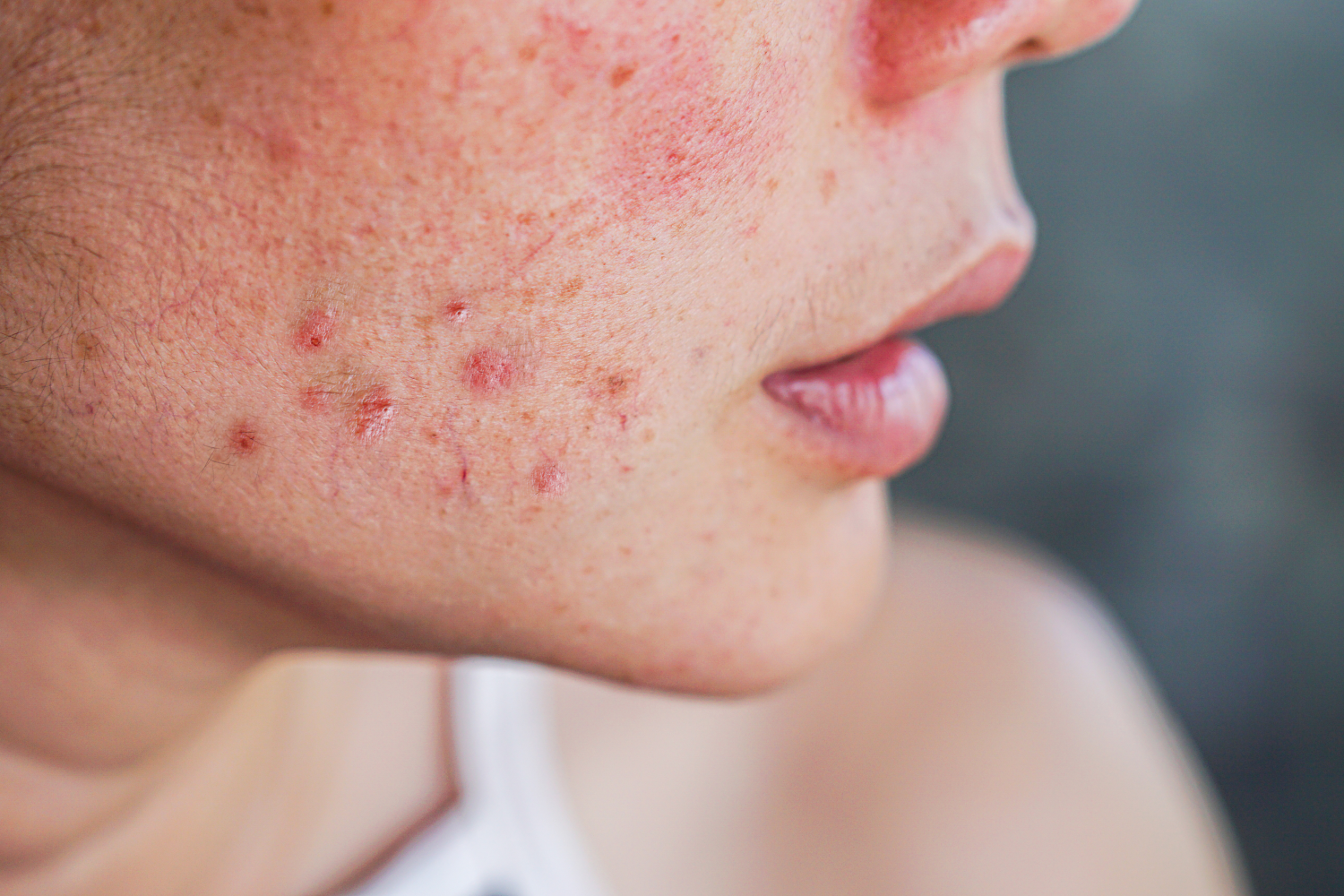
What is acne?
Common acne (acne vulgaris) is a chronic, inflammatory skin condition characterized by pimples, comedones, and pustules. The condition affects the sebaceous-rich skin on the face and neck, and often also on the chest and back. This skin condition typically appears during puberty and usually resolves on its own afterward.
Special forms of acne
In addition to this “typical” acne, there are several other forms that differ from one another in terms of their triggers, nature, and severity of the inflammatory skin lesions. These include, for example:
- Acne inversa: Not actually a form of acne, but a disease of the terminal hair follicles. Abscesses develop, typically in the large skin folds (e.g., under the armpits, under the breasts in women, and in the groin and anal regions).
- Acne fulminans: A severe form of acne that progresses rapidly and intensely and affects the entire body, causing symptoms such as high fever, joint inflammation (arthritis), and swelling of the spleen and liver. Male adolescents are particularly affected.
- Late-onset acne: This term refers to acne symptoms that persist or appear for the first time after the age of 25. The skin of those affected—most of whom are women—is characterized by deep, persistent inflammation, particularly in the lower part of the face.
- Acne neonatorum: A mild form of acne in newborns—that is, babies in the first 30 days of life. Boys are particularly affected.
- Acne infantum: A rare form of acne in infants and toddlers, again most common in boys. The inflammatory skin lesions develop after the 2. through 3rd month of life.
- Acne aestivalis: This acne-like form of “sun allergy” (polymorphic light dermatosis) is also known as Mallorca acne, spring acne, or summer acne. It usually first appears between the ages of 20 and 40, in connection with high levels of UV radiation and/or the use of oil-based sunscreens. In the fall, “Mallorca acne” usually clears up on its own.
- Acne venenata: This type of “contact acne” is triggered by chemical compounds that are “comedogenic,” meaning they promote the formation of blackheads. These include, for example, chlorinated hydrocarbons (chloracne), lubricating oils (oil acne), tar (tar acne), and cosmetics (cosmetic acne = acne cosmetica).
- Acne medicamentosa: Acne or acne-like skin lesions caused by medications, such as glucocorticoids (steroid acne), anabolic steroids (doping-related acne), certain antibiotics, B vitamins, and barbiturates (sleeping pills and sedatives).
Acne - frequency and age
Acne is the most common skin disease worldwide. On average, around 70 to 95 percent of all young people are affected. However, only in 15 to 30 percent of cases is it severe enough to require medical treatment.
Common acne usually begins between the ages of 15 and 18. Males are affected just as often as females, but are more likely to suffer a severe course of the disease.
Acne: causes and risk factors
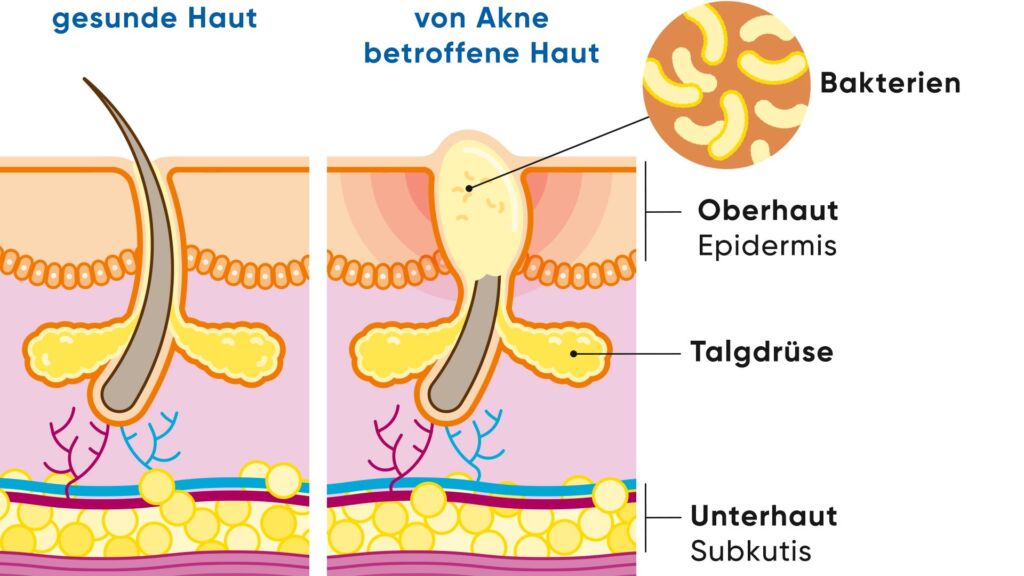
Various factors contribute to the development of common acne. This includes excess sebum production: The sebaceous glands produce too much oily secretion, stimulated by male sex hormones (androgens such as testosterone), which are produced in particular during puberty (including in girls).
Androgens also trigger increased production of keratin in the skin (hyperkeratosis). The horn material can block the duct of a sebaceous gland. This results in a closed blackhead—a skin-colored to whitish, hemispherical plug of sebum and keratin.
As sebum continues to be produced, such a blackhead can grow larger and larger and open up—resulting in an open blackhead whose central keratin plug turns black when exposed to the air.
Blackheads provide a good breeding ground for bacteria: Bacteria of the species Propionibacterium acnes can multiply in the sebaceous glands. They metabolize sebum and can trigger purulent inflammatory processes.
Other Factors That Contribute to Acne
Other factors that can influence the development of acne include, for example:
- Genetic Factors: Some people have a genetic predisposition to acne. The condition may then be more severe—especially if the mother had acne.
- Smoking: Cigarette smoke is believed to promote or worsen acne due to its pro-inflammatory components. However, this is a subject of controversy among experts.
- Medication: There are many drugs that can trigger or worsen acne, e.g. drugs for epilepsy (antiepileptic drugs) and anabolic steroids (muscle-building drugs).
- Climatic factors: In some cases, climatic factors such as UV rays and humidity can contribute to the development of acne.
- Emotional strain and stress: These are also believed to contribute to the development of acne. However, this has not yet been scientifically proven.
- Diet: There are no specific foods that can trigger acne. However, it appears that drinking large amounts of milk and consuming dairy products, as well as eating carbohydrates with a high glycemic index, are detrimental to the skin’s appearance. These are carbohydrates that cause blood sugar levels to rise quickly and sharply (e.g., chocolate, French fries).
Symptoms: Acne
Acne-prone skin is oily and has a greasy sheen, and is covered with numerous closed (white) and open (black) blackheads, known as comedones. When the skin is characterized primarily by comedones, we refer to this condition as “acne comedonica.” Blackheads can develop into inflammatory papules and pustules (“acne papulopustulosa”). Papules are hemispherical nodules, up to the size of a pea, that protrude above the surface of the skin. Pustules are pus-filled “blisters” on the skin that are up to 0.5 centimeters in size and surrounded by a ring of redness.
In severe cases, the condition progresses to “acne conglobata”: In addition to blackheads, papules, and pustules, other skin changes develop, such as large inflammatory nodules, encapsulated collections of pus (abscesses), deep scars, and scabs.
If it is the special form of acne fulminans mentioned above, other symptoms such as high fever and joint inflammation are also present.
Many people with acne suffer not only from the physical symptoms of this skin condition but also from the associated emotional distress: When the face is covered with pimples, blackheads, and pustules, this can significantly erode self-confidence and impair quality of life.
Online Skin Check: Quick and Convenient from Home
Please submit a photo of the affected area of skin and fill out the short questionnaire. Within 24 hours on business days, you’ll receive a reliable diagnosis from our experts. Clicking the button will take you to our partner’s external platform, where you can securely enter your information. These are forwarded to the USZ in a secure manner for further evaluation.
Acne - diagnosis by a doctor
We can usually recognize acne-prone skin at first glance, especially when blackheads, pimples, and pustules appear during puberty. If we suspect that you do not have common acne (acne vulgaris) but rather a specific form triggered by an external factor, we can ask you specific questions—for example, about the cosmetics and medications you use or your exposure to tar or lubricating greases.
We can take a swab from areas of the skin with severe inflammation to test for a bacterial infection. Sometimes we perform additional tests, such as measuring hormone levels in the blood. This may be appropriate, for example, for women who develop acne after the age of 25 and also exhibit signs of “masculinization” (virilization), such as an irregular menstrual cycle and male-pattern hair growth (e.g., facial and chest hair). Affected women produce too many male sex hormones, for example, due to an adrenal disorder or polyendocrine metabolic ovarian syndrome (PMOS). The latter is a common hormonal disorder in women.
Hormone levels are also measured in children who have had acne for more than 16 to 24 weeks after birth or who develop acne between the ages of three and seven.
Acne: prevention, early detection, prognosis
It is virtually impossible to effectively prevent the complex development of acne. The best thing you can do is address the external factors that may contribute to skin conditions. Here are a few tips:
- Please do not smoke.
- Avoid consuming too much milk and dairy products, as well as foods high in sugar. In general, eating a healthy, balanced diet is good for your skin (and the rest of your body).
- Protect your (facial) skin from excessive sun, heat, and cold to avoid irritating it and causing skin problems.
- Clean and care for your skin properly (e.g., with pH-neutral soaps that are free of fragrance and other additives, and water-based creams).
Acne – Course and Prognosis
Common acne is a chronic condition. It usually begins during puberty and worsens in episodes until it gradually resolves on its own in late adolescence or early adulthood.
However, in 10 to 40 percent of those affected, acne persists beyond the age of 25 or does not even begin until that age. This form of late-onset acne mainly affects women.
Acne scars
Acne scars often result from severe acne. They can permanently alter the appearance of the skin and cause psychological distress to those affected. There are different types of acne scars—including depressed (atrophic) and raised (hypertrophic) scars.
There are many treatment options available today. Superficial scars can often be improved with chemical peels or microneedling. For deeper scars, options such as laser treatments (e.g., CO₂ laser), hyaluronic acid injections, or minor surgical procedures may be considered. In some cases, a combination of several methods may also be appropriate.
It is important that the treatment be tailored to the individual’s skin type and the nature of the scars. Please feel free to contact us for a consultation regarding acne scar treatment.
Acne: treatment is planned individually
The treatment of your acne depends above all on the form, severity and current status of the disease. Various medications are used, sometimes also physical therapies. In the case of acne with known external triggers, such as cosmetics or medication, these should be avoided if possible.
Details of the treatments