The pathogen has been detected more frequently in Switzerland and Europe in recent years. Children and young adults are particularly likely to be affected.
How is the fungus transmitted?
Trichophyton tonsurans is transmitted from person to person. This occurs through direct contact, for example, within the household, among family members, or during contact sports (wrestling, judo, martial arts). Shared items such as combs, brushes, hats, pillows, towels, or exercise mats can also be a source of transmission. Hair-cutting tools can also transmit the skin fungus if they are not adequately cleaned and disinfected between clients. Infections are therefore also possible when visiting a barbershop.
Furthermore, the fungus can also colonize people who have no symptoms. These individuals can pass it on without realizing it.
Recognizing Symptoms
The symptoms depend on which part of the body is affected.
- Scalp: Scaly, round, or irregular patches, often accompanied by itching. The hair breaks off just above the scalp (so-called “black dots”) or falls out. In cases of severe inflammation, redness, swelling, pus, and pain may occur. If left untreated, this can lead to permanent hair loss.
- Skin: Red, scaly, usually itchy patches with raised edges that spread in a ring-like pattern. The skin in the center often heals. One or more lesions may appear. The fungal infection is easily mistaken for eczema.
- Face and beard: Red, scaly patches, some with pustules or inflamed hair follicles.
Online Skin Check: Quick and Convenient from Home
Submit a photo of the affected area of skin and fill out the short questionnaire. You’ll receive a reliable diagnosis from our experts within 24 hours on business days. Clicking the button will take you to our partner’s external platform, where you can securely enter your information. This information will be securely transmitted to the USZ for further evaluation.
Diagnosis
The doctor first assesses the appearance of the skin and scalp. Because a fungal infection can resemble other skin conditions, such as eczema or psoriasis, the diagnosis is confirmed by taking a sample. To do this, skin flakes or hair are examined in a laboratory.
The accredited laboratory at the USZ Dermatology Clinic is a leader in the field of fungal skin infections and uses microscopy, culture, and PCR.
Treatment
Treatment depends on the affected area and the extent of the condition.
- Scalp: A fungal infection of the scalp is always treated with pills because creams do not penetrate the hair follicles. An antifungal shampoo can help reduce the risk of infection. Treatment usually lasts several weeks.
- Body and Face: Localized lesions are usually treated with an antifungal cream. Oral medication is necessary for extensive or severely inflamed infections, for infections affecting the hair follicles (for example, in the beard area), or when creams are ineffective. The cream is continued for a few days after the infection has cleared up, usually for several weeks in total.
The doctor determines the choice of medication and the duration of treatment based on the test results, the pathogen, and the course of the infection. During treatment, combs, brushes, hats, towels, bedding, and clothing should be washed regularly at 60 °C. If there is an infection in the family, household members should watch for skin changes and seek medical attention if they experience symptoms, as the fungus can be present without causing any symptoms.
Prevention
The following measures reduce the risk of infection:
- Do not share combs, brushes, hats, towels, or clothing with other people.
- Before your appointment at the men’s salon, ask whether scissors, combs, and razors are cleaned and disinfected after each client.
- If you come into contact with an infected person, avoid close contact with their skin and hair until treatment has begun.
If you experience itching, scaly or ring-shaped patches of skin, pustules, or hair loss, see a doctor early on
Figures and Trends
The Dermatology Clinic at the USZ has observed an increase in cases since 2015. The number of cases per year rose from five (2015) to twelve (2021) and to 20 (2025).
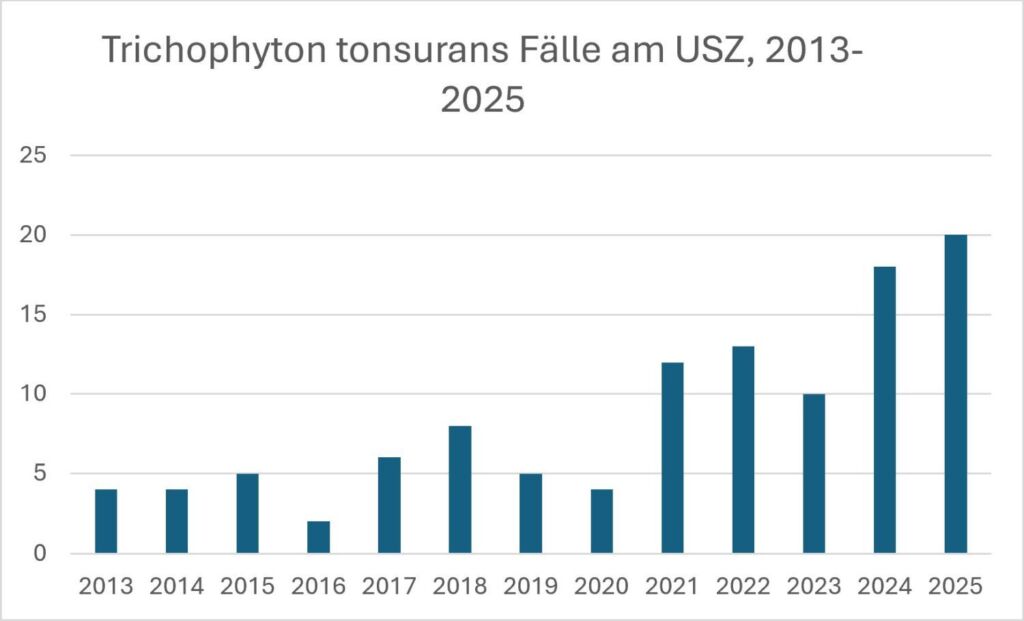
Cases of Trichophyton tonsurans diagnosed in the Dermatology Clinic’s laboratory between 2013 and 2025.
The infection affects all age groups, particularly children and young adults:
- 24% under the age of 14
- 16% Ages 14 to 17
- 23% aged 18 to 24
- 37% of people aged 25 and older
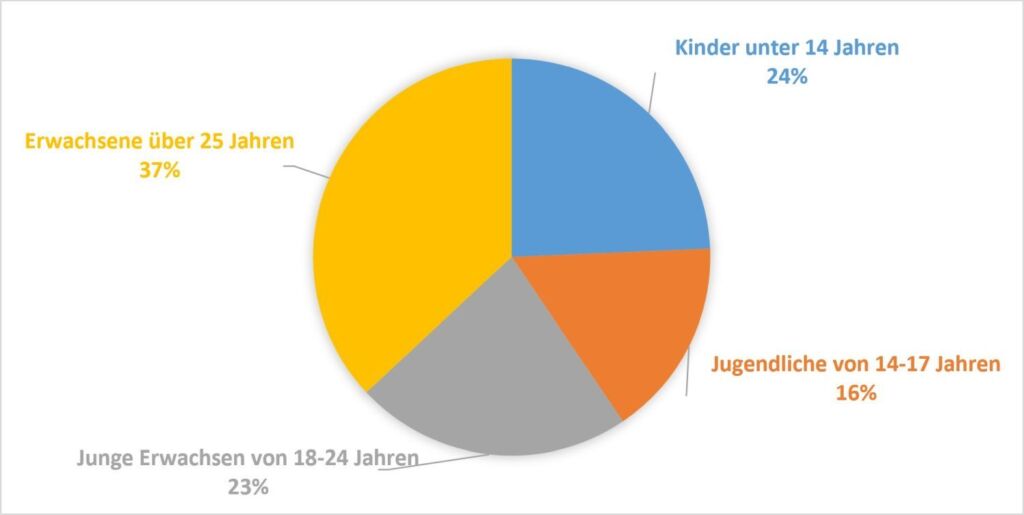
Age distribution of cases diagnosed with Trichophyton tonsurans in the Dermatology Clinic’s laboratory from 2013 to 2025
Men account for 70 percent, and women for 30 percent.
In about half of the patients, the infection affected neither the scalp nor the face, but rather the rest of the body (tinea corporis). Trichophyton tonsurans is therefore not just a scalp fungus.
Frequently asked questions
Trichophyton tonsurans is a skin fungus that can infect the scalp, face, beard, and the rest of the body. It causes scalp ringworm (tinea capitis), beard and facial ringworm (tinea barbae, tinea faciei), and ringworm on the body (tinea corporis).
Yes. The fungus is transmitted through direct contact with the skin and hair, as well as through shared items. Tools in men’s salons and training mats used in contact sports can also transmit it if they are not properly cleaned and disinfected.
Typical symptoms include itchy, scaly, reddened patches—often ring-shaped with raised edges on the body, and accompanied by hair loss or broken hairs on the scalp. These changes resemble those of other skin conditions, such as eczema. A laboratory test confirms the diagnosis.
A fungal infection of the scalp is treated with pills. Fungal infections on the body and face are usually treated with cream if the infection is limited, and with pills if it is widespread or deep-seated. Treatment generally lasts several weeks. The doctor will determine the exact course of treatment.
See a doctor if you notice itchy, scaly, or ring-shaped patches of skin, pustules, or hair loss, or if a rash does not improve within about two weeks of using a cream. Do not wait until inflammation or pain develops.