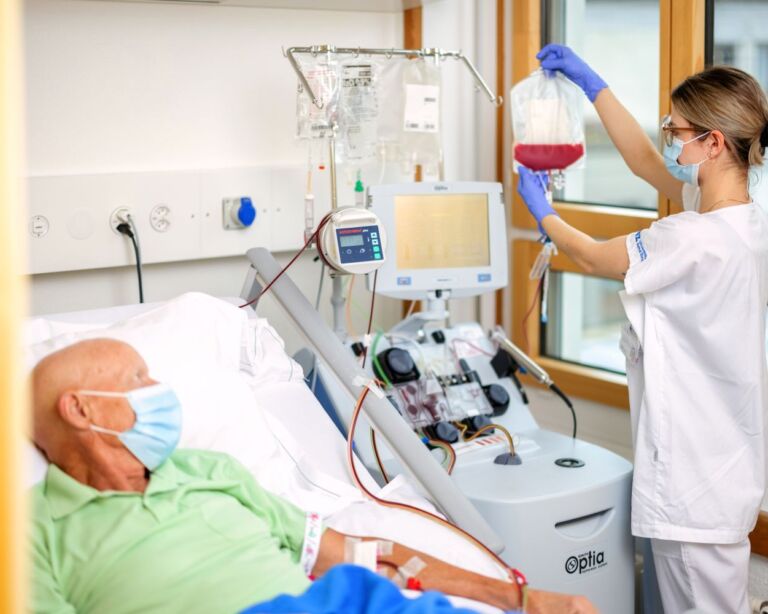
Acute leukemia (blood cancer) is a generic term that describes various malignant diseases of the hematopoietic stem and precursor cells of blood cells. There are two main forms: acute myeloid leukemia (AML) and acute lymphoblastic leukemia (ALL).
The tasks of the blood components
The three basic blood cells (red blood cells, white blood cells, platelets) are formed in the bone marrow from hematopoietic stem and progenitor cells. To understand the effects of acute leukemia, it is important to know the functions of these three blood cell types:
Red blood cells (erythrocytes): They make up the largest proportion of blood cells and transport oxygen from the lungs to the body tissue and carbon dioxide back to the lungs.
White blood cells (leukocytes): They are part of the immune system and protect the body from pathogens. They also remove old or defective body cells. The most important subgroups include granulocytes as well as B and T lymphocytes.
Blood platelets (thrombocytes): They are crucial for blood clotting. In the event of an injury, they adhere to the vessel wall, seal the wound and promote the formation of a stable blood clot.
What is acute leukemia?
If the hematopoietic stem and progenitor cells in the bone marrow degenerate, acute leukemia (blood cancer) develops.
Acute leukemia is not a single disease, but a group of very different malignant diseases of the hematopoietic system. What they have in common is that genetic changes in stem and precursor cells in the bone marrow lead to the formation of immature precursor cells of white blood cells (blasts), which multiply uncontrollably. These blasts suppress normal blood formation and can affect the entire body.
Historically, various diseases were grouped together under the term “leukemia”. Thanks to modern molecular diagnostics, we now know that these are very different clinical pictures, each requiring its own prognosis and special therapy.
The two main forms of acute leukemia are:
Acute myeloid leukemia (AML)
Acute lymphoblastic leukemia (ALL)
Thanks to medical advances, acute leukemia is now much easier to treat and some forms can even be cured.
Forms of acute leukemia
Acute leukemias are classified according to the origin of the cells as either myeloid (from precursor cells of granulocytes, monocytes, erythrocytes, thrombocytes) or lymphatic (from precursor cells of lymphocytes).
Acute myeloid leukemia (AML)
Arises from immature myeloid stem and progenitor cells in the bone marrow.
Progresses rapidly and leads to severe symptoms in a few weeks or months without treatment.
Typical symptoms: Anemia, susceptibility to infections and a tendency to bleed.
AML is the most common form of acute leukemia in adults and occurs predominantly in older adults.
Acute lymphoblastic leukemia (ALL)
Develops from immature stem and precursor cells of lymphocytes.
Develops rapidly and must be treated immediately.
Particularly common in children, where it is the most common form of cancer, but also occurs in adults.
Symptoms are caused by the displacement of healthy blood formation and infestation of the lymph nodes, spleen or central nervous system.
Even though both diseases are grouped together under the term acute leukemia, there are a number of subtypes that differ significantly in their course, symptoms and treatment – which is why an exact diagnosis is crucial for treatment planning.
Frequency of acute leukemia and age distribution
Acute leukemia is one of the rarer forms of cancer. Compared to breast, prostate or colon cancer, they only account for around 2% of all tumor diseases.
The disease predominantly affects older people: Almost half of patients are over 70 years old at the time of diagnosis. Children are significantly less frequently affected by acute myeloid leukemia (AML). Only about 4 in 100 cases of leukemia affect children under the age of 15. In contrast, acute lymphoblastic leukemia (ALL) is less common in adults and significantly more common in children.
Acute lymphoblastic leukemia (ALL): Most common form of cancer in children; around 1 new case per 100,000 children per year.
Acute myeloid leukemia (AML): Most common acute form in adults; around 3-4 new cases per 100,000 people per year, predominantly in older adults.
Center for Hematologic Neoplasms
At the USZ, numerous departments have joined forces to form a Center for Hematologic Neoplasms. The center is certified according to the guidelines of the German Cancer Society (DKG). A team of experts specializing in the medical treatment of leukaemia works closely together here for the benefit of our patients. In DKG-certified centers, patients are treated according to strict quality criteria and, according to current studies, have a better chance of survival on average.
The exact causes of the development of leukemia are still not fully understood. The common mechanism is an acquired genetic alteration in blood stem cells and bone marrow progenitor cells. As a result, immature leukemia cells (blasts) divide uncontrollably and displace healthy blood formation. These genetic changes can occur by chance or be favored by external influences.
Generally known risk factors
An increased risk of various leukemias is associated with the following factors:
Contact with certain chemicals, e.g. benzene
Ionizing radiation, for example after radiation accidents or as part of radiation therapy
Certain medications, especially cytostatic drugs following previous cancer treatment
Tobacco consumption, especially for acute myeloid leukemia (AML)
Genetic predisposition, e.g. familial clustering or syndromes such as trisomy 21
Pre-existing diseases of the hematopoietic system, e.g. myelodysplastic syndrome (MDS) or myeloproliferative neoplasia (MPN)
These risk factors increase the probability, but do not mean that a disease will necessarily develop. In most cases, the cause remains unclear.
Differences between the types of leukemia
AML: Often associated with previous chemotherapy, radiotherapy or exposure to chemicals (e.g. benzene). AML can also develop from precursors such as MDS or MPN.
ALL: Often without a clearly recognizable cause. In rare cases, genetic syndromes (e.g. trisomy 21) or high radiation exposure.
Even if certain influences can increase the risk, most leukemias develop without a clearly identifiable trigger – the decisive factor for treatment is therefore not the cause, but the exact classification of the respective form of leukemia.
Precursors of leukemia
Certain diseases of the bone marrow can occur as a precursor to leukemia. These include above all:
Myelodysplastic neoplasia (MDS): The formation of blood in the bone marrow is disturbed. Immature or defective cells develop, while healthy blood cells are missing. The consequences are anemia, frequent infections or impaired blood clotting. MDS can remain stable or develop into acute myeloid leukemia (AML).
Myeloproliferative neoplasms (MPN): These are chronic diseases of blood formation in which too many dysfunctional blood cells are formed. Certain MPNs can also develop into AML during the course of the disease.
Regular medical check-ups are crucial for these precursors in order to detect changes at an early stage and initiate treatment in good time if necessary.
CCCZ Patient Academy on Acute Myeloid Leukemia (AML)
External content
Please accept cookies to display this content from an external website.
Symptoms of acute leukemia (AML, ALL)
Acute leukemia (AML, ALL) causes symptoms that can quickly become life-threatening if left untreated.
The symptoms begin suddenly and are usually very pronounced. Typical are:
Organ involvement: leukemia cells can colonize the spleen, liver, lymph nodes or the central nervous system → abdominal pain, enlarged lymph nodes, neurological deficits (e.g. e.g. paralysis, dizziness).
Enlarged lymph nodes and involvement of the central nervous system are particularly common in ALL – especially in children.
Diagnosis of leukemia at the USZ
The first signs of leukemia are often found in a blood count. The number and composition of the blood cells (red blood cells, white blood cells, platelets) and the blood pigment hemoglobin are determined. A differential blood count shows which subtypes of leukocytes are present in which concentration and whether immature cells (“blasts”) appear in the blood.
Changes in leukocyte levels are particularly noticeable: Normally they are between 4,000 and 10,000 cells per microliter of blood. In the case of leukemia, the values can fluctuate greatly – they are often significantly elevated (sometimes over 100,000/µl), but can also be low. It is also crucial that immature cells are detectable in the blood, which do not occur under normal circumstances.
However, a bone marrow examination is always necessary for a reliable diagnosis. For this purpose, bone marrow – usually from the pelvic bone – is removed with a needle under local anesthesia. A microscopic analysis shows how many immature and mature cells are present. Molecular tests provide information about the genetic changes in the leukemia blasts.
Depending on the type of leukemia and the clinical picture, additional examinations may be necessary:
Lumbar puncture: examination of the spinal fluid (cerebrospinal fluid) for leukemia cells, especially in acute lymphoblastic leukemia (ALL) with possible involvement of the central nervous system.
Imaging procedures (ultrasound, CT, MRI): To detect organ enlargement (e.g. spleen, liver) or lymph node involvement.
FDG-PET/CTFor the visualization of increased metabolism in affected tissues; only used in special cases of leukemia.
The combination of blood tests, bone marrow analysis and targeted additional examinations, in particular genetic examinations, enables a precise diagnosis, which is the basis for choosing the optimal therapy.
Genetic examination
For the modern treatment of leukaemia, it is crucial to characterize the diseased cells as precisely as possible. In addition to microscopic examination, molecular genetic and cytogenetic analyses are therefore carried out.
The chromosomes and genes of the leukemia cells are examined in order to identify disease-specific changes. Certain gene mutations play an important role in AML and ALL, as they can significantly influence the response to therapy and the prognosis.
Immunophenotyping is also used: This involves determining surface characteristics of the blood cells using special antibodies. This makes it possible to determine exactly which cell series is involved (myeloid or lymphatic) and at what stage of maturity the cells have degenerated.
These genetic and immunological tests are indispensable today, as they help to classify the disease precisely, adapt the therapy individually and monitor the course of the disease.
Self-help groups
The exchange with people who are affected by the same disease can be a great support in coping with the disease. Advice on finding a suitable self-help group is available from Selbsthilfe Zürich. Self-Help Zurich and the University Hospital Zurich are cooperation partners in the national project “Health literacy thanks to self-help-friendly hospitals”.
Second opinion for leukemia
When a cancer diagnosis is made, a second medical opinion is an important decision-making tool. The Comprehensive Cancer Center Zurich supports you with a professional expert opinion. They receive a thorough analysis of the situation as well as personal advice and quick answers to their questions.
Targeted prevention of acute leukemia is only possible to a limited extent, as the exact causes remain unknown in most cases. However, some risk factors can be avoided:
Avoid contact with carcinogenic chemicals (e.g. benzene)
Protection from unnecessary ionizing radiation
Abstaining from tobacco consumption
Early detection in the sense of a screening program, such as exists for breast or colon cancer, does not exist for acute leukaemia. The disease is usually discovered by chance during routine blood tests – for example, if there are abnormal blood values or unspecific symptoms such as tiredness, susceptibility to infections or a tendency to bleed. A complete blood count can provide initial indications in such cases.
Prognosis for leukemia
The prognosis depends heavily on the exact type of leukemia, the patient’s age, general state of health and genetic changes in the leukemia cells.
AML: Must be treated quickly, as the disease leads to death within a few weeks if left untreated. However, thanks to modern therapies and blood stem cell transplants, cures can be achieved, especially in younger patients.
ALL: Also acute and rapidly progressive, requires immediate therapy. In children, the chances of recovery are now very good (over 80 %); in adults, the prognosis is somewhat less favorable, but has improved thanks to new treatment concepts.
Overall, the chances of survival have improved significantly in recent years, as therapies are increasingly adapted to the individual genetic characteristics of the leukemia cells.
“Research into leukemia has also made great progress in recent years. Today, we can differentiate between many different subtypes of leukemia and tailor treatment to the individual form.”
Treatment
The treatment of acute leukemia depends on the exact form of the disease, the course of the disease and individual factors such as age and general condition. The aim is to destroy the leukemia cells and restore normal hematopoiesis. At the USZ we offer a wide range of modern and supportive therapies:
Acute leukemia is not a single disease, but comprises various diseases in which the formation of blood cells in the bone marrow degenerates. As a result of genetic changes, immature or non-functional blood precursor cells (blasts) multiply uncontrollably. This suppresses normal blood formation: Healthy white blood cells, red blood cells and platelets are missing, which leads to susceptibility to infections, anemia and a tendency to bleed.
Myelodysplastic neoplasms (MDS) are considered a possible precursor to leukemia. The blood formation in the bone marrow is disturbed: too many immature or defective cells are produced, while healthy blood cells are missing. This results in frequent infections, anemia or impaired blood clotting. MDS can remain stable for months or years, but in some cases it can develop into acute myeloid leukemia (AML). Regular medical check-ups are therefore important in order to recognize the progression at an early stage and initiate targeted therapy if necessary.
In acute leukemias (AML, ALL), the degenerated cells divide rapidly in the immature stage, the disease progresses quickly and, if left untreated, leads to death within a few weeks to months.
Leukemia can occur at any age, but mainly affects older people: Around half of all patients are over 70 years old at the time of diagnosis. Men fall ill slightly more often than women. ALL occurs more frequently in childhood, while AML mainly affects adults.
Although the disease can also develop without an identifiable cause, factors such as smoking, exposure to certain chemicals (e.g. benzene), ionizing radiation or previous chemotherapy or radiotherapy increase the risk.
The symptoms are often non-specific and depend on the form of the disease. The first signs can be: persistent infections, unexplained bleeding, fatigue or a significant drop in performance.
In acute leukemias, the symptoms occur quickly and are clearly pronounced, whereas in chronic forms they often develop slowly and are hardly noticed at first.
The first indication is usually a blood count with conspicuous changes. To confirm the diagnosis, a bone marrow sample is taken and examined using various methods to determine the type of leukemia and the appropriate treatment.
Yes, AML and ALL can be cured in some patients with intensive therapy and, if necessary, a stem cell transplant.
But even for patients who cannot be cured due to age, comorbidities or other factors, treatment options are now available that can prolong life while maintaining a good quality of life.
In addition to traditional chemotherapy, targeted drugs and immunotherapies are now also used to make treatment more effective and individualized.
Podcast USZ direkt: On the trail of blood cancer
Resident Tharshika Thavayogarajah had a key moment as a teenager. Since then, she has set herself the goal of researching blood cancer and finding new treatment options.