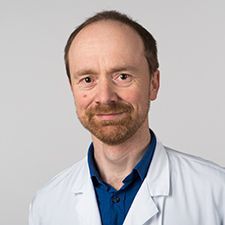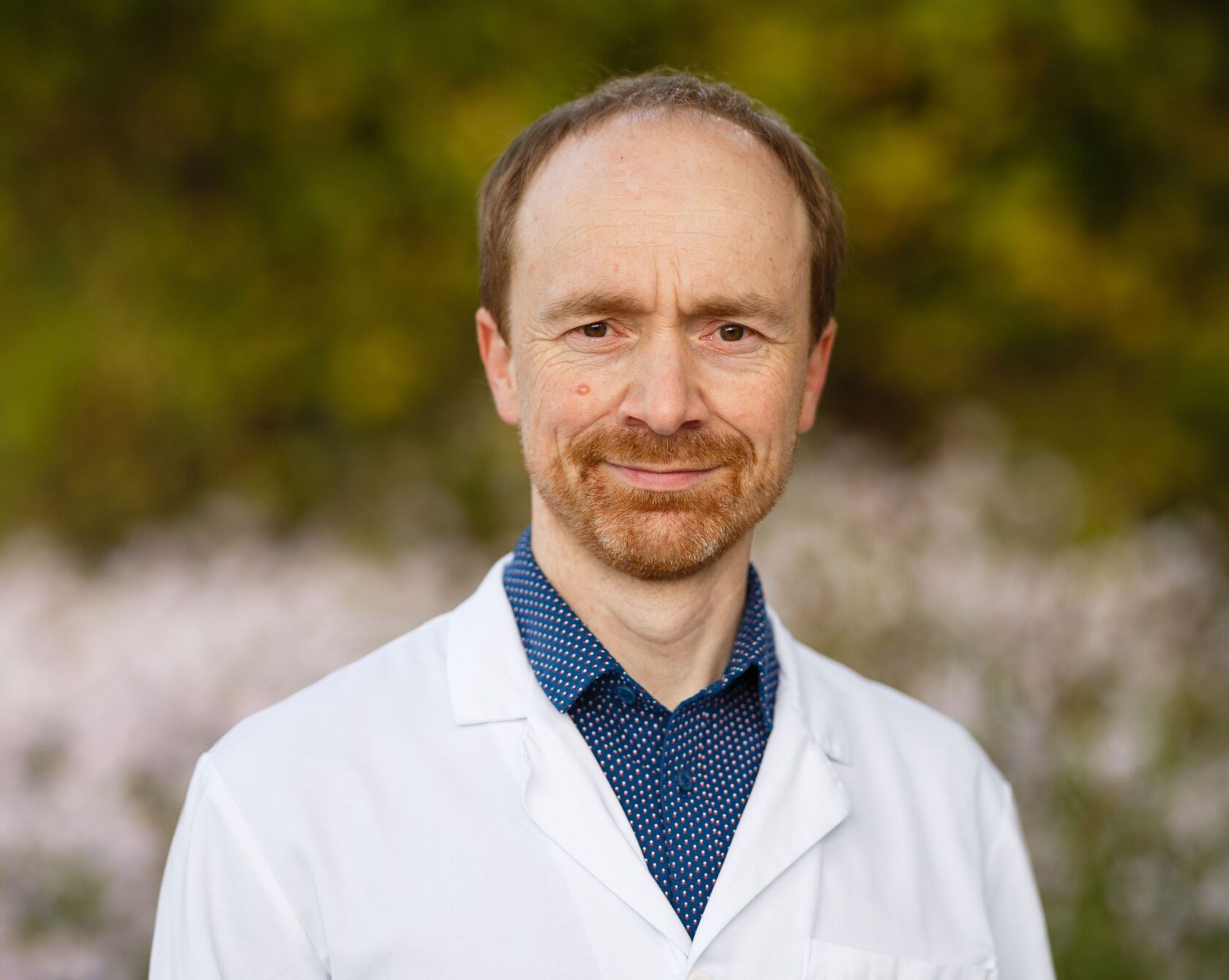
March is Bowel Cancer Awareness Month. We take this as an opportunity to ask Dr. Ralph Fritsch, Head of the Colorectal Tumor Center at the CCCZ, 5 questions about colorectal cancer.
Dr. Fritsch, you are head of the Intestinal Tumor Center at the CCCZ. What is the concept of such a specialized center?
In the Colorectal Tumor Center of the Comprehensive Cancer Center Zurich, all important specialist departments and clinics have joined forces and work closely together on all aspects of colorectal cancer. An interdisciplinary team of specialists and oncologists is available to our patients for assessment, consultation and treatment. We take care of the entire spectrum of screening, diagnostics, treatment and aftercare for bowel cancer at all stages. It is important that we discuss and decide on the findings and treatment recommendations for our patients together in our weekly tumor boards. Our advice is therefore not just the opinion of a single specialist, but is based on the expertise and experience of a team from numerous disciplines.
In your opinion, what improvement can be achieved for cancer patients as a result?
Our aim is to provide optimal medical care that is tailored to the individual needs of people suffering from cancer. We can offer comprehensive cancer medicine at the CCCZ. This means that patients receive the entire spectrum of diagnostics, endoscopy, surgery, radiotherapy and systemic tumor therapy(chemotherapy, molecularly targeted therapy, immunotherapy) “from a single source”, so to speak.
This means short distances for patients, standardized processes across disciplines and fixed contact persons. All of this is important in the case of cancer: making a precise diagnosis, providing competent advice and individualized treatment. And all this as quickly as possible and in an interdisciplinary manner. We also have numerous supportive counseling and treatment services at the CCCZ that provide our patients with physical, psychosocial and emotional support. All of this leads to holistic care.
How is colorectal cancer researched at the CCCZ?
At the CCCZ, we conduct intensive research in many areas of cancer medicine at an internationally recognized high level. More than 65 research groups and clinical departments work together at the CCCZ. This enables us to quickly transfer findings from basic research into clinical application. This also enables us to test new cancer treatment approaches in clinical trials and offer them earlier than is the case elsewhere. Patients at the CCCZ can thus benefit from the latest scientific findings and newly available therapeutic approaches. Established standards and innovative procedures complement each other very well in the clinic.
Are there already approaches for customized therapy (precision oncology) for colorectal cancer?
Precision oncology for colorectal cancer means that each individual patient receives optimal diagnostics, treatment and aftercare precisely tailored to the disease situation and tumor characteristics. Depending on the stage of the tumor in patients with colorectal cancer, we carry out extensive molecular diagnostics before treatment begins in order to tailor the systemic treatment to the tumor and patient as closely as possible. Targeted therapies can often increase the effectiveness of treatment and avoid unnecessary side effects.
There are now many molecular subgroups of colorectal cancer, which are increasingly being treated with different drugs. Surgery and radiotherapy for bowel tumors are also becoming increasingly precise. Using robot-assisted or minimally invasive tumor surgery, we can remove tumors with individual small skin incisions (so-called keyhole technique or laparoscopy) with fewer complications. The use of state-of-the-art imaging and radiation equipment enables the tumor to be monitored “live” during radiotherapy and irradiated with millimeter precision
How important is prevention and early detection of bowel cancer?
Colorectal cancer is the third most common cancer in Switzerland. Over 4,000 people are diagnosed with bowel cancer every year. Around 1,700 people die every year as a result of bowel cancer. The earlier bowel cancer can be detected, the better the chances of recovery. From the age of 50, it is therefore strongly recommended to have a screening colonoscopy. If there is a risk constellation (especially family history), preventive measures should sometimes start earlier; this also requires individual advice. Preliminary stages of bowel cancer can be detected and removed during a screening colonoscopy. This has been proven to reduce the risk of bowel cancer.
Colorectal cancer screening at the USZ