Kidney – structure, function, diseases

The kidneys are our body's sewage treatment plants. They filter toxins and water-soluble end products of protein metabolism from the blood. They also produce hormones and regulate our water, mineral and acid-base balance as well as our blood pressure. Diseases such as kidney stones, kidney failure or kidney inflammation can severely impair kidney function and lead to serious health problems.

The kidney is a paired organ, i.e. every person normally has two kidneys – one on the left and one on the right. The kidneys are the most important organs for the excretion of superfluous and toxic substances such as medication. Both kidneys work independently of each other. If one kidney fails, the second kidney takes over its function. If both kidneys fail, too many toxins enter the bloodstream. The blood must then be artificially purified by hemodialysis (= blood washing).

Where is the kidney located in humans?

The kidneys are located at the back of the upper abdomen on both sides of the spine, approximately at the level of the lower ribs. The right kidney is slightly lower than the left because the liver needs space on the right. A pyramid-shaped gland, the adrenal gland, sits on top of each kidney. It produces various vital hormones, including cortisol and adrenaline.

Kidney structure: Anatomy of the kidneys

The kidneys are two bean-shaped organs. Each kidney is about the size of a fist. On the inwardly curved side of each kidney is the so-called renal portal, a depression through which important vessels and structures run. The renal artery transports blood contaminated with waste products to the kidney so that it can be cleansed there. The renal vein, on the other hand, returns the purified blood to the bloodstream. Lymph vessels, nerves and the ureter, which carries the urine produced in the kidney to the bladder, also pass through here. The body passes around 1500 liters of blood through the kidneys every day.

Illustration vom Aufbau der Niere

Location and anatomy of the kidney in the human body

Structure of the kidney – simply explained

To protect it, each kidney is surrounded by a connective tissue capsule, which is also covered by a thick layer of fat and another thin layer of connective tissue. This fat and connective tissue capsule fixes the kidney to the posterior abdominal wall and protects it from impact injuries. There are three main areas inside the kidney: the outer renal cortex, the adjoining renal medulla and the renal pelvis, which is located near the renal orifice.

Function and structure of the nephron

The tissue of each kidney contains around one million tiny filter units, the so-called nephrons. They are responsible for the purification of the blood and the formation of urine. Each nephron consists of a renal corpuscle (glomerulus) and the corresponding urinary tubule (tubule). Together they form a functional unit.

Every day, around 170 liters of so-called primary urine are extracted from the blood by filtration in the renal corpuscles. To reduce this large quantity, the urinary tubules reabsorb around 99% of the filtered salts and fluid and return them to the blood. In the end, only about one tenth of the primary urine – about 1.5 to 2 liters – is excreted as urine.

Role and function of the kidney

The kidneys have various functions in the body.

The six tasks of the kidneys at a glance:

  • Blood filtration: The kidneys are our body’s purification systems. They filter the blood and remove waste, toxins and excess substances.
  • Urine formation: The kidneys excrete waste products that they have filtered out of the blood in the urine. These include urea, which is produced when proteins are broken down, and substances that we have absorbed through food or our metabolism. Medication, drugs and toxins are also excreted via the urine.
  • Regulation of the water balance: The kidneys regulate the water balance by either retaining water or excreting more water. If they retain water, the volume in the bloodstream increases and blood pressure rises. If the kidneys excrete more water, the blood volume decreases and the blood pressure drops. The kidneys also produce the protein renin, which has a hormone-like effect and increases blood pressure.
  • Hormone production: The kidneys produce two other important hormones: erythropoietin, which stimulates the formation of red blood cells, and calcitriol, the active form of vitamin D, which regulates the calcium balance in the body, among other things.
  • Regulation of the acid-base balance: The kidneys also play an important role in the acid-base balance by ensuring that the blood is neither too acidic nor too alkaline.
  • Control of the metabolism: Another important function of the kidneys is to influence the energy metabolism. If the blood sugar level is too low, the kidneys can produce sugar (glucose) themselves and release it into the blood.

Kidney – Diseases and Infections

The kidneys play an important role in our health. Unfortunately, like all organs, they can become diseased or inflamed. Many kidney diseases develop slowly and go unnoticed. They are usually only diagnosed when kidney function is already severely impaired. Signs of kidney problems include high blood pressure, increased excretion of colorless, light-colored urine, water retention and red urine.

It is therefore important to check kidney function regularly, especially if risk factors such as high blood pressure or diabetes are present. This allows your doctor to recognize early on if something is wrong and start treatment in good time.

How do I recognize kidney problems?

Possible signs of kidney problems are

  • Fatigue
  • Loss of appetite
  • Breathing problems
  • Increased blood pressure
  • Skin rash (renal insufficiency)
  • Itching
  • Muscle twitches and cramps
  • Nausea
  • red urine
  • Increased excretion of light-colored urine
  • Confusion
  • Water retention (often in the legs)

Kidney diseases

The most common kidney problems include pyelonephritis, kidney stones, but also long-term illnesses such as chronic renal failure, which can be caused by diabetes or high blood pressure. If left untreated, these diseases can severely restrict kidney function and, in the worst case, lead to kidney failure.

Renal cysts and cystic kidneys

Individual kidney cysts are usually harmless and do not impair kidney function. Cystic kidneys, on the other hand, are hereditary and lead to the formation of numerous fluid-filled cysts in both kidneys, causing the affected kidney to enlarge. In the worst case, this can lead to kidney failure. The most common form of cystic kidney disease is autosomal dominant polycystic kidney disease (ADPKD). A cure is not yet possible, but there are new therapeutic approaches to alleviate the symptoms and slow down the progression of the disease. In the final stage, dialysis or a kidney transplant is often necessary.

Renal pelvic inflammation

Pyelonephritis is one of the most common kidney diseases. It mainly affects women, as their significantly shorter urethra makes it easier for bacteria to quickly reach the bladder. From there, the infection can spread to the renal pelvis. In contrast to cystitis, which remains localized, pyelonephritis causes a pronounced feeling of illness throughout the body. Fever, vomiting or back pain are further symptoms of kidney inflammation or kidney problems.

More on the treatment of pyelonephritis

Kidney stones (renal colic, urolithiasis, nephrolithiasis)

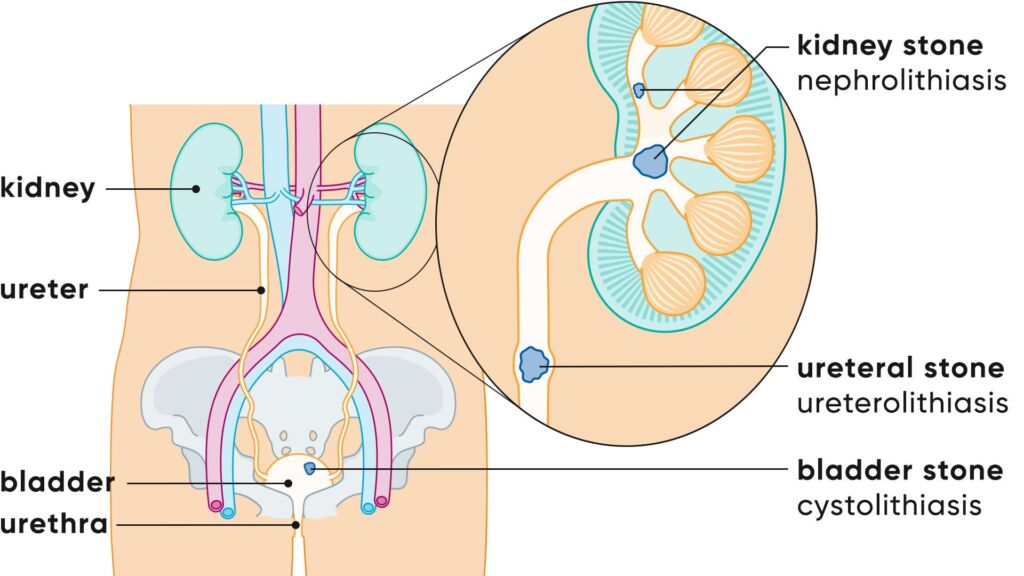
Kidney stones are solid deposits of urine components. They are formed when certain minerals and salts are present in high concentrations and crystallize. Kidney stones can cause severe pain (renal colic). Depending on their location, they are referred to as kidney stones (nephrolithiasis), ureteral stones (ureterolithiasis) or bladder stones (cystolithiasis). The size varies from tiny to several centimeters. Small kidney stones usually pass off on their own with the urine. Some can be dissolved with medication. Surgery is rarely necessary.
Chronic kidney disease

Chronic kidney disease usually develops unnoticed over a long period of time. It is often diagnosed by chance. The main causes of chronic kidney disease include high blood pressure and diabetes. Although a complete cure is not possible, the progression of the disease can be slowed down with targeted measures. This includes an adapted diet, blood pressure-lowering medication and good blood sugar control. At an advanced stage, dialysis or a kidney transplant may be necessary.

Chronic renal insufficiency (kidney weakness, kidney failure)

In the case of renal insufficiency, the kidneys only work to a limited extent and can no longer filter the blood sufficiently to excrete metabolic waste products. Doctors distinguish between an acute and a chronic form. While acute kidney failure occurs suddenly, kidney function deteriorates gradually over a longer period of time in chronic kidney disease (CKD). In Switzerland, an estimated 10% of the adult population is affected.

Adrenal hypofunction (Addison’s disease)

Addison’s disease is a rare chronic disease of the adrenal cortex that leads to a deficiency of vital hormones such as cortisol and aldosterone. These hormones are responsible for regulating many important bodily functions. The most common symptoms include persistent tiredness and exhaustion. Another noticeable sign of the disease is a brownish discoloration of the skin, which is why Addison’s disease is also called bronze skin disease. The skin changes mainly occur in areas exposed to the sun.

Therapy for adrenal hypofunction

Renal artery stenosis (NAST)

In renal artery stenosis, the artery that carries blood to the kidney is narrowed – usually due to arteriosclerosis or fibromuscular dysplasia. This constriction reduces the blood supply to the kidney, which can lead to high blood pressure. The kidneys react to the reduced blood flow by releasing hormones that increase blood pressure. If left untreated, the stenosis can lead to kidney failure. Common symptoms are high blood pressure and impaired kidney function. Treatment can be carried out using medication or procedures such as balloon dilatation.

More about NAST

Nutcracker syndrome

Nutcracker syndrome is a rare condition in which the left renal vein is trapped between two arteries, which impairs blood flow. Women are particularly frequently affected, but children and adolescents can also fall ill. The main symptom of the disease is frequent and sometimes severe lower abdominal pain – caused by the circulatory disorder in the affected vein. The pain can be acute or chronic and varies in intensity. In some cases, there are also other symptoms, such as blood in the urine or discomfort when urinating.

Therapy for nutcracker syndrome

Conn’s syndrome

Conn’s syndrome is a disease of the adrenal glands. These are two pyramid-shaped endocrine glands located in the immediate vicinity of the kidneys in the abdominal cavity. The adrenal glands produce aldosterone, a hormone that plays an important role in regulating blood pressure and salt balance. Normally, aldosterone works closely with other hormones to precisely control these functions. In Conn’s syndrome, however, too much aldosterone is produced. This disturbs the fine balance of this regulation and usually leads to a permanently high blood pressure – and sometimes also to a low potassium level in the blood.

Thrombotic microangiopathy

Thrombotic microangiopathy (TMA) is also a rare disease: In TMA, small blood vessels in various organs, particularly in the kidneys, are damaged. This damage leads to the formation of blood clots (thrombi) in the fine vessels, which impede blood flow and cause organ damage. There are various causes of TMA, such as infections, medication or certain genetic diseases. Typical symptoms are anemia, platelet deficiency (thrombocytopenia) and kidney problems.

Tubulopathy

Tubulopathy is a disease of the small renal tubules (tubules). They are responsible for the filtration and balance of fluid, electrolytes and acids in the body. In tubulopathy, this filtration does not function properly, which can lead to problems such as electrolyte imbalances, kidney failure or acid-base balance disorders. Tubulopathies can be congenital or acquired.

Kidney cancer (renal cell carcinoma, renal carcinoma)

Kidney cancer is a malignant disease in which tumors form in the kidneys. The most common form is clear cell renal cell carcinoma. Chromophobe renal cell carcinoma is a rather rare subtype. Although renal cell carcinomas are not as common as other types of cancer, they often grow unnoticed for a long time as they rarely cause symptoms in the early stages. Only when the tumor grows can pain in the lower back, blood in the urine or a palpable mass appear. Risk factors include smoking, obesity and a family history of the disease. Early diagnosis is important because kidney cancer is more difficult to treat at an advanced stage. With the right treatment, which often consists of surgery or immunotherapy, the prognosis is good, especially if the cancer is detected early.
Bladder and Kidney Tumor Center

At the USZ, numerous specialist departments have joined forces to form a Bladder and Kidney Tumor Center. The center is certified according to the guidelines of the German Cancer Society (DKG). A team of experts specializing in the medical treatment of kidney cancer works closely together here for the benefit of our patients. At DKG-certified centers, patients are treated according to strict quality criteria and, according to current studies, have a better chance of survival on average.

To the Center

How to keep your kidneys healthy

Kidneys are very important for your health, but there are some simple things you can do to protect them:

  • Drink enough: Drinking enough water is one of the best ways to support the kidneys. It helps to flush waste products out of the body and keep the kidneys going. A general recommendation is to drink around 1.5 to 2 liters of water per day – this can vary depending on activity and climate.
  • Healthy diet: Make sure you eat a balanced diet. Less salt, sugar and processed foods are good for the kidneys. Too much salt can increase blood pressure, which in turn can damage the kidneys. A diet rich in fruit, vegetables and fiber supports kidney function.
  • Regular exercise: A moderate amount of physical activity helps to keep blood pressure and weight under control – and that’s good for the kidneys.
  • Keep an eye on blood pressure and blood sugar levels: High blood pressure and diabetes are among the most common causes of kidney damage. It is therefore important to check blood pressure and blood sugar levels regularly and to treat any illness in order to protect the kidneys.
  • Stimulants in large quantities: Alcohol and smoking can damage the kidneys, especially if they are consumed in large quantities over a long period of time. It is good to limit alcohol consumption and give up smoking completely.
  • Be careful with medication: Some painkillers and medicines put a strain on the kidneys if they are taken over a long period of time or in large quantities. Talk to your doctor about whether your medication can damage your kidneys.
  • Regular visits to the doctor: Regular monitoring of kidney function is important, especially if there are risk factors such as high blood pressure, diabetes or a family history of the disease. Early detection of kidney problems can help to prevent serious damage.